Grade reconstruction report · Winter 24–Summer 26 · 16 films
Sixteen Worlds, One Grading Discipline
A practical reconstruction study of Ffern: sixteen image-construction problems, twelve documented nodes, and a different set of decisions for each film.
The companion Everything Ffern report asks what the campaign corpus has in common. This report asks how to work with that knowledge in Resolve. It selects one distinct photographic problem from each of the sixteen films: a painted room, a dark aperture, foliage depth, pale tabletop materials, red cloth on ice, several kinds of cream, a violet interview, a pink vehicle, orchard costume, a translucent veil, an open-field portrait, a warm face in darkness, a flowering greenhouse, graphic overlays, wet fur and reflective armour.
The proposal is a consistent separation of tasks, not a consistent set of knob positions. Establish the source transform and scene key, preserve environmental colour, protect narrative objects, skin and pale materials, then check local attention, texture, output and typography. Some scenes need almost none of those optional operations; others cannot be reproduced without the right capture and production design.
Each plate is copied byte-for-byte from the verified Ffern publication. Frame metrics describe that exact midpoint, while the nearby campaign profile uses the separate duration-weighted three-phase photography estimate. No single campaign is allowed to borrow another campaign's timeline identity or masquerade as a pooled house exposure target.
Subject
Ffern campaign corpus
Studies
16 frames
Measured against
16 separate campaign profiles; selected-frame scopes
Interpretation
gamma24
The campaign-corpus construction
What holds the look together
A shared method, not a house exposure
The source corpus contains both the low-key Rhubarb and Lighthouse films and the brighter Search for Autumn and Grand Bug Hotel. A universal exposure, contrast or black-lift target would overwrite those scene differences. The common discipline is to protect the relationships that each scene makes legible.
Colour is assigned to materials
Red cloth, violet paper, a pink vehicle, yellow flowers and orange sleeves are photographed objects. Their local density, chroma and relation to skin or background can be refined in grade. Their shape, reflection, texture and placement must first come from the scene.
White and black need spatial readings
The cream Fairytale costume remains distinct from its collar and backdrop without a high white peak. A small Rhubarb doorway remains readable inside near-black. The useful reconstruction target is local structure, not merely an endpoint on a waveform.
Text and texture finish the same image
Ffern's supplied films make burnt-in words part of the final composition. Fine letters compete with fur, leaves, paper and grain-like structure. A texture or sharpening decision is incomplete until the subtitle layer has been seen at delivery size. The web encode does not establish a universal film-grain recipe.
Resolve blueprint
A node tree built to be adjusted, not copied blindly
Use actual camera metadata to normalise originals to DaVinci Wide Gamut / DaVinci Intermediate through RCM or one explicit input CST. The installed DaVinci Resolve 21 Reference Manual describes this separation of input, timeline and output colour spaces. Do not apply a camera-log input transform to these finished reference PNGs.
F01–F03 establish the technical input, scene key and tonal structure. F04–F07 are independent environmental, narrative-colour, skin and pale-material branches feeding a parallel mixer. F08–F10 follow their merge. F11 represents the output transform; F12 is the delivery-aware typography and graphic finish, not a second look node.
The F prefix identifies this proposed report graph only; it does not encode placement. Each node's stage field is authoritative. Numerical values are broad diagnostic starting ranges on appropriate log/raw material, not portable presets or recovered original settings. Optional branches and texture processing start bypassed.
Group Pre-Clip / project RCMF01
Input normalisation
Give actual camera sources a known scene-referred starting point; never treat a finished Ffern reference as ungraded log.
Do this
Decode raw from camera metadata or use the correct documented input colour space and gamma.
Normalise into DaVinci Wide Gamut / DaVinci Intermediate through RCM or a single input CST; keep the display reference on an appropriate comparison path.
Starting points
With RCM performing the input transform, omit this node. With explicit CSTs, document the source gamut/gamma and the output mapping separately.
No creative white balance, exposure or film emulation belongs in this technical input decision.
Watch
A wide-gamut conversion cannot restore the web reference's camera latitude or bit depth.
Confirm source data/video levels; a range error can masquerade as Ffern's darkness.
Clip · serialF02
Scene key and neutral anchors
Set a credible scene key before the campaign's palette is refined.
Do this
Use exposure controls to place the important material, then choose a genuine neutral if the scene offers one.
Keep warm practical illumination, coloured walls and costumes out of automatic neutral balancing.
Starting points
On correctly exposed log/raw, test adjustments within roughly ±0.25 stop first; expand only when the source warrants it.
Compare the selected frame with its campaign profile, but do not move it to the campaign mean.
Watch
A greenhouse, a forcing shed and a firelit face do not share a brightness target.
Whole-frame L* is not a face exposure reading.
Clip · serialF03
Contrast, toe and bright-end spacing
Shape the available tonal separation without claiming to recover an original tone curve.
Do this
Use broad Custom Curves or HDR/Log zone controls to separate the near-black field, important midtones and light materials.
Judge the smallest important aperture and pale-material folds after the output transform.
Starting points
Start with contrast unchanged. Try a small 1.00–1.10 contrast range only if the source needs added structure; adjust pivot by the scene, not by a house preset.
Treat black placement and highlight compression as separate decisions; start bright-end compression bypassed.
Watch
A brighter black point can erase the enclosure of a doorway.
A global contrast increase can destroy cream folds before the picture appears generally contrasty.
Clip · parallel branch AF04
Environment colour
Give foliage, water, stone and timber independent density.
Do this
Use broad Hue vs Hue, Hue vs Lum or Color Warper moves to refine the environmental families.
Preserve multiple greens and the warm/cool differences inside apparently neutral surfaces.
Starting points
Test broad hue movements of approximately 2–5 degrees and small density adjustments before global desaturation.
Reduce correction strength with Key Output Gain if the scene starts looking recoloured.
Watch
Fine leaves can produce unstable narrow qualifiers.
Protect the garment, fruit, flower, paint or vehicle that carries the chromatic argument.
Do this
Select the important colour with a broad key and a spatial constraint when required.
Separate its density from its chroma; compare the object with adjacent surfaces rather than matching a palette swatch blindly.
Starting points
Start with the branch bypassed. Test Key Output Gain around 0.25–0.60 for gentle selective moves.
A 5–10% chroma adjustment is a diagnostic first move, not a target that every campaign needs.
Watch
Reflections and transparencies may need some of the same correction.
A key that selects the red costume may also select lips, apples or subtitles.
Clip · parallel branch CF06
Skin in its environment
Maintain credible faces without neutralising the light or homogenising complexions.
Do this
Intersect a broad skin-family key with a tracked region when needed; inspect the matte.
Make small lightness or hue changes only after checking what the costume and background are doing.
Starting points
Test local exposure within ±0.15–0.25 stop; begin hue correction at zero.
Compare illuminated and shadowed skin separately in mixed-light scenes.
Watch
Wood, fur and ochre fabric can pass a skin key.
A skin-line target cannot account for coloured illumination or individual complexion.
Clip · parallel branch DF07
Pale materials and reflections
Separate paper, cloth, petals and metal instead of making them one white.
Do this
Use broad luminance and spatial constraints to distinguish light materials from bright sky and subtitles.
Preserve reflected dark shapes in metal, cool/warm shifts in cloth and tiny highlights in transparent surfaces.
Starting points
Start with small exposure moves, roughly ±0.10–0.20 stop, and gentle broad-channel balance.
Keep highlight desaturation bypassed until a specific chromatic problem is visible.
Watch
A luma key also selects lettering and eye highlights.
Clipped or textureless capture cannot be repaired by changing the display white point.
Clip · serial after colour-branch mergeF08
Local attention and integration
Refine the relationship between figure and surrounding space.
Do this
Use a broad tracked window or a restrained background adjustment only when a visible distraction requires it.
Check edge softness, occlusion, spill and depth before invoking an additional relight or composite.
Starting points
A local ±0.10–0.25 stop test is usually more informative than a large vignette.
Keep integration work bypassed when the source is already coherent; none of these nodes proves an original mask.
Watch
An untracked window will reveal itself in motion.
Uniform edge darkening is not a substitute for real doorway or canopy geometry.
Clip · serialF09
Luminance-dependent chroma
Protect colour at both ends of the display range without flattening the palette.
Do this
Inspect shadows and strong coloured material after the scene key and branch corrections.
Use broad Lum vs Sat or Sat vs Sat adjustments only where shadow noise, fluorescent colour or gamut pressure is actually visible.
Starting points
Start at unity. Try reducing only the affected region by approximately 5–15% before changing global saturation.
Keep garment folds and the colour of reflections visible during the test.
Watch
Removing all low-level colour makes foliage and wood look synthetic.
RGB-channel ceiling pixels in this encode do not prove clipping at capture.
Clip / finishing · optionalF10
Texture, diffusion and grain
Keep photographed texture intact and add no unsupported film-stock claim.
Do this
Assess source detail at native scale and final delivery size before noise reduction, sharpening, glow or grain.
If a reconstruction needs texture, audition it on moving footage and against the subtitle layer.
Starting points
Start all optional texture effects bypassed. No stock preset or grain strength is inferred from these web files.
Use the lowest effective correction and compare equal-resolution deliverables.
Watch
Fine fur, paper fibres and leaves are subjects, not noise.
Halation-like colour or softness can come from several stages; a still does not separate them.
Project RCM / Group Post-ClipF11
Output transform and display trim
Map the scene-referred grade into the actual delivery once.
Do this
Use the correct managed output or one documented output CST, with appropriate tone/gamut mapping.
Inspect the result on a calibrated target display and a representative final encode.
Starting points
For an SDR reconstruction test, document Rec.709 gamma 2.4 output; other deliverables require separate trims.
The report's sRGB PNGs are already display references, not camera inputs for this node graph.
Watch
Do not stack a second display transform on RCM.
A monitor surround or browser colour-management difference can be mistaken for a grade error.
Finishing · after creative look, delivery-awareF12
Typography and graphic finish
Evaluate subtitles and graphic overlays as authored picture elements.
Do this
For a new production, coordinate a colour-managed type/graphics composite after the photographic look, then QC the final encoding.
For these burnt-in references, leave the letters in place; any exclusion mask is only a diagnostic aid, never recovered photography.
Starting points
Begin from the campaign's actual visual hierarchy, not a universal Ffern font or colour.
Test one- and two-line captions against the busiest and brightest relevant backgrounds at phone size.
Watch
A global photographic hue change also changes burnt-in type.
Graphic compositing, grain and output transforms can alter apparent letter weight and edges.
16 reconstruction studies
Read the image first; use the scopes to test the read
Each study begins with the visible frame and the production conditions it needs, followed by source-frame scopes, feasibility, a calibrated photographic-composite reading and six shot-specific decisions. Titles and subtitles are admitted as authored picture elements, but no graphic-only title card substitutes for a photographic study.
The integer shot_index is a stable campaign namespace for machine joins, not a single Ffern timeline. The visible header names the real film and local segment or window; source time is local elapsed HH:MM:SS.mmm, with native frame ordinal also retained. Charleston's selected interval is a time window, not an invented cut.
Waveforms show encoded Y′ versus horizontal picture position. RGB plots are channel distributions, not spatial parades. The vectorscope uses BT.709 Y′CbCr with a square, consistently mapped 2Cb/2Cr grid. These are analytical scopes from the decoded reference, not screenshots of Resolve's scopes. Baselines are exported separately; they are not overlaid as if a film-average picture existed.
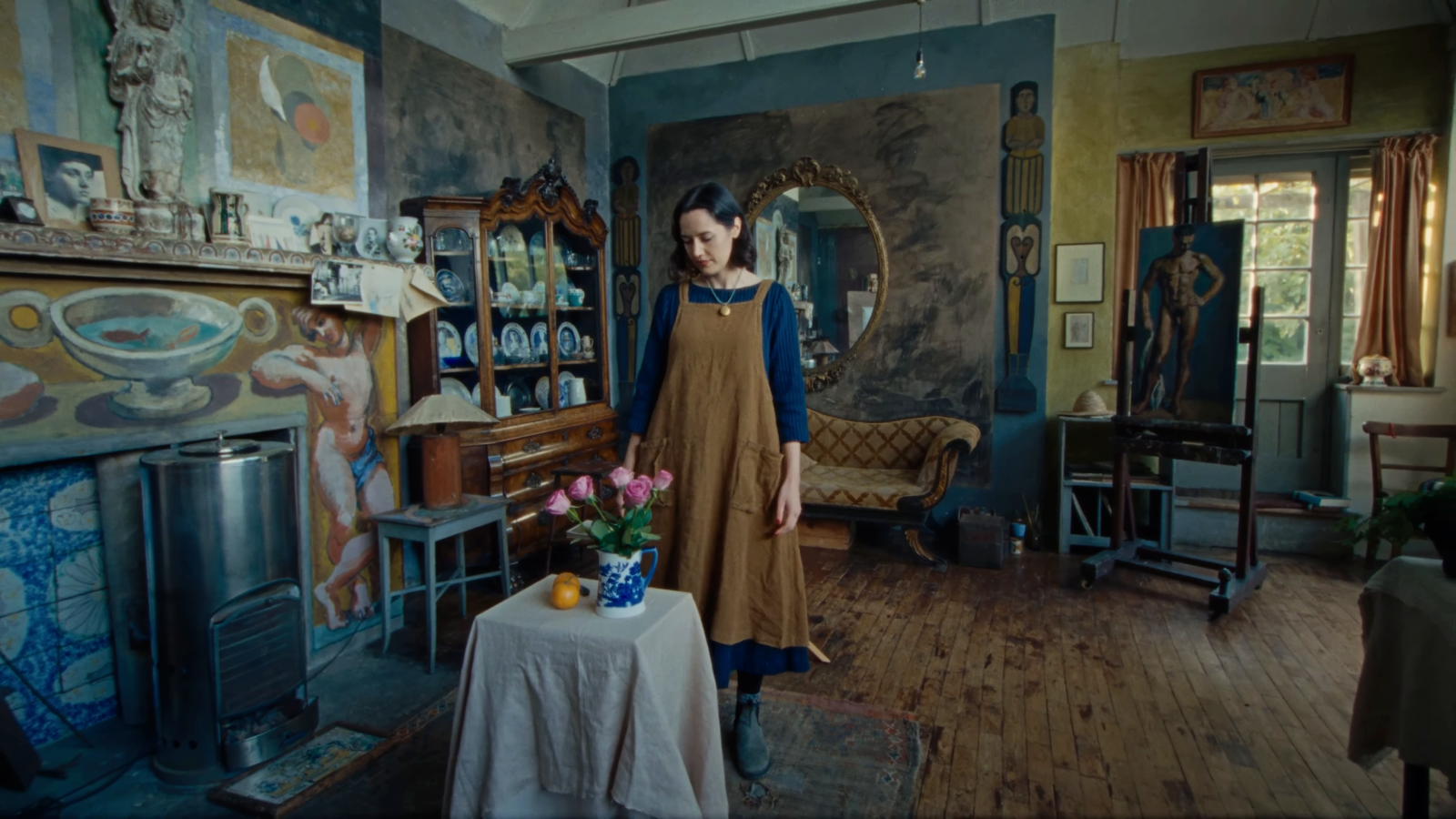
Pink roses and yellow fruit rest on a pale cloth beside the woman in a brown apron and blue dress; the decorated room repeats those colours at lower prominence.
Regular-footage feasibility: Conditional · preserve the production relationshipPhotographic composite read: none
Pink roses and yellow fruit rest on a pale cloth beside the woman in a brown apron and blue dress; the decorated room repeats those colours at lower prominence.
What is remarkable
A woman in blue and ochre stands beside a small table of pink flowers and yellow fruit. The room repeats these colours in murals, furniture and objects, but at smaller scales and usually lower prominence. The challenge is not a lack of colour; it is deciding which colour relationships should remain easiest to read.
The pale tablecloth is a local light shape, not a white balance target for the whole room. Cool painted surfaces and warmer timber remain distinct. A single warm wash would make the room simpler numerically but less specific visually.
Measurement check, limited to this active midpoint: mean L* 26.8, mean C* 10.1, 8.0% of pixels below L* 5 and 0.07% at or above L* 85. These values describe the full active image, including visible text; they do not measure the specific objects named above.
Where the image comes from
The decorated interior, costume, fruit and flowers must be supplied by location and production design. Their spatial arrangement cannot be generated with a broad hue rotation. The window and room geometry also constrain the direction of available illumination.
Grading can refine background density, preserve the blue costume and give the small still life a little more local separation. It should not remove all variation in the mural or turn every warm surface into the same ochre.
Waveform
RGB distribution
Vectorscope
Can regular footage get there?
Conditional · preserve the production relationship
The relationship is approachable when the source already contains the stated production conditions. The recipe refines that foundation; it does not invent missing surfaces, light or geometry.
Minimum capture conditions
An interior with real painted and material colour variation.
Enough exposure in the blue costume and room shadows to separate texture.
A foreground subject and still life already arranged with useful value contrast.
Composite and background read
The photographed room is internally coherent
Furniture, walls, subject and reflected room details have plausible shared perspective and illumination; the selected still gives no reason to require an environment replacement.
No visible reason to require a photographic composite is not proof that no VFX occurred. Invisible cleanup or integration remains possible; source plates or production documentation would be needed. Visible subtitles and graphic overlays are acknowledged separately.
Shot-specific Resolve pass
Use the global tree, then make these decisions
F02
Place the interior key
Balance from a credible room neutral, then place the subject without making the window a neutral-grey target.
Why: The figure must remain part of the interior's low-key range.
Watch: Over-bright cloth or blue clothing can detach from the room.
F04
Keep paint and timber apart
Make broad, small cool/warm refinements to painted surfaces and wood; leave the mural's colour variation intact.
Why: The location supplies several related but distinct palettes.
Watch: A wall-colour key can capture the blue dress.
F05
Protect the blue-and-ochre figure
Use a restrained spatially constrained correction only if the broad costume shape loses separation.
Why: The costume is the most compact large colour relationship.
Watch: Watch the apron edge and the adjacent painted cabinet.
F07
Retain cloth and fruit structure
Separate the pale cloth's folds from the brighter fruit reflections without pushing the whole table to display white.
Why: Several materials share a small area.
Watch: A broad highlight key can pull yellow out of the fruit.
F08
Reduce a specific distraction
If needed, lower a competing background patch rather than adding a uniform vignette.
Why: The room is ornate but does not need to become empty.
Watch: Check window feathering against furniture and moving limbs.
F10
Preserve the painted surface
Leave added grain and broad smoothing bypassed until the delivery-sized source is assessed.
Why: Much of the visible texture is physical decoration.
Watch: Noise reduction may erase brushwork and fabric before it improves the image.
Failure modes to check before approval
A wall-colour key can capture the blue dress.
Watch the apron edge and the adjacent painted cabinet.
A broad highlight key can pull yellow out of the fruit.
Check window feathering against furniture and moving limbs.
Review the moving shot, not just this midpoint; check tracking, temporal texture and final subtitle readability before approval.
02 · The Rhubarb Triangle / Black geometry · a deliberately hard case · campaign reference 11029 · 00:02:32.240
A doorway occupying a nearly black field
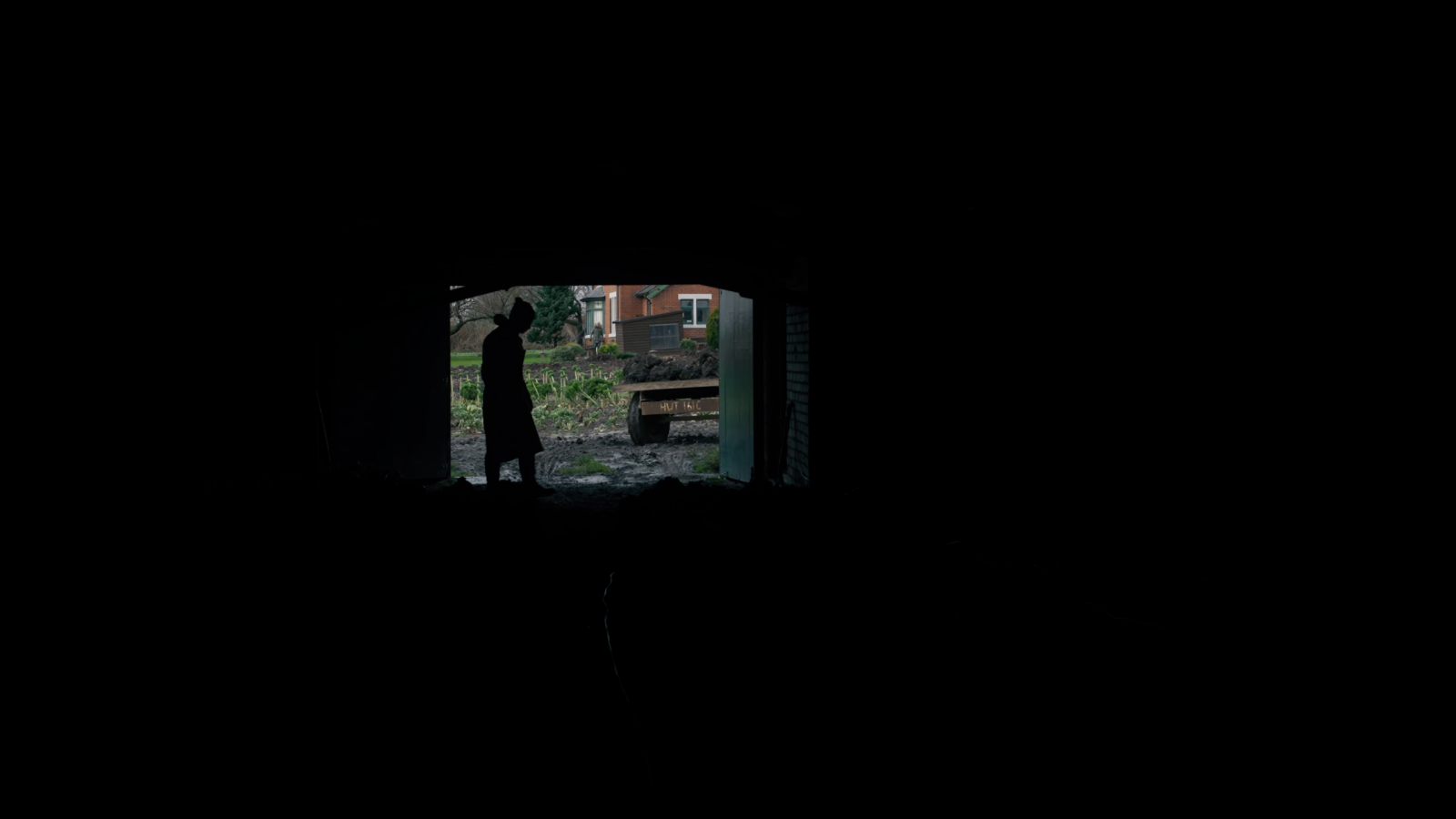
A small distant doorway and a standing silhouette remain visible inside an almost black shed.
A small distant doorway and a standing silhouette remain visible inside an almost black shed.
What is remarkable
A small outdoor opening and a silhouette sit inside a much larger dark shed. The opening supplies the subject's scale and the image's principal spatial cue. Most of the frame is not an invitation to recover more wall detail; its darkness is the enclosure around the opening.
This is an especially poor candidate for a universal raised-black recipe. Brightening the full frame changes the ratio between the aperture and its surround. The source's large baked side borders have been excluded from measurements, so the low key described here belongs to the active image.
Measurement check, limited to this active midpoint: mean L* 1.6, mean C* 0.5, 94.2% of pixels below L* 5 and 0.00% at or above L* 85. These values describe the full active image, including visible text; they do not measure the specific objects named above.
Where the image comes from
A dark enclosure and a substantially brighter exterior are capture conditions. Ordinary evenly lit room footage will not acquire the same nested depth simply by lowering Lift. The silhouette also needs to occur against the opening, not against an equally dark wall.
The grade can place the aperture, shape low-level separation at its edge and avoid accidentally opening the entire shed. It cannot reconstruct a well-exposed exterior or hidden shadow detail from this web reference.
Waveform
RGB distribution
Vectorscope
Can regular footage get there?
Low · capture-specific reference
This is a deliberately demanding reference. Ordinary unrelated footage cannot reproduce its spatial construction through a conventional grade alone; the capture or element requirements below are part of the result.
Minimum capture conditions
A real dark enclosure with a small bright opening and a useful silhouette.
Camera originals that retain exterior detail at the required exposure relationship.
A controlled viewing environment and sufficient source bit depth for near-black decisions.
Composite and background read
An aperture is not evidence of a replacement plate
The silhouette, threshold and outdoor view have a plausible spatial relationship. Their dramatic brightness difference alone does not establish compositing.
No visible reason to require a photographic composite is not proof that no VFX occurred. Invisible cleanup or integration remains possible; source plates or production documentation would be needed. Visible subtitles and graphic overlays are acknowledged separately.
Shot-specific Resolve pass
Use the global tree, then make these decisions
F02
Place the opening first
Set exposure from the visible doorway and silhouette relationship; do not average the black surround into a neutral target.
Why: The opening is the frame's readable information.
Watch: Automatic exposure compensation would open the shed.
F03
Protect the enclosure
Shape the toe locally enough to retain meaningful threshold edges while leaving the broad surround dark.
Why: Black is a spatial field here.
Watch: A lifted floor can expose compression without adding useful scene information.
F08
Constrain any local aid
If the silhouette needs help, consider a small adjustment to the opening behind it rather than a bright halo around the figure.
Why: Separation can come from the background.
Watch: Track and inspect the actual occluding edges in motion.
F04
Keep the exterior believable
Retain the modest colour differences in the outdoor patch without an exaggerated cool/warm split.
Why: Its small size already concentrates attention.
Watch: A saturation boost can turn the aperture into a coloured cut-out.
F09
Inspect low-level chroma
Reduce unstable chroma only where the camera original requires it; do not neutralise all near-black pixels by rule.
Why: The source may carry real low-level colour as well as noise.
Watch: An unstable key at the floor can flicker.
F11
Judge the final black
Review the output on the target display and a final encode, with the room surround controlled.
Why: This image can change radically with viewing conditions.
Watch: Do not compensate for a bright viewing room by changing the grade.
Failure modes to check before approval
Track and inspect the actual occluding edges in motion.
A saturation boost can turn the aperture into a coloured cut-out.
Do not compensate for a bright viewing room by changing the grade.
Review the moving shot, not just this midpoint; check tracking, temporal texture and final subtitle readability before approval.
03 · A Tuscan Summer / Landscape · density without one green · campaign reference 14010 · 00:00:47.040
The canopy frames the road
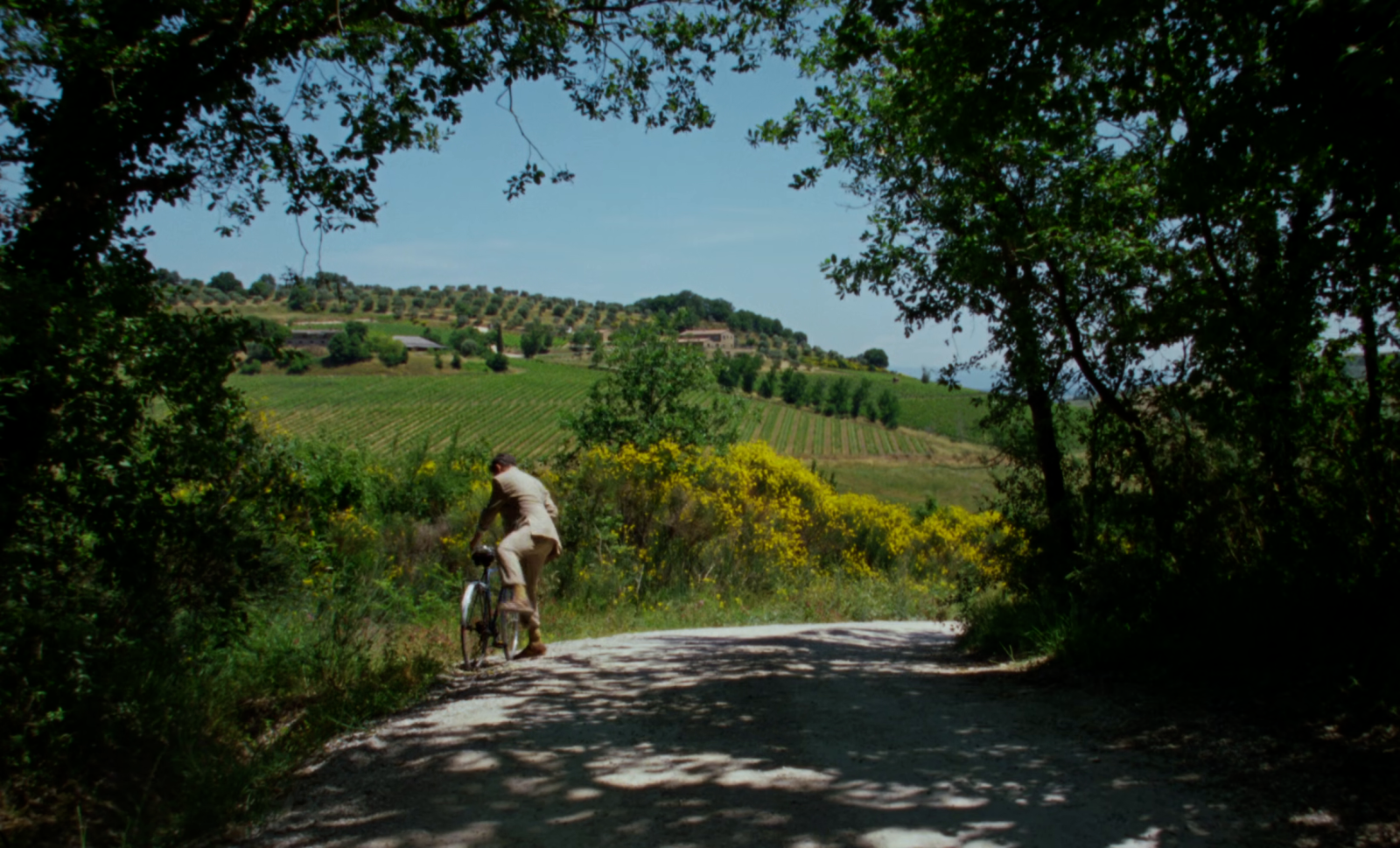
A cyclist follows a light road beneath a dark arch of foliage; the distant fields remain lighter and less enclosed.
Regular-footage feasibility: Conditional · preserve the production relationshipPhotographic composite read: none
A cyclist follows a light road beneath a dark arch of foliage; the distant fields remain lighter and less enclosed.
What is remarkable
A cyclist follows a pale road through a dark foliage arch. The distant fields and sky are less enclosed, and the road connects the foreground to that open landscape. The frame works through a broad dark-near/light-far relationship rather than a strong colour on the cyclist.
Several greens occupy different levels and scales. Dark leaf masses frame the view; brighter vegetation describes the hillside. Compressing every green into a single olive can preserve an overall hue impression while destroying this depth structure.
Measurement check, limited to this active midpoint: mean L* 22.3, mean C* 12.5, 32.8% of pixels below L* 5 and 0.00% at or above L* 85. These values describe the full active image, including visible text; they do not measure the specific objects named above.
Where the image comes from
The canopy, road placement, cyclist and open distant landscape are location and staging. The dappled pattern on the road is photographed illumination, not a detail a global curve can plausibly invent.
Use grading to control near-foliage density and retain the road's texture. If the distant view is too bright, a broad background adjustment can help, but its edge must not draw a line through the fine foliage.
Waveform
RGB distribution
Vectorscope
Can regular footage get there?
Conditional · preserve the production relationship
The relationship is approachable when the source already contains the stated production conditions. The recipe refines that foundation; it does not invent missing surfaces, light or geometry.
Minimum capture conditions
Near foliage that already frames a brighter open view.
A pale textured road and a subject that separates from it.
Exposed foliage and sky detail, not a clipped or excessively noisy source.
Composite and background read
The landscape does not require an extension
Near branches, dappled road light and the distant terrain form a coherent arrangement. A still cannot demonstrate invisible cleanup.
No visible reason to require a photographic composite is not proof that no VFX occurred. Invisible cleanup or integration remains possible; source plates or production documentation would be needed. Visible subtitles and graphic overlays are acknowledged separately.
Shot-specific Resolve pass
Use the global tree, then make these decisions
F02
Place the road
Set the scene key from the pale road and distant land before adjusting the darkest leaves.
Why: The road is the link through the composition.
Watch: Do not make sunlight patches uniformly white.
F03
Hold the near frame
Deepen or open the foliage mass only enough to preserve the framing relationship.
Why: The canopy should remain darker than the vista.
Watch: Crushing fine branches creates an artificial cut-out.
F04
Separate green layers
Make broad hue and density moves that preserve yellow-green field colour against darker blue-green leaves.
Why: Green variation carries depth.
Watch: Narrow Hue vs Hue spikes can outline leaves.
F08
Control the vista gently
Use a soft broad window if the distant field competes too strongly; inspect it around branch gaps.
Why: Global exposure would also change the road and cyclist.
Watch: A hard horizon key becomes visible through the canopy.
F05
Keep the figure readable
Protect the pale clothing only if it merges with the road; prefer small value separation to chroma.
Why: The cyclist is intentionally small in the landscape.
Watch: Do not create a conspicuous bright subject patch.
F11
Check sky and leaf edges
Inspect the output at full frame and final delivery size.
Why: Fine dark edges and sky gradients expose aggressive processing.
Watch: Look for halos, banding and shadow blocking.
Failure modes to check before approval
Narrow Hue vs Hue spikes can outline leaves.
A hard horizon key becomes visible through the canopy.
Do not create a conspicuous bright subject patch.
Look for halos, banding and shadow blocking.
Review the moving shot, not just this midpoint; check tracking, temporal texture and final subtitle readability before approval.
04 · When Life Gives You Oranges / Tabletop · warm room, pale material · campaign reference 15018 · 00:01:00.520
Cloth, glass and metal are three different whites
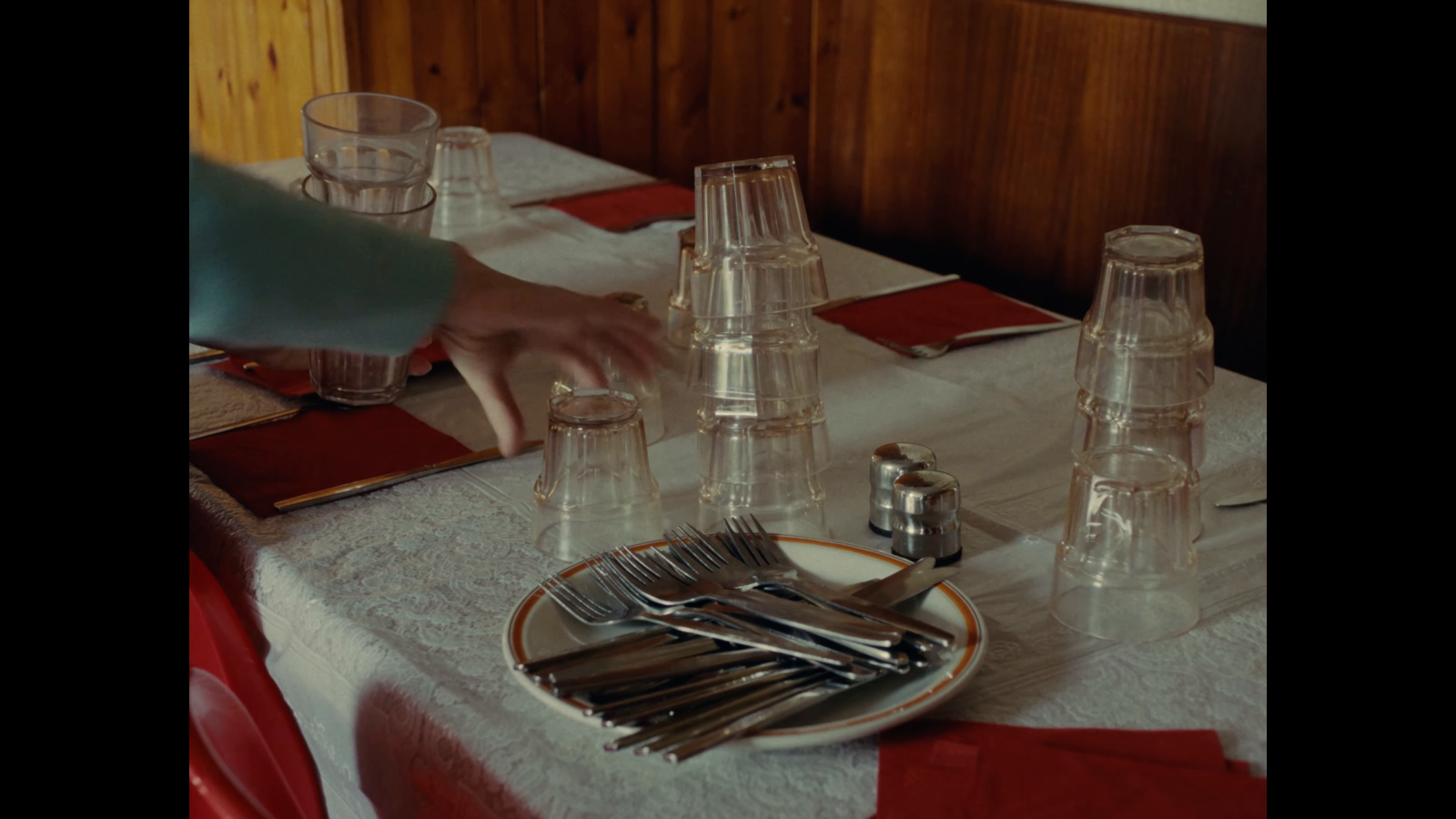
A hand places glassware above a pale tablecloth with red napkins and metal cutlery; creases and reflections distinguish the light surfaces.
Regular-footage feasibility: High · with the stated sourcePhotographic composite read: none
A hand places glassware above a pale tablecloth with red napkins and metal cutlery; creases and reflections distinguish the light surfaces.
What is remarkable
A hand reaches among stacked glasses above a pale tablecloth. Red napkins, metal cutlery and warm timber surround the light fabric. Creases, rims and reflections distinguish the objects; none needs to be rendered as a featureless white patch.
The room's warmth is not a reason to remove all blue from the sleeves or glass reflections. These small counterweights help the table remain a physical surface rather than an amber colour field. The baked side borders remain in the plate but not in the measurements.
Measurement check, limited to this active midpoint: mean L* 28.2, mean C* 15.5, 5.5% of pixels below L* 5 and 0.00% at or above L* 85. These values describe the full active image, including visible text; they do not measure the specific objects named above.
Where the image comes from
The light on the cloth and the reflected room shapes in the glass and cutlery must come from capture. Styling supplies the repeated transparent forms, red accents and the cloth's fine structure.
The grade can preserve a warm room while giving the cloth enough local contrast to describe its folds. Selective bright-end work must distinguish diffuse fabric from hard glass and metal reflections.
Waveform
RGB distribution
Vectorscope
Can regular footage get there?
High · with the stated source
The relationship is approachable when the source already contains the stated production conditions. The recipe refines that foundation; it does not invent missing surfaces, light or geometry.
Minimum capture conditions
A textured pale cloth, transparent glassware and metal with real reflections.
Soft directional light that models the folds without clipping the glass.
A warm environment that still contains usable channel information.
Composite and background read
Ordinary reflected surfaces, not a composite cue
The hand, glass rims and table reflections are consistent with a photographed tabletop. No visible integration problem requires an added element.
No visible reason to require a photographic composite is not proof that no VFX occurred. Invisible cleanup or integration remains possible; source plates or production documentation would be needed. Visible subtitles and graphic overlays are acknowledged separately.
Shot-specific Resolve pass
Use the global tree, then make these decisions
F02
Balance the room, not the cloth
Use a credible reference for corrective balance and leave a modest warm cast in the table setting.
Why: The cloth belongs to the room's illumination.
Watch: Neutralising fabric aggressively can make skin and timber cold.
F07
Separate diffuse and specular light
Use restrained luminance shaping to retain cloth folds while allowing narrow glass and metal highlights.
Why: Material identity depends on different highlight structures.
Watch: A shared highlight compression can make all three materials matte.
F05
Protect the red accents
Check red napkin density after the warm balance; reduce only an actual excess.
Why: The red areas punctuate the pale table.
Watch: Red-orange skin may enter the same qualifier.
F06
Keep the hand attached
Evaluate the hand beside the sleeve and cloth before any skin correction.
Why: Local reflected warmth is plausible.
Watch: A neutral, brighter hand can look pasted over the table.
F10
Preserve small structure
Keep smoothing and sharpening low enough to retain cloth and glass edges naturally.
Why: The scene's tactility is largely photographed.
Watch: Check ringing on glass rims and fabric waxiness.
F11
Inspect final bright separation
Review the output after the transform and final encode.
Why: Small reflections can merge in delivery.
Watch: Do not infer a camera shoulder from this eight-bit reference.
Failure modes to check before approval
A shared highlight compression can make all three materials matte.
Red-orange skin may enter the same qualifier.
A neutral, brighter hand can look pasted over the table.
Check ringing on glass rims and fabric waxiness.
Review the moving shot, not just this midpoint; check tracking, temporal texture and final subtitle readability before approval.
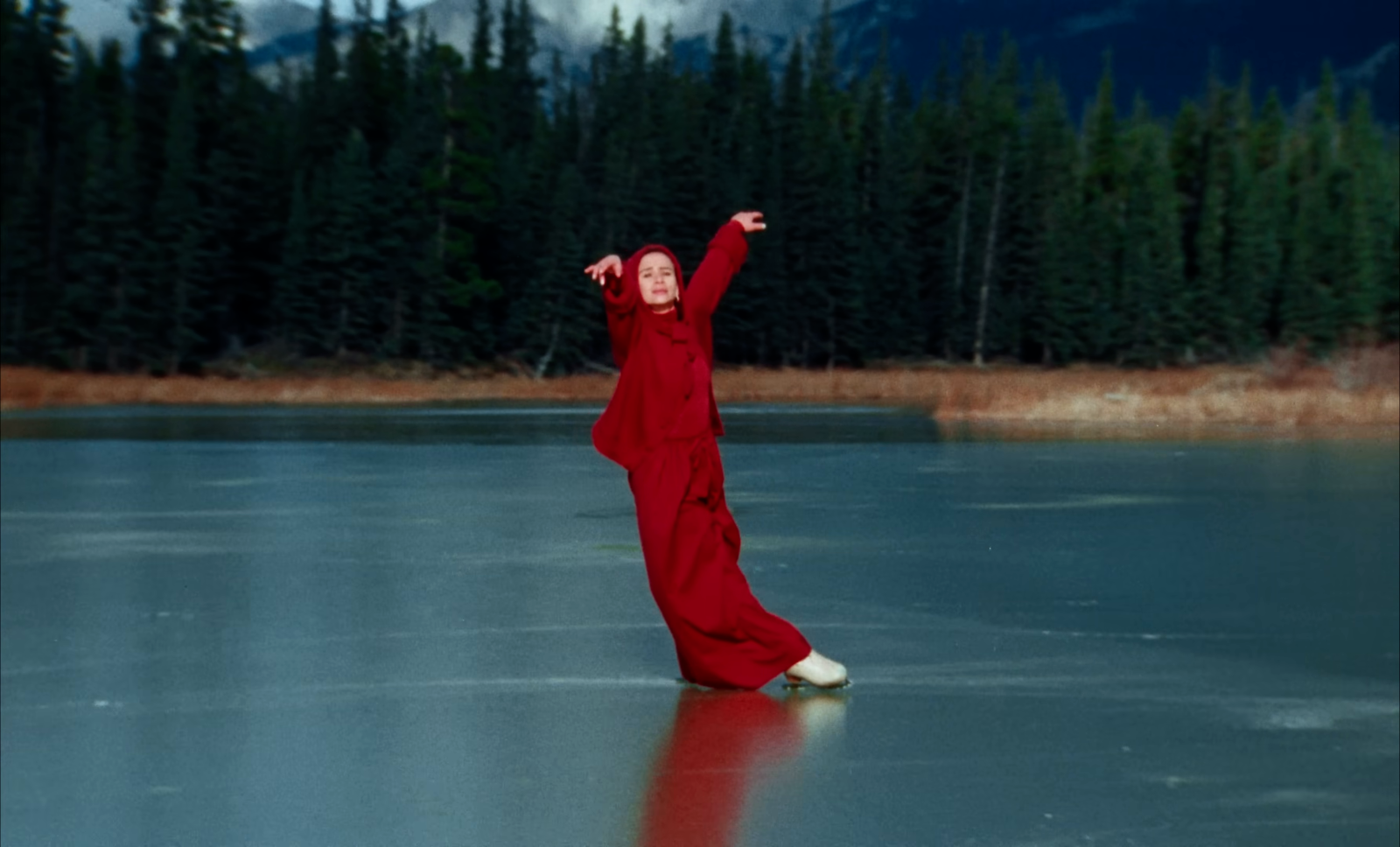
05 · A Dance on Wild Ice / Narrative colour · accent, field and reflection · campaign reference 16019 · 00:01:01.680
Red cloth and its reflection on blue-green ice
A skater in a red costume stands over a red reflection and fine marks on blue-green ice, separated from a dark forest.
Regular-footage feasibility: Conditional · preserve the production relationshipPhotographic composite read: none
A skater in a red costume stands over a red reflection and fine marks on blue-green ice, separated from a dark forest.
What is remarkable
A red-clothed skater stands in front of a dark tree line, with a red reflection below on blue-green ice. The garment is conspicuous because it is a concentrated warm shape inside a larger cool field. Its folds and shading matter as much as its saturation.
The reflection belongs to the same colour relationship but is not an identical duplicate of the costume. It is lower in clarity and altered by the ice surface. A costume-only key that ignores reflected colour can break the physical connection.
Measurement check, limited to this active midpoint: mean L* 23.8, mean C* 13.5, 18.1% of pixels below L* 5 and 0.02% at or above L* 85. These values describe the full active image, including visible text; they do not measure the specific objects named above.
Where the image comes from
Costume colour, ice, trees, the subject's placement and the reflection are capture and staging. Grading an unrelated landscape cyan does not supply the reflective surface or the red silhouette.
The grade can separate costume density from its chroma, refine the ice's cool family and keep the tree line dark. It must preserve skin and fabric texture instead of using the entire warm range as one object mask.
Waveform
RGB distribution
Vectorscope
Can regular footage get there?
Conditional · preserve the production relationship
The relationship is approachable when the source already contains the stated production conditions. The recipe refines that foundation; it does not invent missing surfaces, light or geometry.
Minimum capture conditions
A genuinely red garment with visible folds and preserved channel detail.
A cool reflective setting with a darker background.
Exposure that retains skin and ice detail together.
Composite and background read
The reflection supports a photographed interaction
Costume and reflection occupy corresponding positions on the ice, with plausible surface detail between them. This is not proof against invisible retouching.
No visible reason to require a photographic composite is not proof that no VFX occurred. Invisible cleanup or integration remains possible; source plates or production documentation would be needed. Visible subtitles and graphic overlays are acknowledged separately.
Shot-specific Resolve pass
Use the global tree, then make these decisions
F02
Set the ice as the field
Place the ice and tree line before lifting the red body.
Why: The environment establishes the scale of the accent.
Watch: Do not turn the ice into a uniformly bright cyan plane.
F04
Keep ice and forest distinct
Refine the ice's cool hue without forcing the evergreen background onto exactly the same axis.
Why: The scene has two different cool materials.
Watch: A global blue-green correction can flatten their separation.
F05
Protect garment and reflection
Use a broad red key with separate spatial constraints if the reflection needs a gentler treatment.
Why: Reflected colour should remain physically related.
Watch: Watch skin, lips and any warm shore vegetation in the matte.
F09
Contain excess red chroma
Inspect red channel structure and apply a small saturation compression only if folds start merging.
Why: Cloth needs internal value and hue variation.
Watch: Strong chroma can conceal detail loss on a small monitor.
F06
Keep skin locally credible
Leave the face warmer than the ice; use only a restrained independent adjustment if needed.
Why: Environmental coolness does not require cyan skin.
Watch: A broad skin correction may also alter the red costume.
F10
Review detail in motion
Check ice marks and moving fabric before adding texture or noise reduction.
Why: Fine surface detail is part of the scene.
Watch: Look for temporal trails, crunchy skate marks and unstable grain.
Failure modes to check before approval
A global blue-green correction can flatten their separation.
Watch skin, lips and any warm shore vegetation in the matte.
A broad skin correction may also alter the red costume.
Look for temporal trails, crunchy skate marks and unstable grain.
Review the moving shot, not just this midpoint; check tracking, temporal texture and final subtitle readability before approval.
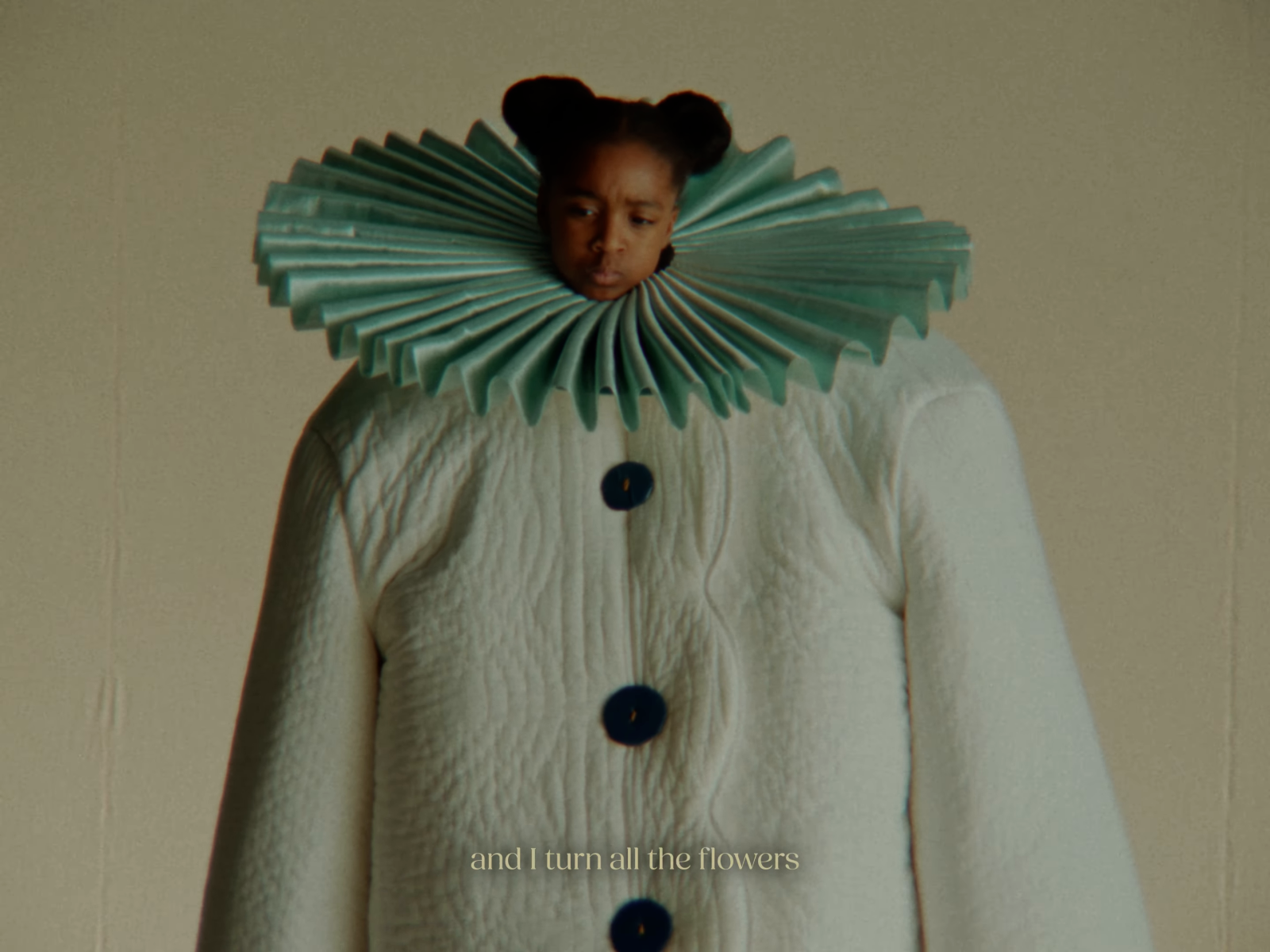
06 · A Ffern Fairytale / White architecture · separation without a white peak · campaign reference 4061 · 00:03:52.080
Cream costume, cool collar, warm backdrop
A child wears a pale textured costume and blue-green pleated collar against a warm cream backdrop.
Regular-footage feasibility: Conditional · preserve the production relationshipPhotographic composite read: none
A child wears a pale textured costume and blue-green pleated collar against a warm cream backdrop.
What is remarkable
A child wears a broad cream textured costume with dark buttons and a blue-green pleated collar against a warm cream backdrop. The pale surfaces remain distinct through small hue and lightness differences and the shadows inside folds.
This is not a high-white endpoint exercise. The costume can read as white while staying well below the display ceiling. The face and buttons supply small darker forms within the broad light shape, and the collar establishes a separate cool material around the head.
Measurement check, limited to this active midpoint: mean L* 47.4, mean C* 13.9, 2.2% of pixels below L* 5 and 0.00% at or above L* 85. These values describe the full active image, including visible text; they do not measure the specific objects named above.
Where the image comes from
The collar's pleats, the costume texture, the cream backdrop and the soft modelling must exist in the photographed scene. Grading cannot create their different material responses from a flat, textureless white costume.
Use grading to preserve warm/cool separation among the pale objects and keep the child's face legible without detaching it. The burnt-in subtitle is a fourth pale object and must be evaluated along with the cloth.
Waveform
RGB distribution
Vectorscope
Can regular footage get there?
Conditional · preserve the production relationship
The relationship is approachable when the source already contains the stated production conditions. The recipe refines that foundation; it does not invent missing surfaces, light or geometry.
Minimum capture conditions
A pale textured costume and a genuinely different collar colour.
Soft directional illumination that models the pleats and face.
Unclipped camera originals with distinct backdrop and costume levels.
Composite and background read
A constructed costume is not itself a composite
Pleats, buttons, face occlusion and the backdrop are compatible with a photographed costume setup. The fantastic character does not require a digital-environment claim.
No visible reason to require a photographic composite is not proof that no VFX occurred. Invisible cleanup or integration remains possible; source plates or production documentation would be needed. Visible subtitles and graphic overlays are acknowledged separately.
Shot-specific Resolve pass
Use the global tree, then make these decisions
F02
Place the pale middle range
Set exposure so the costume reads as pale without making its brightest texture approach clipping.
Why: White identity does not require a high white endpoint.
Watch: A blanket exposure increase can weaken the buttons and collar folds.
F07
Separate the three pale materials
Use broad spatially constrained adjustments for warm background, cream cloth and cooler collar.
Why: Small hue differences are doing important work.
Watch: Avoid a luma-only key that collects all three and the subtitle.
F06
Preserve the face within the costume
Make any face adjustment modest and compare it with the collar's reflected colour.
Why: The face should remain inside this soft setup.
Watch: Over-warming can create an orange island.
F03
Use local structural contrast
Preserve low-amplitude fold shadows without making the pale surface hard.
Why: Texture gives the broad costume its volume.
Watch: Global contrast can darken the face before improving the cloth.
F10
Keep texture natural
Leave heavy spatial smoothing and synthetic grain bypassed for the first pass.
Why: The photographed material already has fine detail.
Watch: Inspect pleat edges and costume weave at native and final size.
F12
Check the small subtitle
Judge the delivered pale letters against the lower costume with the final look visible.
Why: The subtitle shares the light-material range.
Watch: Sharpening or glow can increase its apparent weight.
Failure modes to check before approval
Avoid a luma-only key that collects all three and the subtitle.
Over-warming can create an orange island.
Inspect pleat edges and costume weave at native and final size.
Sharpening or glow can increase its apparent weight.
Review the moving shot, not just this midpoint; check tracking, temporal texture and final subtitle readability before approval.
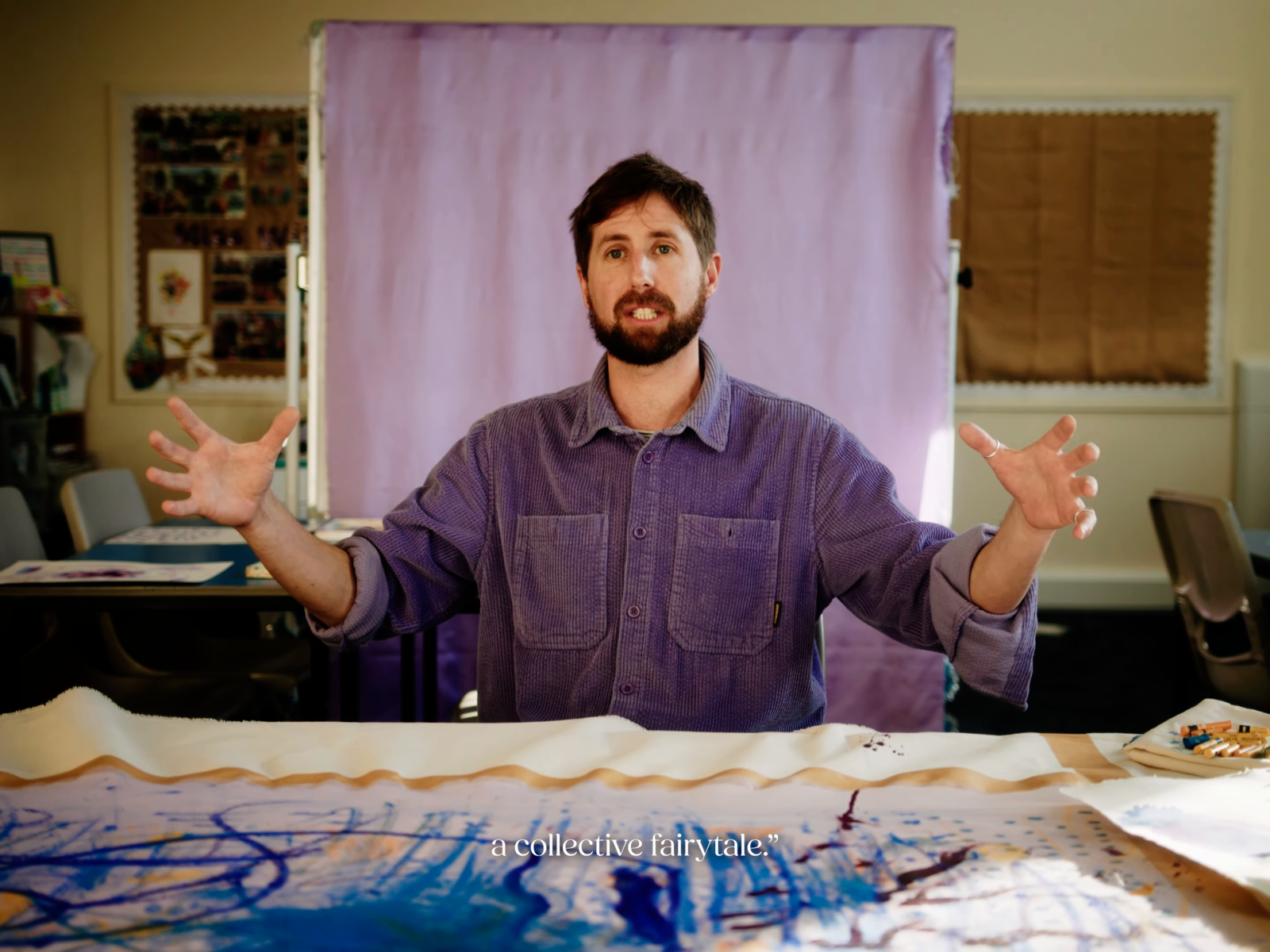
07 · Making a Fairytale / Related palettes · fiction versus process · campaign reference 6006 · 00:00:10.177
Violet connects an interview to the workshop
A man in a violet shirt sits behind painted fabric in front of a pale violet cloth backdrop; small white subtitles overlay the fabric below.
Regular-footage feasibility: High · with the stated sourcePhotographic composite read: none
A man in a violet shirt sits behind painted fabric in front of a pale violet cloth backdrop; small white subtitles overlay the fabric below.
What is remarkable
A man in a violet shirt sits before a pale violet backdrop, with painted fabric across the foreground. The background outside the cloth contains a real room with warmer surfaces and visual clutter. A small white subtitle sits over the foreground material.
The related violet areas have different lightness and texture; making them identical would turn a physical backdrop and a shirt into a graphic flat. The warm face is distinct from both, and the pale foreground needs its own brightness budget.
Measurement check, limited to this active midpoint: mean L* 43.2, mean C* 17.4, 8.9% of pixels below L* 5 and 3.09% at or above L* 85. These values describe the full active image, including visible text; they do not measure the specific objects named above.
Where the image comes from
Wardrobe, a hung backdrop, the table arrangement and room lighting provide the palette relationship. This is an interview setup inside a workshop, not proof of a globally violet grade.
Grading can hold the violet connection while keeping skin and paper credible. It should match the making-of to its own scene requirements, not force its mean lightness to the darker fictional Fairytale.
Waveform
RGB distribution
Vectorscope
Can regular footage get there?
High · with the stated source
The relationship is approachable when the source already contains the stated production conditions. The recipe refines that foundation; it does not invent missing surfaces, light or geometry.
Minimum capture conditions
Related but non-identical wardrobe and backdrop colours.
A face lit separately enough from the background to remain readable.
Foreground material with retained detail and controllable reflections.
Composite and background read
A visible backdrop is a practical colour device
The cloth backdrop, room edges and subject are compatible with an ordinary interview setup. A coloured backdrop is not evidence of chroma-key replacement.
No visible reason to require a photographic composite is not proof that no VFX occurred. Invisible cleanup or integration remains possible; source plates or production documentation would be needed. Visible subtitles and graphic overlays are acknowledged separately.
Shot-specific Resolve pass
Use the global tree, then make these decisions
F02
Place the interview exposure
Balance the face and pale table material before deciding how dense the violet should be.
Why: The person and workspace must remain credible.
Watch: A bright foreground can pull a whole-frame auto-exposure decision down.
F04
Retain the real room
Reduce only distracting background colour or brightness, keeping the room's material variation.
Why: The making process is part of the image.
Watch: Do not erase context with indiscriminate desaturation.
F05
Link shirt and backdrop
Refine the two violet families independently enough to preserve cloth texture and depth.
Why: Related does not mean identical.
Watch: A violet key may select the painted foreground too.
F06
Keep skin away from violet
Use a restrained spatially constrained skin correction only when contamination is visible.
Why: The face is the warm counterweight.
Watch: Over-correction can make skin orange against the cool background.
F07
Protect the pale foreground
Hold its brightness without flattening the painted marks.
Why: The table explains the interview's subject.
Watch: Luma keys may change the white subtitle.
F12
Inspect the foreground lettering
Check the small subtitle against paint and cloth at phone size.
Why: Letters sit on texture, not an empty lower band.
Watch: Avoid grain or sharpening that makes the type shimmer.
Failure modes to check before approval
Do not erase context with indiscriminate desaturation.
A violet key may select the painted foreground too.
Over-correction can make skin orange against the cool background.
Luma keys may change the white subtitle.
Review the moving shot, not just this midpoint; check tracking, temporal texture and final subtitle readability before approval.
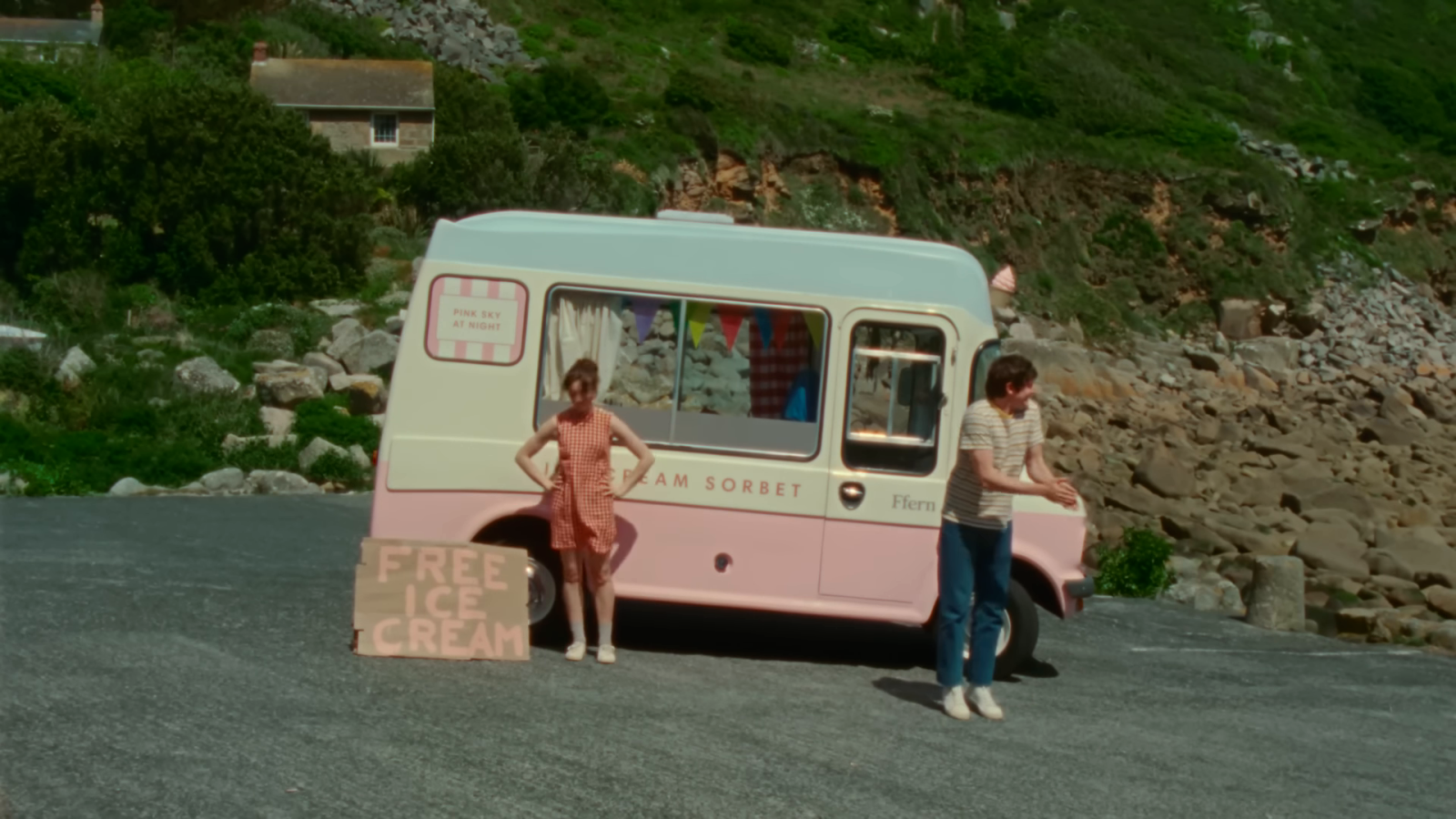
08 · Pink Sky at Night / Production colour · a portable room · campaign reference 7052 · 00:01:18.280
Pink paint, cream panels and a green hillside
Two figures and a sign stand beside a pink-and-cream van against a rocky green hillside.
Regular-footage feasibility: Conditional · preserve the production relationshipPhotographic composite read: none
Two figures and a sign stand beside a pink-and-cream van against a rocky green hillside.
What is remarkable
Two people stand beside a pink-and-cream van against a rocky green hillside. The van's broad painted panels provide a stable warm-coloured field, while the figures and dark openings give it scale and internal structure.
Pink paint, warm skin and red patterned clothing are neighbours, not one correction target. The cream upper body of the van belongs to the paint scheme; treating it as a perfectly neutral white can distort the intended relationship with the pink lower panel.
Measurement check, limited to this active midpoint: mean L* 33.7, mean C* 16.4, 3.0% of pixels below L* 5 and 0.02% at or above L* 85. These values describe the full active image, including visible text; they do not measure the specific objects named above.
Where the image comes from
The vehicle's paint, its position against the hillside and the clothing are production decisions. A regular unpainted vehicle does not become this scene through an ordinary global grade without object recolouring or VFX.
The grade can refine pink-versus-peach separation, control the green hillside and preserve cream-panel structure. It should not make the environment look unrelated merely to increase the vehicle's prominence.
Waveform
RGB distribution
Vectorscope
Can regular footage get there?
Conditional · preserve the production relationship
The relationship is approachable when the source already contains the stated production conditions. The recipe refines that foundation; it does not invent missing surfaces, light or geometry.
Minimum capture conditions
A vehicle or equivalent broad object with the intended pink-and-cream paint relationship.
A surrounding landscape with usable colour and value separation.
Camera originals that retain both painted highlights and the darker windows.
Composite and background read
The van has a coherent place in the landscape
Contact with the ground, figure scale, window darkness and the surrounding rocks are plausible in one photographed location. The still gives no decisive extension cue.
No visible reason to require a photographic composite is not proof that no VFX occurred. Invisible cleanup or integration remains possible; source plates or production documentation would be needed. Visible subtitles and graphic overlays are acknowledged separately.
Shot-specific Resolve pass
Use the global tree, then make these decisions
F02
Place the van in daylight
Set the daylight key while retaining detail on the cream panels and in the window openings.
Why: The vehicle is a room-like object, not a glowing colour card.
Watch: Do not over-open its dark windows.
F05
Keep pink separate from skin
Use a broad paint-colour key constrained to the bodywork if needed.
Why: The paint and faces have different material identities.
Watch: A hue-only key can capture skin and warm clothes.
F07
Keep cream deliberately warm
Preserve panel detail and a modest warm bias rather than forcing neutral white.
Why: The two-tone paint is a designed relationship.
Watch: Highlight desaturation can make the cream look grey.
F04
Refine the hillside
Adjust vegetation density and hue broadly, keeping rock and greenery distinct.
Why: The location grounds the vehicle.
Watch: An aggressive green shift can leave obvious boundaries around the van.
F06
Recheck the two figures
Judge each face and garment against the newly balanced panels.
Why: Background changes alter apparent skin colour.
Watch: Avoid equalising people to one brightness or complexion.
F11
Check panels in the final encode
Inspect smooth paint gradients and window edges after output mapping.
Why: Large flat surfaces reveal banding and ringing.
Watch: Do not add texture merely to hide an avoidable encoding defect.
Failure modes to check before approval
A hue-only key can capture skin and warm clothes.
Highlight desaturation can make the cream look grey.
An aggressive green shift can leave obvious boundaries around the van.
Avoid equalising people to one brightness or complexion.
Review the moving shot, not just this midpoint; check tracking, temporal texture and final subtitle readability before approval.
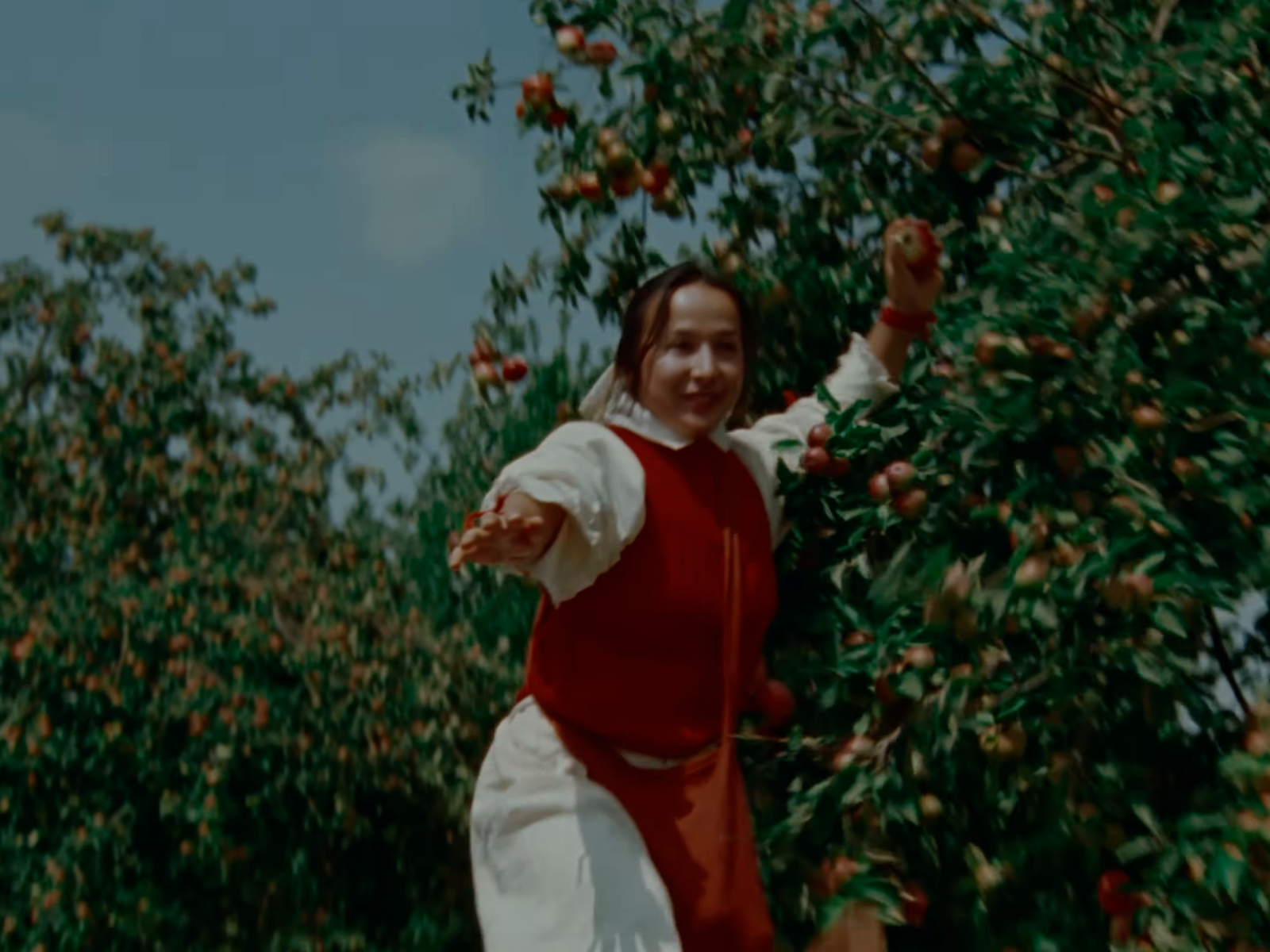
09 · A Wild Apple Heist / Warm accents · costume and skin · campaign reference 1014 · 00:01:17.520
Red costume stays distinct inside an orchard
A figure in a red waistcoat and cream sleeves extends an arm against green apple trees.
Regular-footage feasibility: Conditional · preserve the production relationshipPhotographic composite read: none
A figure in a red waistcoat and cream sleeves extends an arm against green apple trees.
What is remarkable
A red waistcoat and cream sleeves stand against green apple trees. The broad costume shape remains readable while leaves and fruit introduce finer colour events around it. The sleeve provides value separation; the red provides a second, chromatic separation.
The face, red clothing and apples are related warm areas, but their importance and saturation differ. A broad warm-axis boost could make all three louder without improving the figure's hierarchy. The source is a performance midpoint; it does not establish how a qualifier will behave throughout the shot.
Measurement check, limited to this active midpoint: mean L* 20.3, mean C* 14.0, 21.4% of pixels below L* 5 and 0.00% at or above L* 85. These values describe the full active image, including visible text; they do not measure the specific objects named above.
Where the image comes from
The garment colours and their relationship to the orchard are wardrobe and location. The arm's placement and the surrounding gaps in foliage also matter before grading begins.
Refine the red's density while keeping the cream sleeve and skin believable. A reconstruction can use selective tools, but its mattes must be tested on moving arms, leaf occlusions and the changing distribution of fruit.
Waveform
RGB distribution
Vectorscope
Can regular footage get there?
Conditional · preserve the production relationship
The relationship is approachable when the source already contains the stated production conditions. The recipe refines that foundation; it does not invent missing surfaces, light or geometry.
Minimum capture conditions
A red and cream costume photographed against real foliage.
Preserved red-channel structure in fabric and skin.
Source footage with enough detail around moving limbs and leaves for stable selective work.
Composite and background read
A performer among overlapping foliage
Costume, skin, leaves and fruit have plausible mutual occlusion. Their coordinated colours do not imply a digitally combined scene.
No visible reason to require a photographic composite is not proof that no VFX occurred. Invisible cleanup or integration remains possible; source plates or production documentation would be needed. Visible subtitles and graphic overlays are acknowledged separately.
Shot-specific Resolve pass
Use the global tree, then make these decisions
F02
Place the cream sleeve
Establish the scene key while keeping the sleeve's texture and the face's modelling.
Why: The sleeve is an important value anchor.
Watch: Do not force it to neutral display white.
F04
Preserve orchard depth
Refine foliage broadly while keeping yellow-green and darker green regions distinct.
Why: The orchard is a layered environment.
Watch: An olive wash can collapse leaves and fruit into one field.
F05
Control red density before chroma
Use a red branch to retain fabric shading; raise saturation only if the source is genuinely weaker.
Why: Cloth must remain a volume.
Watch: The key can include apples, lips and warm skin.
F06
Keep skin independent
Use a restrained spatial constraint if a warm-colour move changes the face.
Why: Skin and costume should not share identical density.
Watch: Check the hand and face separately.
F09
Protect saturated folds
Inspect the garment at the output and soften only problematic high-chroma compression.
Why: A red shape can look intense while still retaining detail.
Watch: Do not treat the palette's red swatch as a flat target for the entire garment.
F10
Judge the performance at delivery size
Evaluate moving fabric and leaves before adding grain or reducing noise.
Why: Source texture and motion interact.
Watch: Look for qualifier chatter, temporal smearing and unstable edges.
Failure modes to check before approval
An olive wash can collapse leaves and fruit into one field.
The key can include apples, lips and warm skin.
Check the hand and face separately.
Look for qualifier chatter, temporal smearing and unstable edges.
Review the moving shot, not just this midpoint; check tracking, temporal texture and final subtitle readability before approval.
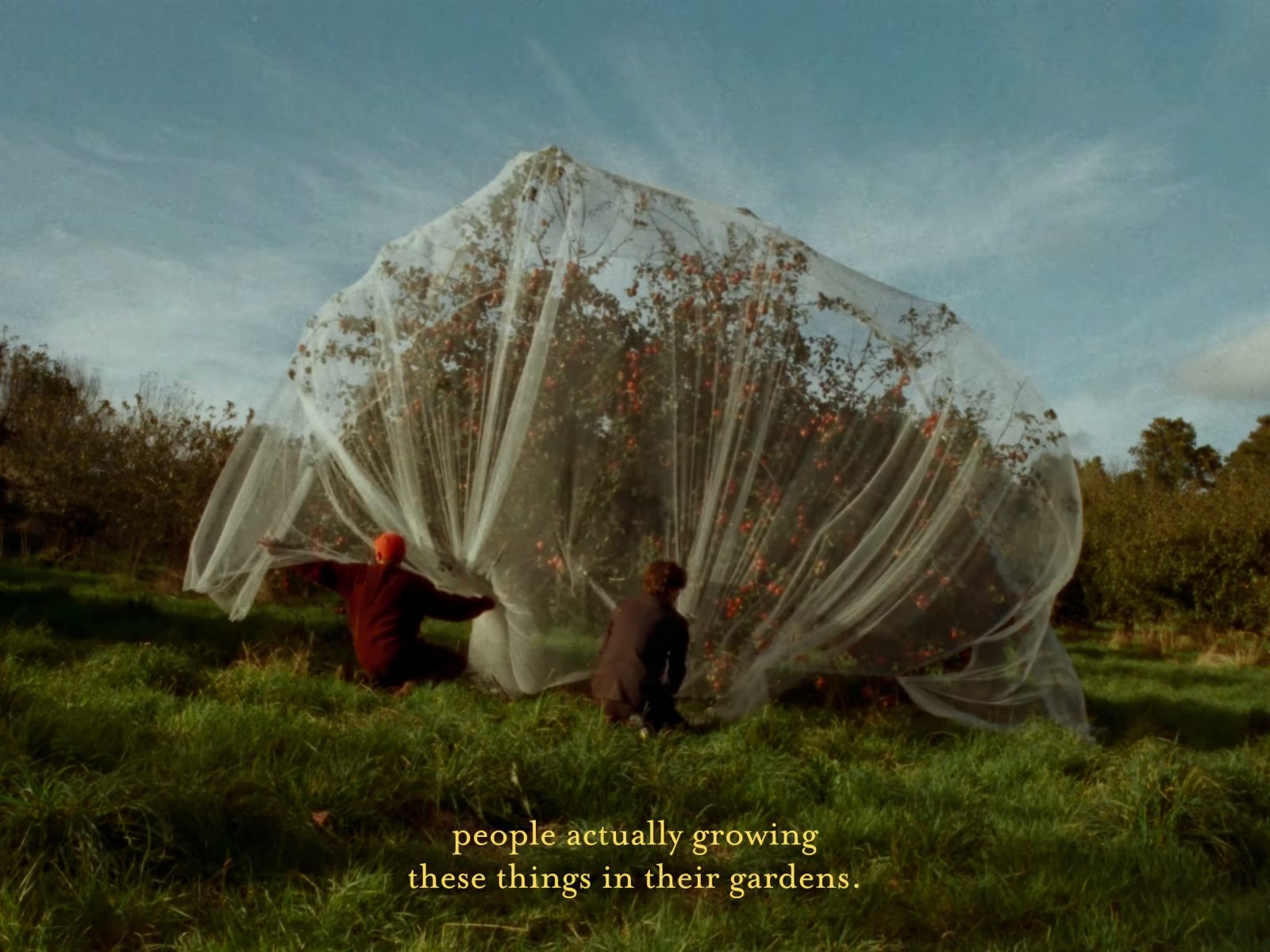
10 · Some Interesting Apples / Optical material · another hard case · campaign reference 8051 · 00:02:35.560
A pale veil changes the tree itself
Figures hold translucent pale fabric over an apple tree beneath a blue sky, revealing the tree through a softened veil; yellow subtitles cross the darker grass below.
Figures hold translucent pale fabric over an apple tree beneath a blue sky, revealing the tree through a softened veil; yellow subtitles cross the darker grass below.
What is remarkable
Two figures hold translucent pale fabric over a tree beneath a blue sky. Leaves and small fruit remain visible through the material, but their contrast is reduced and vertical folds cross the image. Yellow subtitles occupy the darker grass below.
The softer tree is not simply a low-contrast version of the uncovered landscape. The fabric contributes its own shape, highlights and varying transparency. A global haze or diffusion node would also affect the sky, grass and people, which would be a different construction.
Measurement check, limited to this active midpoint: mean L* 35.8, mean C* 15.8, 5.4% of pixels below L* 5 and 0.02% at or above L* 85. These values describe the full active image, including visible text; they do not measure the specific objects named above.
Where the image comes from
The large translucent material, its changing overlap with the tree and the figures' contact with it are physical staging requirements. On ordinary uncovered-tree footage, a similar spatial veil would require a practical element or carefully integrated compositing; the grade alone is not enough.
The grade can preserve transmission differences, keep the fabric pale without clipping its folds and refine the grass/sky balance. Strong dehaze or texture enhancement would work against the visible material effect.
Waveform
RGB distribution
Vectorscope
Can regular footage get there?
Low · capture-specific reference
This is a deliberately demanding reference. Ordinary unrelated footage cannot reproduce its spatial construction through a conventional grade alone; the capture or element requirements below are part of the result.
Minimum capture conditions
A real translucent covering, or appropriate element plates and tracked integration work.
An underlying tree and illumination that remain visible through the covering.
Unclipped fabric highlights and sufficient contrast detail in the transmitted image.
Composite and background read
Practical fabric is a sufficient explanation
Folds, contact with the figures and varying visibility of branches are consistent with a real covering. The selected still does not require a digital veil, although a reconstruction without one would need additional material.
No visible reason to require a photographic composite is not proof that no VFX occurred. Invisible cleanup or integration remains possible; source plates or production documentation would be needed. Visible subtitles and graphic overlays are acknowledged separately.
Shot-specific Resolve pass
Use the global tree, then make these decisions
F02
Place the transmitted scene
Set exposure from the fabric and the tree seen through it, not from a hypothetical uncovered version.
Why: The lowered local contrast is part of the subject.
Watch: Automatic dehaze can destroy the material relationship.
F07
Separate folds from transparency
Use gentle broad shaping to retain pale fabric ridges while leaving foliage visible underneath.
Why: The covering needs both its own surface and transmitted detail.
Watch: A bright luma key can grab sky and subtitles too.
F04
Keep the surrounding landscape distinct
Refine grass and sky without equalising them to the veiled tree's contrast.
Why: The uncovered environment explains what the veil is doing.
Watch: A global milky lift removes the spatial distinction.
F08
Respect contact and occlusion
If compositing a new element, solve fabric-edge transparency, contact and occlusion before the shared look.
Why: These cues cannot be supplied by a final colour wash.
Watch: Inspect moving hands, folds and branch intersections.
F10
Avoid texture restoration by reflex
Keep sharpening and local contrast restrained on the covered area.
Why: Softness through the fabric is not necessarily a defect.
Watch: Enhancement can produce a gauze-like pattern that was not present in the source.
F12
Protect the yellow subtitle
Evaluate its weight against the dark grass and the broad pale object above it.
Why: Text is a separate high-contrast designed layer.
Watch: A yellow-green correction can recolour the burnt-in letters.
Failure modes to check before approval
A bright luma key can grab sky and subtitles too.
A global milky lift removes the spatial distinction.
Inspect moving hands, folds and branch intersections.
Enhancement can produce a gauze-like pattern that was not present in the source.
Review the moving shot, not just this midpoint; check tracking, temporal texture and final subtitle readability before approval.
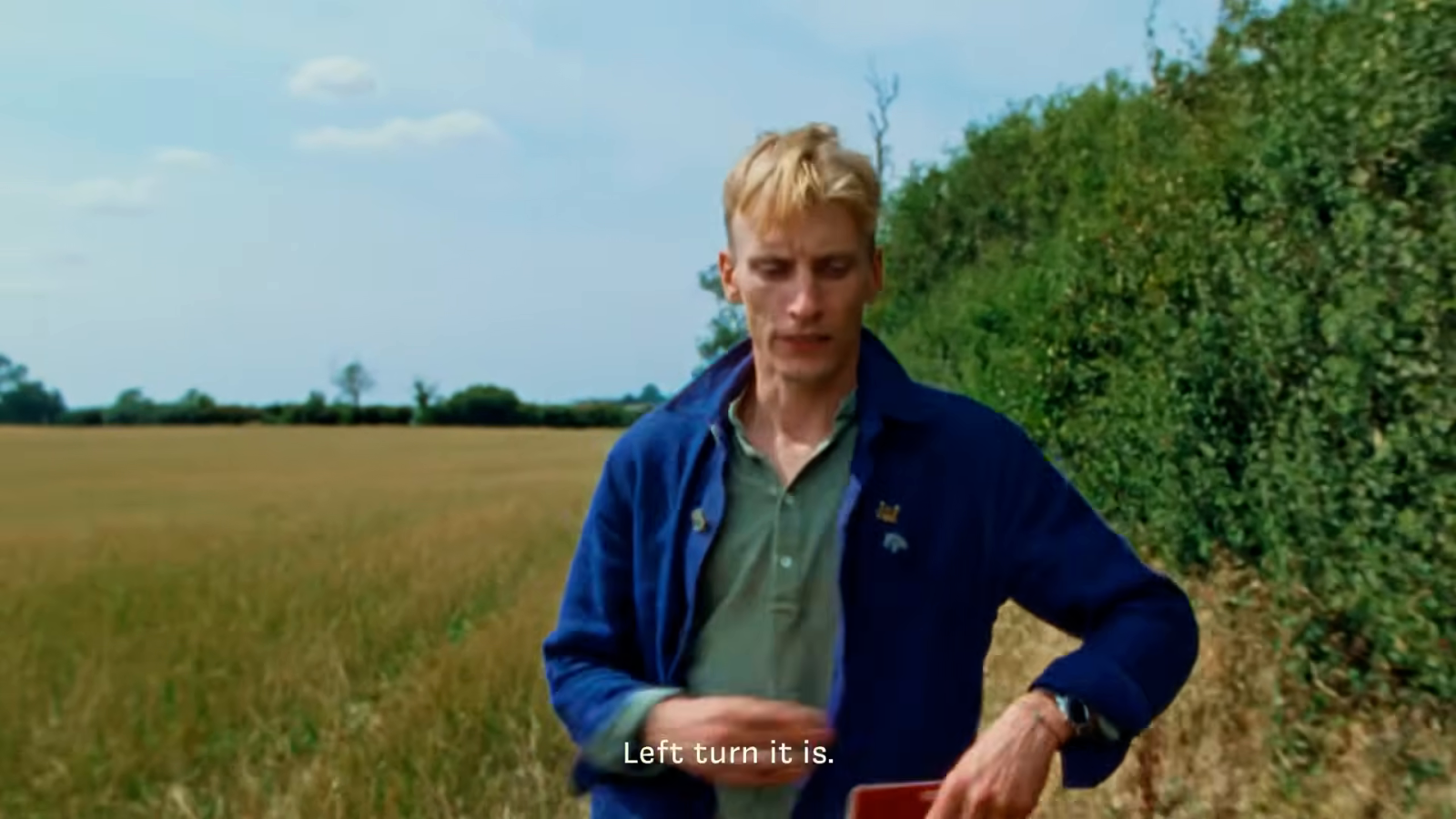
11 · The Search for Autumn / Simple colour territories · keeping the ratios · campaign reference 12003 · 00:00:11.720
A blue coat, a green shirt and a gold field
A man in a dark blue coat and green shirt stands in a gold field beneath blue sky.
Regular-footage feasibility: High · with the stated sourcePhotographic composite read: none
A man in a dark blue coat and green shirt stands in a gold field beneath blue sky.
What is remarkable
A man wears a blue coat over a green shirt in a gold field beneath a pale blue sky. The blue coat is darker and more chromatic than the sky, while the shirt relates to the greener field edge. A small white subtitle sits below the hands.
The palette is simple enough that small errors are easy to see. If the coat becomes too cyan it approaches the sky; if the crop becomes uniformly orange it competes with skin. The grade's task is to preserve three distinct broad territories, not to introduce more colours.
Measurement check, limited to this active midpoint: mean L* 44.8, mean C* 23.6, 9.1% of pixels below L* 5 and 0.14% at or above L* 85. These values describe the full active image, including visible text; they do not measure the specific objects named above.
Where the image comes from
The costume and field already supply the principal opposition. The horizon, person's scale and background hedge are compositional conditions, not consequences of saturation.
Use a comparatively light-touch grade to retain coat density, natural crop variation and credible skin. This bright exterior should not be lowered to match the dark narrative films merely because all carry the Ffern name.
Waveform
RGB distribution
Vectorscope
Can regular footage get there?
High · with the stated source
The relationship is approachable when the source already contains the stated production conditions. The recipe refines that foundation; it does not invent missing surfaces, light or geometry.
Minimum capture conditions
Blue wardrobe with a different level from the sky.
A warm field and a background that leave the subject readable.
A well-exposed face with retained sky and fabric detail.
Composite and background read
A coherent open-field portrait
The figure, field and hedge have plausible relative scale and illumination. The colour opposition does not imply a replacement background.
No visible reason to require a photographic composite is not proof that no VFX occurred. Invisible cleanup or integration remains possible; source plates or production documentation would be needed. Visible subtitles and graphic overlays are acknowledged separately.
Shot-specific Resolve pass
Use the global tree, then make these decisions
F02
Keep the open daylight key
Place the face and field naturally within the available range.
Why: This campaign uses a brighter key than the low-light stories.
Watch: Do not match it to a brand-wide lightness average.
F05
Hold blue coat density
Refine the coat separately from the pale sky if needed.
Why: Shared hue family does not mean shared material.
Watch: A broad blue key can alter the entire upper frame.
F04
Keep crop and hedge different
Retain fine yellow-gold variation and a distinct green field edge.
Why: Both temperature and structure describe the setting.
Watch: Excess yellow saturation can make the crop flat.
F06
Preserve a credible face
Check skin after the crop and coat adjustments; use only a small correction if necessary.
Why: Simultaneous colour contrast can change the face's apparent warmth.
Watch: Do not remove every cool or warm influence from skin.
F03
Retain cloth and crop detail
Add contrast only where texture needs it, keeping the sky gradient smooth.
Why: The scene does not require a heavy toe.
Watch: Watch shoulder seams and bright cereal heads.
F12
QC the subtitle against the field
Inspect the small white line at phone scale with the final encode.
Why: The lower band contains fine moving crop structure.
Watch: A sharpened subtitle can look heavier than the photographic detail.
Failure modes to check before approval
A broad blue key can alter the entire upper frame.
Excess yellow saturation can make the crop flat.
Do not remove every cool or warm influence from skin.
A sharpened subtitle can look heavier than the photographic detail.
Review the moving shot, not just this midpoint; check tracking, temporal texture and final subtitle readability before approval.
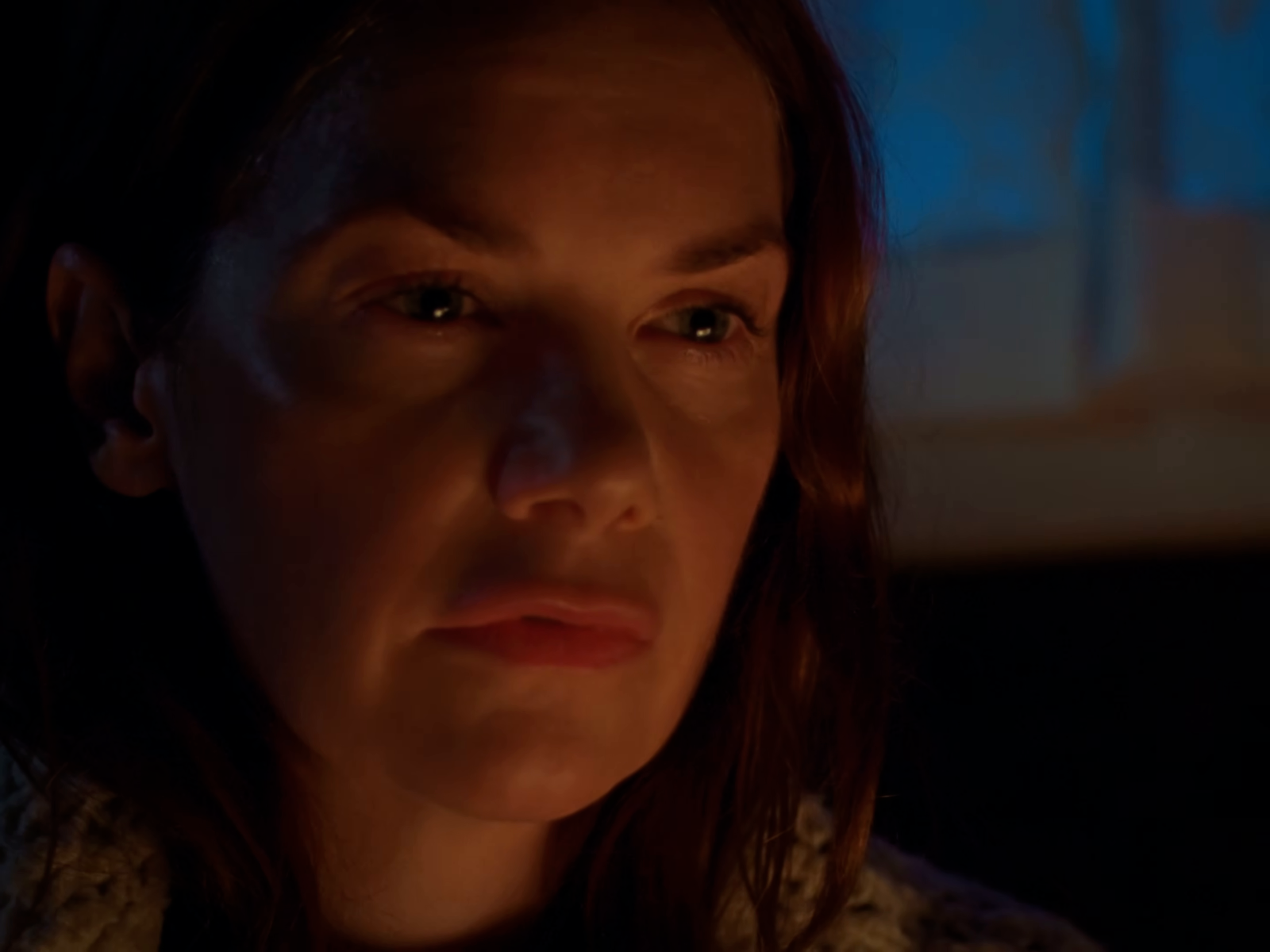
12 · The Lighthouse Keeper / Mixed light · preserving a low-key face · campaign reference 10056 · 00:02:14.720
Warm skin is an island inside blue and black
An orange-lit face is set against a deep blue room with much of the frame near black.
Regular-footage feasibility: Conditional · preserve the production relationshipPhotographic composite read: none
An orange-lit face is set against a deep blue room with much of the frame near black.
What is remarkable
An orange-lit face occupies the foreground while a deep blue room remains visible behind it. Large areas of hair and surrounding space approach black. The warm/cool opposition is spatially specific; it is not a uniform teal-and-orange palette spread across all surfaces.
The face still has internal modelling. Its warmer lit planes and darker contours must remain distinct, and the blue background must not become bright enough to compete. No subtitle is visible in this selected midpoint, although other frames in the film carry pale yellow captions.
Measurement check, limited to this active midpoint: mean L* 9.2, mean C* 12.0, 49.6% of pixels below L* 5 and 0.00% at or above L* 85. These values describe the full active image, including visible text; they do not measure the specific objects named above.
Where the image comes from
The lighting relationship between a warm face and cooler room must be captured or deliberately relit with adequate source information. The finished still cannot establish which fixture, fire effect or combination produced it.
A colourist can preserve low-level skin structure, refine the background blue and avoid making the face an isolated bright mask. Correcting the whole frame to neutral would remove the central environmental relationship.
Waveform
RGB distribution
Vectorscope
Can regular footage get there?
Conditional · preserve the production relationship
The relationship is approachable when the source already contains the stated production conditions. The recipe refines that foundation; it does not invent missing surfaces, light or geometry.
Minimum capture conditions
A face modelled by genuinely warmer light than its surroundings.
Camera originals retaining usable red, green and blue detail in the face.
A dark environment with enough signal for controlled local adjustments.
Composite and background read
Mixed illumination is not proof of compositing
Face modelling and the visible background are compatible with a single mixed-light setup. A colour discontinuity alone does not establish a separate plate.
No visible reason to require a photographic composite is not proof that no VFX occurred. Invisible cleanup or integration remains possible; source plates or production documentation would be needed. Visible subtitles and graphic overlays are acknowledged separately.
Shot-specific Resolve pass
Use the global tree, then make these decisions
F02
Place the face without opening the room
Set exposure from the lit and unlit face planes while preserving the dark environment.
Why: The face belongs to a low-key scene.
Watch: A global lift exposes the room and changes the contrast hierarchy.
F06
Keep skin warm but differentiated
Use a restrained skin region if necessary to protect channel separation; do not neutralise the warm light.
Why: Warm skin still needs several distinguishable tones.
Watch: A correction based on a generic skin line can remove the illumination.
F04
Refine the background blue
Keep its colour and level distinct from hair and near-black areas.
Why: The blue patch supplies depth behind the warm face.
Watch: Excess saturation can make the room look emissive.
F03
Protect the near-black contour
Shape the toe so important edges survive without opening all surrounding darkness.
Why: Contour separation is local, not a new black level for the film.
Watch: Judge on the managed output rather than a bright UI surround.
F09
Inspect low-level colour noise
Reduce only unstable chroma that belongs to the actual camera source.
Why: The web reference cannot reveal the original noise floor.
Watch: Aggressive desaturation can leave grey shadows across the face.
F10
Avoid a plastic face
Use minimal texture processing and check motion before approval.
Why: Fine skin detail and soft modelling are both required.
Watch: Temporal noise reduction can trail facial movement.
Failure modes to check before approval
A correction based on a generic skin line can remove the illumination.
Excess saturation can make the room look emissive.
Temporal noise reduction can trail facial movement.
Review the moving shot, not just this midpoint; check tracking, temporal texture and final subtitle readability before approval.
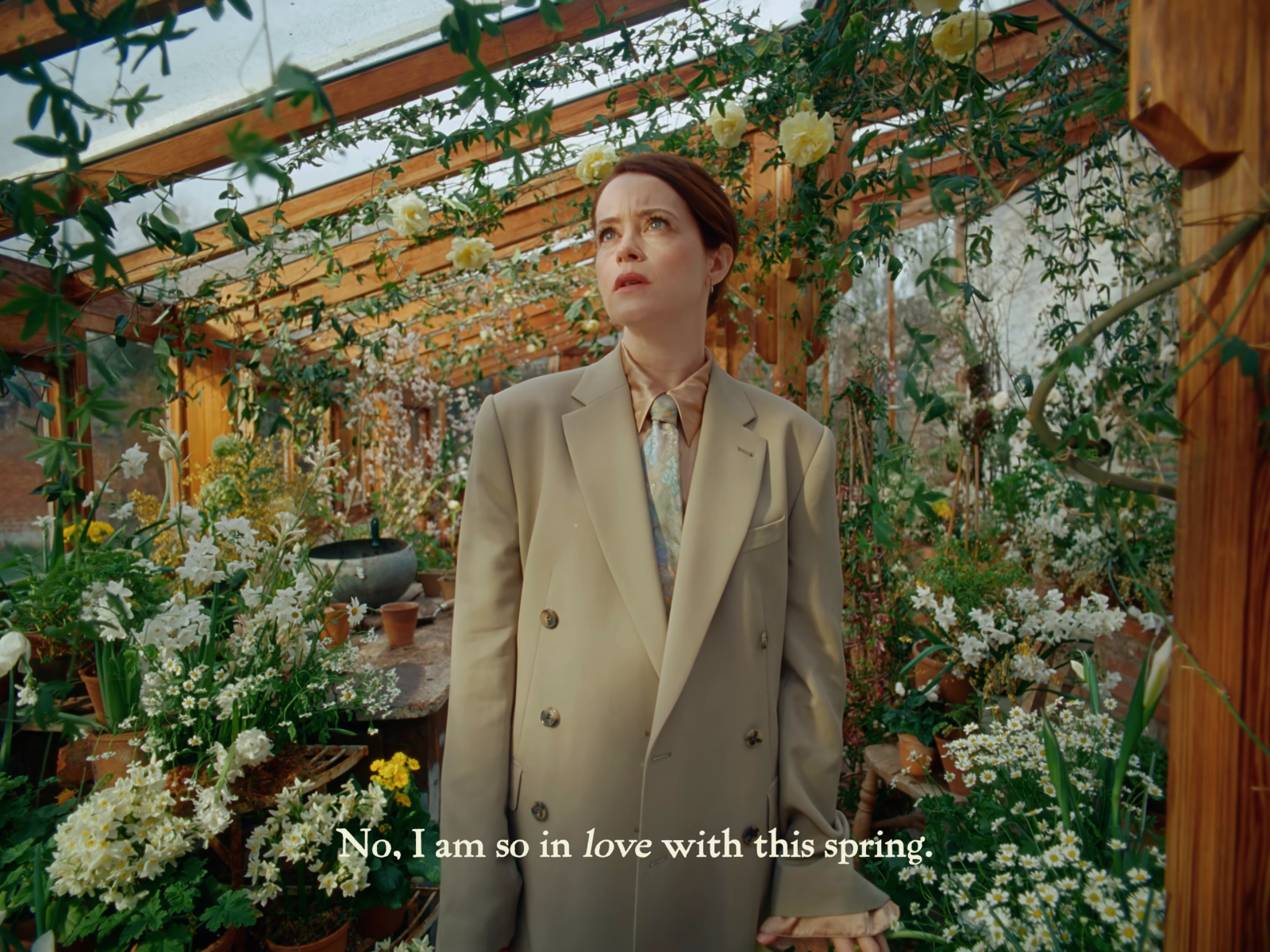
13 · Becoming the Land / Neutral subject · detailed colour surround · campaign reference 2001 · 00:00:04.708
A beige suit inside a flowering frame
A woman in a beige suit stands among greenhouse flowers and timber bars, with a light serif subtitle across the lower centre.
Regular-footage feasibility: Conditional · preserve the production relationshipPhotographic composite read: none
A woman in a beige suit stands among greenhouse flowers and timber bars, with a light serif subtitle across the lower centre.
What is remarkable
A woman in a beige suit stands among white flowers, green leaves and greenhouse timber. The comparatively quiet suit is surrounded by many smaller colour and edge events. Pale serif subtitles sit across the lower centre, where plants and clothing also occupy space.
The suit does not need to be recoloured into the environment to belong to it. Its warmer neutral surface gives the face and silhouette a broad support, while foliage, timber and pale blossoms remain separate materials around it.
Measurement check, limited to this active midpoint: mean L* 37.7, mean C* 19.8, 2.6% of pixels below L* 5 and 1.07% at or above L* 85. These values describe the full active image, including visible text; they do not measure the specific objects named above.
Where the image comes from
The greenhouse, costume, flowers and the figure's placement supply the visual density. Light passing through the structure also determines local brightness and shadow patterns.
Grading can protect suit/skin separation, keep multiple greens and restrain a distracting bright blossom. It cannot manufacture a convincing flowering surround from an empty room with a hue shift.
Waveform
RGB distribution
Vectorscope
Can regular footage get there?
Conditional · preserve the production relationship
The relationship is approachable when the source already contains the stated production conditions. The recipe refines that foundation; it does not invent missing surfaces, light or geometry.
Minimum capture conditions
A quiet neutral costume in an already detailed botanical environment.
Adequate exposure and separation on face and suit.
Preserved white blossom detail and realistic green channel information.
Composite and background read
Dense surroundings can be practical staging
Timber, plants, figure and foreground occlusion form a plausible greenhouse scene. Detail density alone is not evidence of a digital background.
No visible reason to require a photographic composite is not proof that no VFX occurred. Invisible cleanup or integration remains possible; source plates or production documentation would be needed. Visible subtitles and graphic overlays are acknowledged separately.
Shot-specific Resolve pass
Use the global tree, then make these decisions
F02
Place the suit and face
Set the key from the subject while retaining the lit flowers around her.
Why: The neutral suit must remain a readable broad shape.
Watch: Do not pull all surrounding blossom to the suit's level.
F04
Keep botanical greens varied
Use broad adjustments that preserve yellow-green leaves, darker green regions and warm timber.
Why: The environment is a collection of surfaces.
Watch: A narrow green key can create unstable leaf edges.
F06
Separate skin from beige cloth
Check face and lapel together before a skin hue move.
Why: They share warmth but are not the same material.
Watch: A global warm push can merge the face into the suit.
F07
Control only distracting pale areas
Hold blossom detail and the light costume without flattening them.
Why: Pale objects have different roles and scales.
Watch: The subtitle will also enter an indiscriminate luma key.
F08
Refine attention gently
If the figure needs more separation, reduce a specific background distraction rather than vignette the whole greenhouse.
Why: The scene should remain visually abundant.
Watch: Track around stems crossing the figure.
F12
Read the complete lower frame
Check serif letter weight and line spacing against the actual plants and suit.
Why: The subtitles form a second designed shape.
Watch: Avoid hue or sharpening changes that make the text look detached.
Failure modes to check before approval
A narrow green key can create unstable leaf edges.
A global warm push can merge the face into the suit.
The subtitle will also enter an indiscriminate luma key.
Track around stems crossing the figure.
Review the moving shot, not just this midpoint; check tracking, temporal texture and final subtitle readability before approval.
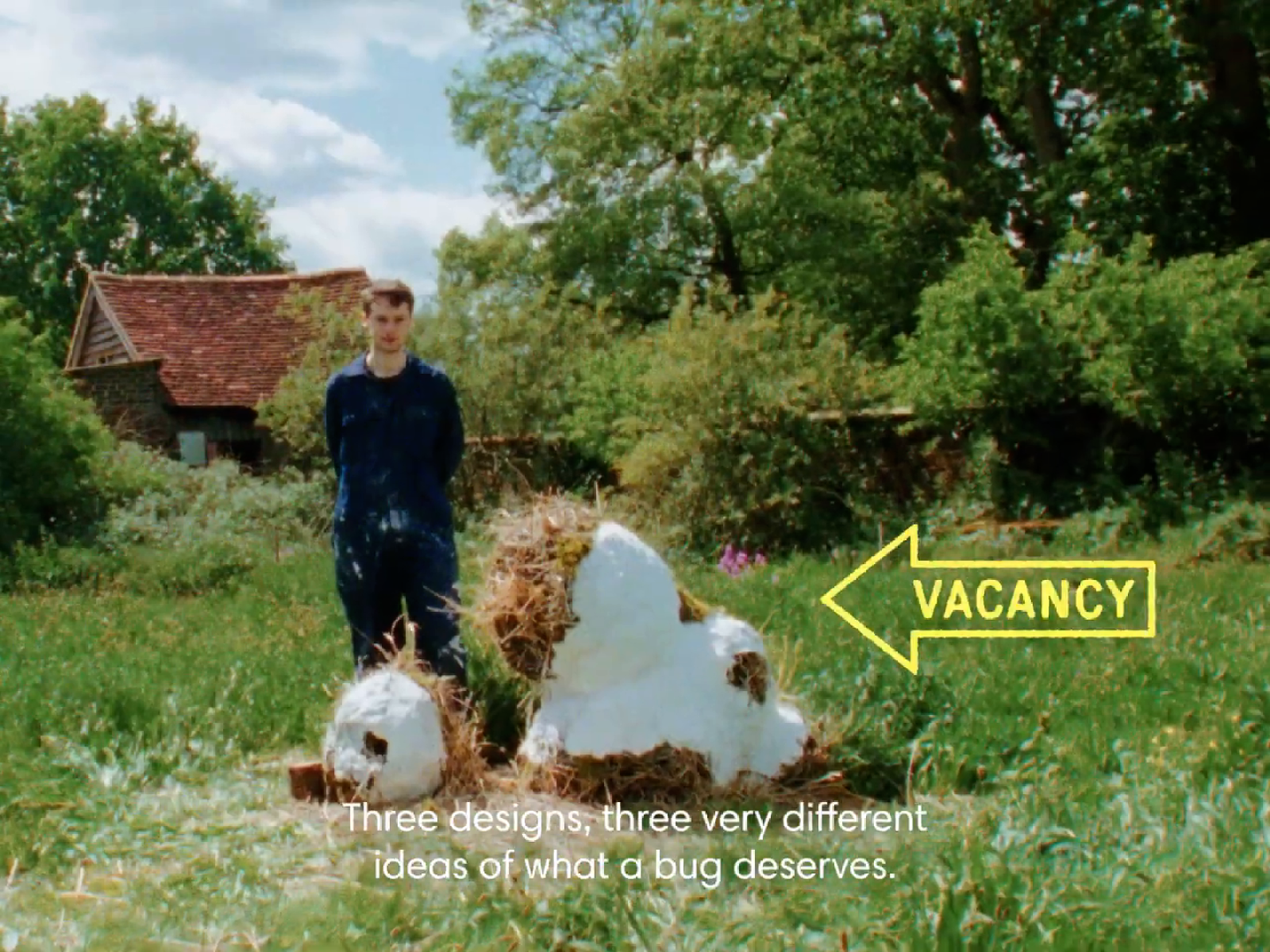
14 · Grand Bug Hotel Designs / Graphic integration · three layers in one frame · campaign reference 5054 · 00:01:15.560
Photograph, pale sculpture, yellow arrow
A designer in blue stands behind a pale insect-hotel structure in a meadow, with a yellow vacancy arrow at the right and white subtitles below.
Regular-footage feasibility: Conditional · preserve the production relationshipPhotographic composite read: none
A designer in blue stands behind a pale insect-hotel structure in a meadow, with a yellow vacancy arrow at the right and white subtitles below.
What is remarkable
A designer in blue stands behind a pale insect-hotel structure in a green meadow. A yellow vacancy arrow occupies the right-hand side, while two white subtitle lines sit lower in the picture. The photograph and graphic design openly share the task of directing attention.
The pale structure contains holes, straw and uneven surfaces; it must remain a material object rather than a white cut-out. The yellow arrow has a different edge character and colour purpose from the naturally lit vegetation and clothing.
Measurement check, limited to this active midpoint: mean L* 43.7, mean C* 25.7, 5.9% of pixels below L* 5 and 4.77% at or above L* 85. These values describe the full active image, including visible text; they do not measure the specific objects named above.
Where the image comes from
The meadow, person and handmade structure are photographic subjects. The arrow and subtitles are visibly designed overlays; that does not establish that the photographed background is a composite.
Grade the photographic materials with the graphic hierarchy visible. For a new production, keep type and graphics separately manageable through finishing. In the supplied burnt-in file, selective photographic corrections can also change letters and arrow edges.
Waveform
RGB distribution
Vectorscope
Can regular footage get there?
Conditional · preserve the production relationship
The relationship is approachable when the source already contains the stated production conditions. The recipe refines that foundation; it does not invent missing surfaces, light or geometry.
Minimum capture conditions
A real textured pale object and usable detail in bright outdoor capture.
A separate graphics/text element for a new production, or acceptance that a burnt-in reference cannot provide a clean plate.
A delivery-size check that includes the final typography and encoding.
Composite and background read
Overt graphics, no asserted environment replacement
The yellow arrow and captions are an explicit graphic finish. The person, structure and meadow do not supply an independent reason to claim a replaced background; this confidence rating concerns the photographic scene.
No visible reason to require a photographic composite is not proof that no VFX occurred. Invisible cleanup or integration remains possible; source plates or production documentation would be needed. Visible subtitles and graphic overlays are acknowledged separately.
Shot-specific Resolve pass
Use the global tree, then make these decisions
F02
Establish the daylight photograph
Balance the person, sculpture and meadow with the graphics visible.
Why: The brighter documentary key should remain distinct from the narrative films.
Watch: Do not lower everything simply to match a dark brand average.
F07
Hold structure in the pale object
Preserve straw, holes and uneven edges while controlling excess brightness.
Why: The sculpture's material identity depends on small contrast.
Watch: Luma selection can also include white subtitles.
F04
Keep the meadow varied
Refine green hue and density without collapsing all grasses into a flat background.
Why: Vegetation anchors the outdoor setting.
Watch: Green/yellow keys may select the arrow.
F05
Preserve the blue figure
Check the designer's clothing against the pale structure and grass.
Why: The figure is a distinct colour layer.
Watch: Avoid making dark blue featureless.
F10
Match photographic texture only
Do not use source grain or smoothing as a reason to degrade the clean graphic edges.
Why: Photograph and overlay can intentionally have different texture.
Watch: Added grain across type may make small letters less stable.
F12
Finish the graphic hierarchy
For new work, composite the arrow and subtitles through the documented output pipeline; compare on a phone.
Why: Yellow label and white dialogue should remain different functions.
Watch: Check two-line captions, edge halos and colour shifts from a duplicated transform.
Failure modes to check before approval
Luma selection can also include white subtitles.
Green/yellow keys may select the arrow.
Avoid making dark blue featureless.
Added grain across type may make small letters less stable.
Review the moving shot, not just this midpoint; check tracking, temporal texture and final subtitle readability before approval.
15 · This Wild Land / Texture · a subject that looks like noise to a filter · campaign reference 13015 · 00:00:38.920
Wet fur, dark nose and fine white letters
A close frontal view of a wet brown beaver face contrasts a dark nose with fine warm fur and a small pale subtitle.
Regular-footage feasibility: Conditional · preserve the production relationshipPhotographic composite read: none
A close frontal view of a wet brown beaver face contrasts a dark nose with fine warm fur and a small pale subtitle.
What is remarkable
A wet brown beaver face fills the picture. Fine warm fur surrounds a darker nose, with darker water or foreground at the bottom and a small pale subtitle. The face is legible through both broad modelling and very fine directional texture.
The fur contains much of the high-frequency structure. A grain metric cannot separate that subject detail from imaging texture without additional evidence. Making this frame smoother may remove the very material information that makes it tactile.
Measurement check, limited to this active midpoint: mean L* 33.1, mean C* 15.8, 9.8% of pixels below L* 5 and 0.11% at or above L* 85. These values describe the full active image, including visible text; they do not measure the specific objects named above.
Where the image comes from
Animal position, wet fur, focus and the reflective surface are capture conditions. The directional strands and whiskers are not a texture layer the grade can recreate after heavy reduction.
Grading can keep warm brown fur distinct from the nose, preserve bright strands and avoid excess sharpening. A skin heuristic would be inappropriate: warm fur can satisfy the same colour gate without being human skin.
Waveform
RGB distribution
Vectorscope
Can regular footage get there?
Conditional · preserve the production relationship
The relationship is approachable when the source already contains the stated production conditions. The recipe refines that foundation; it does not invent missing surfaces, light or geometry.
Minimum capture conditions
Sufficient focus and exposure to retain individual fur strands.
A source with manageable compression and motion blur.
A restrained finishing path that preserves wet highlights and the dark nose.
Composite and background read
A close photographic material study
Fur direction, muzzle structure and small wet highlights are spatially coherent. Their detail is not in itself evidence for a synthetic or composited animal.
No visible reason to require a photographic composite is not proof that no VFX occurred. Invisible cleanup or integration remains possible; source plates or production documentation would be needed. Visible subtitles and graphic overlays are acknowledged separately.
Shot-specific Resolve pass
Use the global tree, then make these decisions
F02
Place the broad face model
Set the overall key while retaining the dark nose and lit fur as separate regions.
Why: Broad modelling should read before fine detail.
Watch: A lifted nose can lose its surface identity.
F04
Separate warm fur from its surroundings
Use a broad colour refinement only where the environmental green or reflection needs balancing.
Why: The subject's warmth is a material property.
Watch: Do not apply a human skin correction to the fur.
F07
Protect small wet highlights
Retain narrow bright strands without clipping or globally whitening the coat.
Why: Specular events describe wetness.
Watch: An aggressive highlight key can collect the subtitle.
F03
Keep local structure without crunch
Use restrained contrast, judging the full frame as well as native detail.
Why: Fur needs internal differences, not a harsh outline.
Watch: Watch whiskers, nose edges and foreground contact.
F10
Treat texture as evidence
Begin noise reduction and sharpening bypassed; compare any intervention at final size and in motion.
Why: Fine fur can be mistaken for noise.
Watch: Look for clumping, ringing and temporal smears.
F12
Check letters over the dark foreground
Keep the small subtitle readable without adding a bright line that dominates the muzzle.
Why: Its weight is judged relative to real texture.
Watch: Post-sharpened lettering can become much harder than the fur.
Failure modes to check before approval
Do not apply a human skin correction to the fur.
An aggressive highlight key can collect the subtitle.
Look for clumping, ringing and temporal smears.
Post-sharpened lettering can become much harder than the fur.
Review the moving shot, not just this midpoint; check tracking, temporal texture and final subtitle readability before approval.
16 · The Green Knight / Reflective versus diffuse colour · campaign reference 9022 · 00:01:14.920
Metal reflects; orange cloth glows softly
A red-haired figure wears silver armour over orange sleeves against pale stone and green vegetation.
Regular-footage feasibility: Conditional · preserve the production relationshipPhotographic composite read: none
A red-haired figure wears silver armour over orange sleeves against pale stone and green vegetation.
What is remarkable
A red-haired figure wears silver armour over orange sleeves, with stone and green vegetation behind. The armour contains broad subdued reflections and darker contours. The cloth is more chromatic and has a softer material response.
The metal is not a neutral white patch waiting to be balanced. Its reflected colours and dark structure make it metallic. Orange sleeves, skin and hair share parts of the warm spectrum but must remain distinguishable from one another and from the stone.
Measurement check, limited to this active midpoint: mean L* 29.9, mean C* 19.1, 1.8% of pixels below L* 5 and 0.00% at or above L* 85. These values describe the full active image, including visible text; they do not measure the specific objects named above.
Where the image comes from
Armour, costume colour, hair, location and reflection geometry are production and capture. An ordinary pale shirt cannot acquire the armour's changing reflections through a conventional grade.
The grade can protect metallic structure, refine the orange's chroma and keep skin separate. It should not turn neighbouring stone orange to make the frame feel warm or desaturate the armour until all reflections are grey.
Waveform
RGB distribution
Vectorscope
Can regular footage get there?
Conditional · preserve the production relationship
The relationship is approachable when the source already contains the stated production conditions. The recipe refines that foundation; it does not invent missing surfaces, light or geometry.
Minimum capture conditions
Real reflective material or a correctly rendered element with plausible reflected surroundings.
Distinct orange cloth and usable skin/hair colour separation.
Unclipped highlights and sufficient channel detail in the strong warm colours.
Composite and background read
Reflective material, not a proven digital element
Armour reflections, cloth contact and the figure's relationship with the setting are plausible. The costume's unusual appearance alone does not prove CG or compositing.
No visible reason to require a photographic composite is not proof that no VFX occurred. Invisible cleanup or integration remains possible; source plates or production documentation would be needed. Visible subtitles and graphic overlays are acknowledged separately.
Shot-specific Resolve pass
Use the global tree, then make these decisions
F02
Place the figure and stone
Set the scene key without using the brightest metal patch as the sole exposure target.
Why: The armour must belong to the environment.
Watch: A global lift can make the metal look painted white.
F07
Preserve reflected dark shapes
Refine metallic highlights gently while retaining broad darker reflections and contours.
Why: Metallic identity depends on the full reflection range.
Watch: Strong highlight desaturation or soft clipping can flatten the breastplate.
F05
Protect orange cloth
Control sleeve density and chroma separately from hair and skin where needed.
Why: The cloth carries a distinct warm accent.
Watch: A hue-only key can collect the face and background stone.
F06
Recheck skin and hair
Keep complexion and hair colour distinct from the orange sleeves without forcing a neutral complexion.
Why: Related warm objects are still different materials.
Watch: Overcorrection can create an isolated face colour.
F04
Retain green and stone variation
Use broad environmental colour work to keep the background coherent.
Why: The surroundings support the costume rather than becoming one flat field.
Watch: Do not let warm grading contaminate every neutral surface.
F09
Inspect strong colour through output
Check warm fabric and reflected highlights after the display transform; compress only actual problem regions.
Why: A pleasing working-space image can fail at delivery.
Watch: Watch for red-channel flattening, hue bends and artificial metal edges.
Failure modes to check before approval
Strong highlight desaturation or soft clipping can flatten the breastplate.
A hue-only key can collect the face and background stone.
Overcorrection can create an isolated face colour.
Do not let warm grading contaminate every neutral surface.
Review the moving shot, not just this midpoint; check tracking, temporal texture and final subtitle readability before approval.
May I count your visit? Google Analytics would tell me which pages get read.
Nothing loads from Google unless you say yes, and you can change your mind
from the footer.