Comparative spectrum · 84 Remington plates against 466 First Cow frames
Same Fire, Different Green
First Cow is said to have been modelled on Frederic Remington's nocturnes. Measured on colour against 36 other films it is one of the least Remington-like in the corpus; measured on seventeen axes that are not colour it is middling. Its firelight and Remington's are the same to the limit of what a reproduction can resolve.
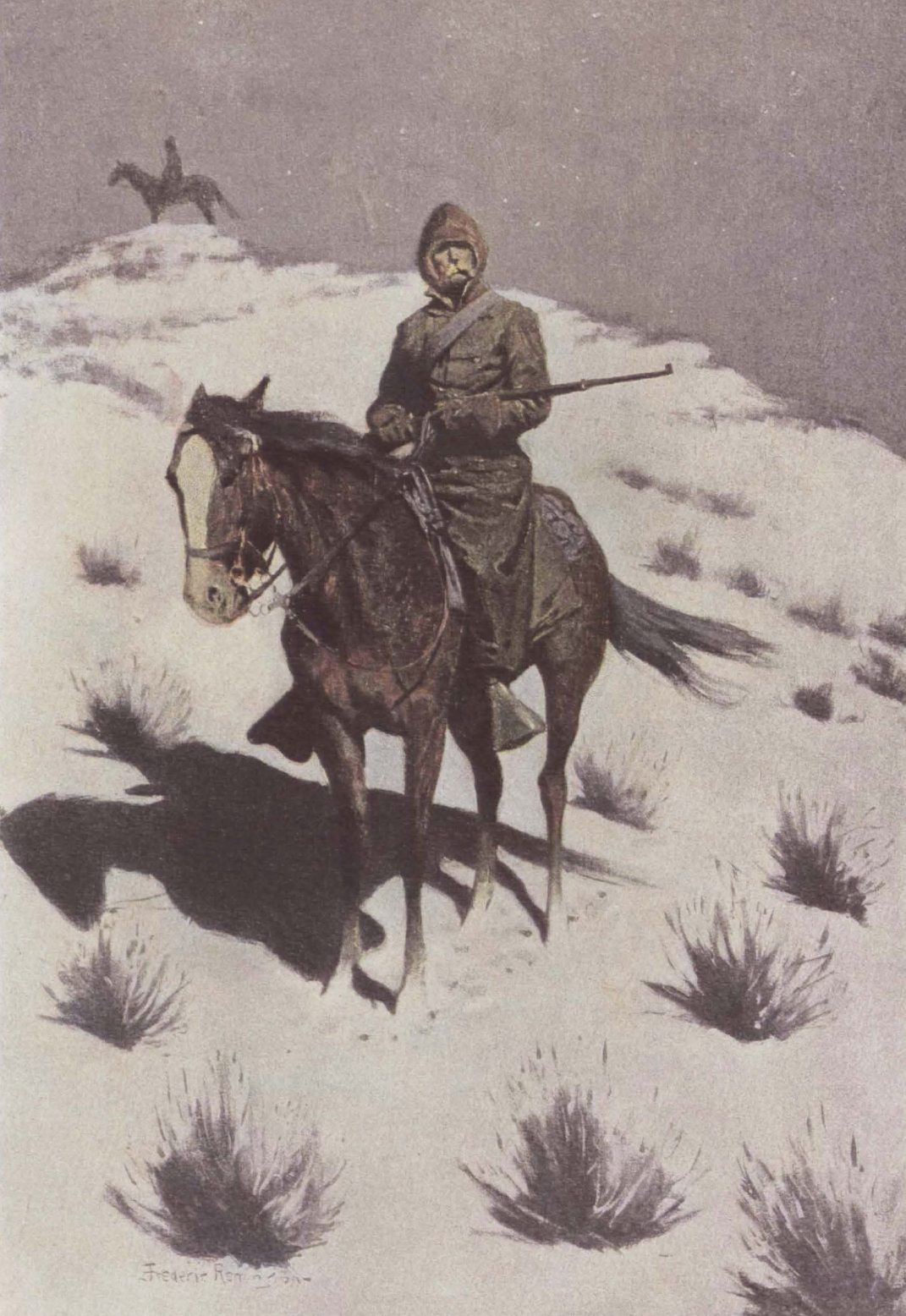
The claim under test is specific enough to measure: that the grade, and the colour, of First Cow (2020) were modelled on the body of Frederic Remington nocturnes shown as The Color of Night. This report does not test composition, subject or staging. It tests colour, one material at a time, and it tests the whole picture as well: is the night sky the same night sky, is the forest green the same forest green, is the snow the same snow.
Two corpora are compared. On one side, all 466 photographed midpoint frames of First Cow, measured by the pipeline this repository uses for every film it holds. On the other, 84 supplied reproductions of Remington paintings, put through the same code with the same thresholds. Ten of those 84 turn out to be second printings of a painting already in the set, which is a gift: the disagreement between two printings of one painting is the smallest difference this method can honestly resolve, and it is measured rather than assumed.
The answer is not one word. At the level of the whole picture the two do not meet: First Cow ranks 35th of 39 corpora for closeness to Remington's nocturnes on colour, about as far away as Remington's own daylight paintings are, and 23rd of 39 on eleven further axes that have nothing to do with hue. At the level of individual materials the picture splits. Where the light source is a fire, the two are indistinguishable. Where the light is the sky, they sit on opposite sides of neutral. The film's forest green is in Remington's green family and roughly twice as far from grey. And the film's snow cannot be compared with Remington's, because the film has none.
- Film corpus
- 466 photographed midpoint frames, 1436×1080 active picture, 8-bit WEB-DL read as gamma 2.4
- Plate corpus
- 84 supplied reproductions, 74 distinct works, 10 works held twice
- Control corpora
- 36 other films on the stills volume, 120 frames sampled from each
- Measurements
- 9 material questions in u′v′ chromaticity, plus 17 further axes of which 9 resolve above their own reproduction floor
Two corpora that cannot share a lightness scale
First Cow reaches this repository as an 8-bit distribution encode whose photographed frames average L* 7.28. The Remington plates reach it as screen grabs of printed reproductions of oil paintings, and average L* 42.5. Subtracting one from the other measures the difference between a digital cinema master and a book page. Nothing in this report does that.
Instead each picture is normalised by its own diffuse white — the mean linear luminance of its brightest half per cent is placed at 1.0 — which is the ordinary colourist's move of matching level before judging colour. A scalar gain in linear light leaves chromaticity exactly unchanged, so all colour statements are made in CIE 1976 u′v′, where that normalisation provably cannot have any effect at all. Two numbers describe a material: Δu′v′, how far its chromaticity sits from the D65 white point, and the direction it sits in.
Lightness statements are made separately, in the delivered encode, and are labelled as statements about the encode. Where a region of the film is described by so few code values that a hue measured from it would be a measurement of the compression rather than of the photography, the report says so and stops.
One assumption in that chain is worth pricing rather than merely declaring. The plates are decoded with gamma 2.4 so that they sit on the same footing as the film, and a screen grab is at least as likely to be sRGB. Unlike the exposure normalisation, which provably cannot move chromaticity, a different transfer does. Decoding all 84 plates both ways moves them by a median Δu′v′ of 0.00239 and at most 0.00969, with hue directions never more than 4.0 degrees apart — and every one of the 84 moves less than the reproduction floor of 0.01179. The choice of transfer is not what limits this report. The printing is.
- Mean chroma, plates
- C* 13.1160 nocturne plates, white-normalised
- Mean chroma, film
- C* 13.11466 frames, white-normalised
- Mean hue, plates
- 79°chroma-weighted CIELAB hue
- Mean hue, film
- 144°chroma-weighted CIELAB hue
- Transfer assumption
- Δu′v′ 0.00239median move from gamma 2.4 to sRGB; 100% of plates move less than the floor
Those four numbers are the report in miniature. Once both corpora are exposed to the same white they carry almost exactly the same quantity of colour — C* 13.11 against C* 13.11 — and they put it in completely different places: 79 degrees, a warm yellow-orange, against 144 degrees, a green.
What a second printing does to a painting
Ten of the 84 plates are second printings of a painting already in the set, found by structural matching and confirmed by eye. They are the report's instrument calibration. Sampling the same rectangle of the same painting in both printings gives a difference caused by nothing except ink, paper and scanner, and no difference smaller than that is reported below as a difference.
Across those pairs the same rectangle moves by Δu′v′ 0.00879 at the median and 0.01179 at the worst, with hue directions as much as 26.2 degrees apart. Whole plates move by Δu′v′ 0.00783 at the median. On the hue-spectrum measure used in the next section, two printings of one painting differ by 14.41 degrees at the median and 52.94 degrees at the worst.
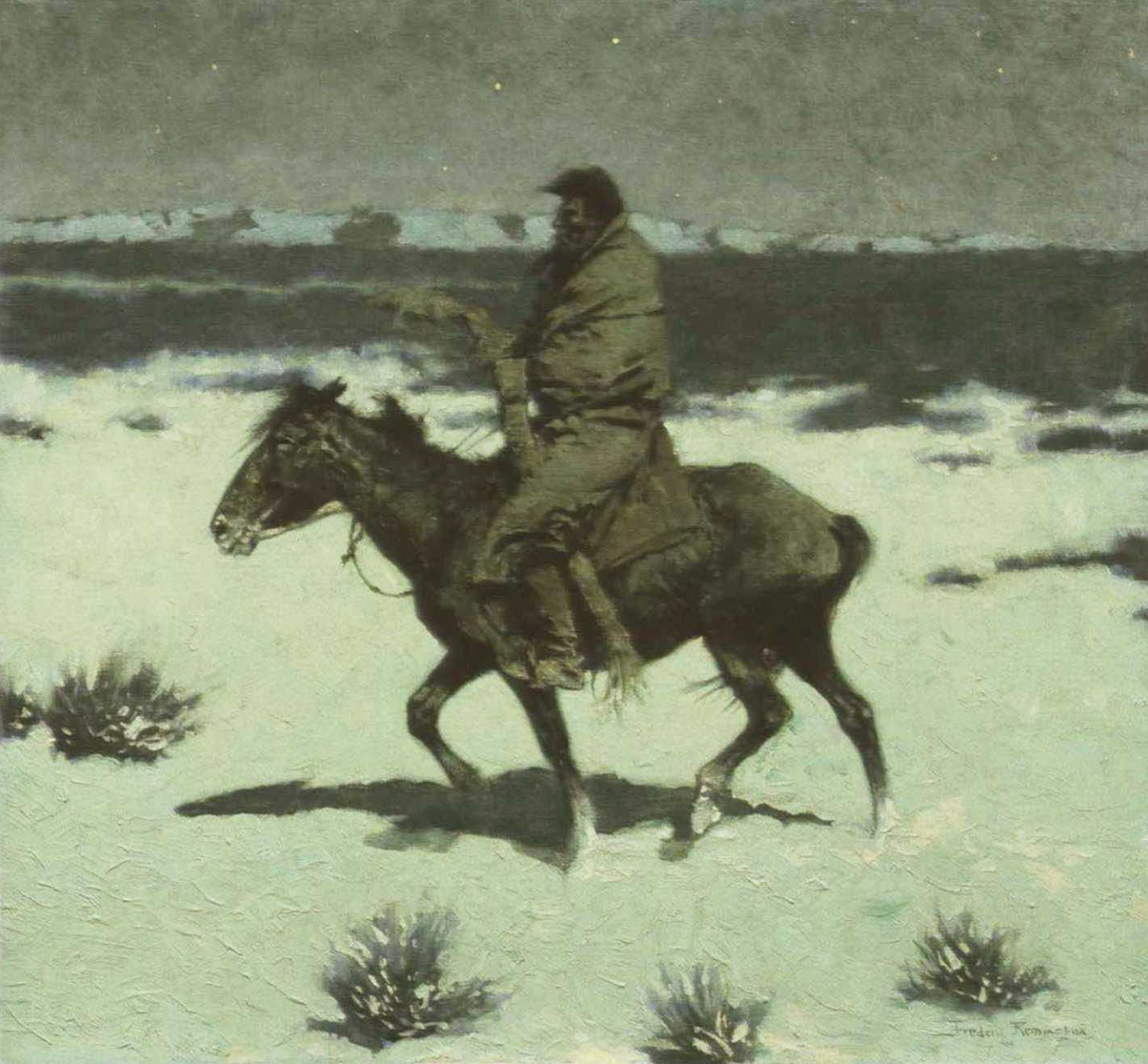
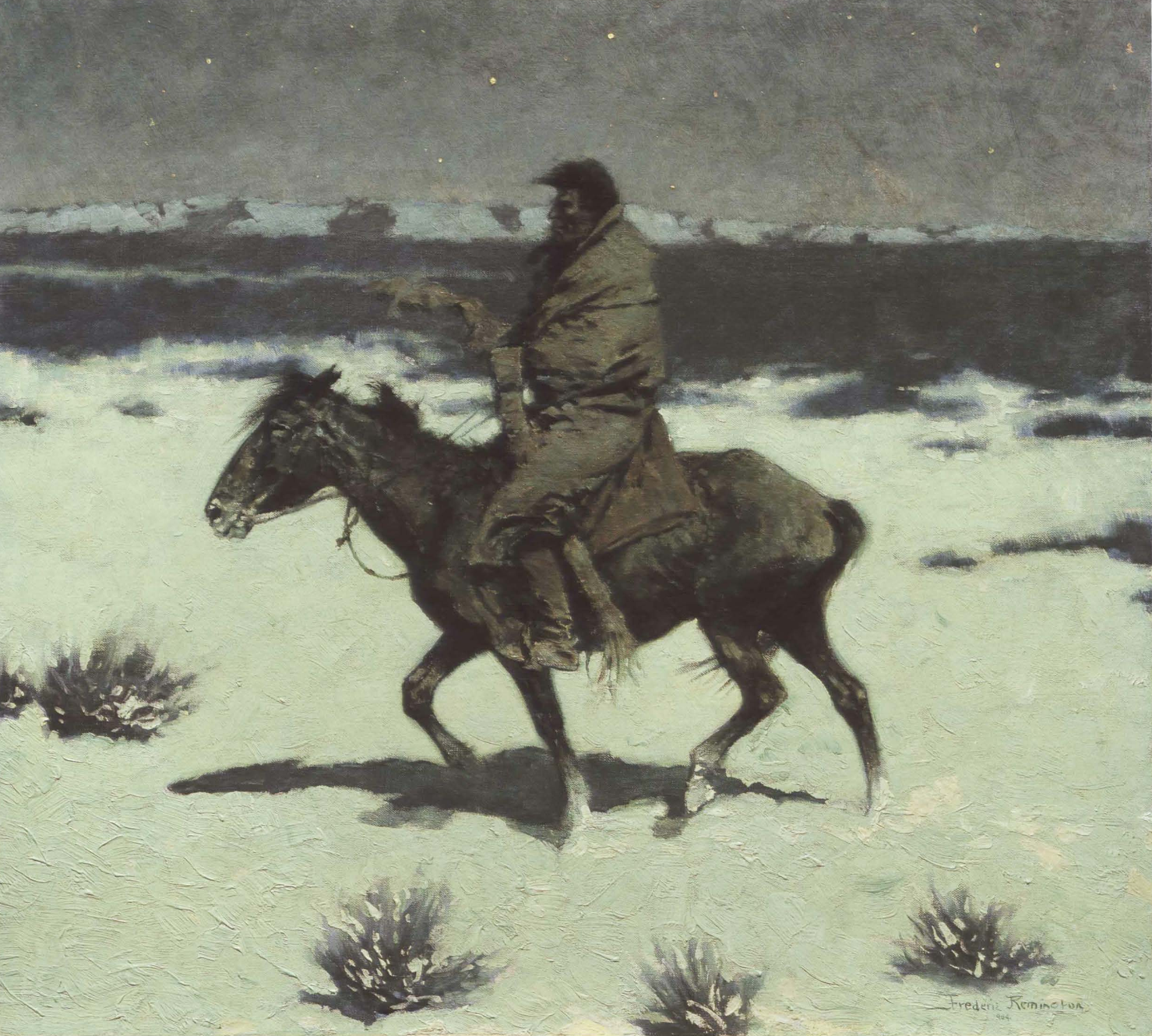
| Material sampled | Plates | Δu′v′ between printings | Hue direction apart | ΔL* after exposure match |
|---|---|---|---|---|
| Unlit timber | R63 / R12 | 0.0118 | 26.2° | -3.21 |
| Moonlit snow | R15 / R77 | 0.0069 | 6.0° | -0.34 |
| Night sky | R6 / R22 | 0.0106 | 6.9° | +5.18 |
| Campfire core | R18 / R47 | 0.0023 | 2.6° | +1.72 |
Each row is one painting held twice in the supplied plate set, sampled at the identical rectangle in both printings. Nothing about the painting changed between the two columns.
The campfire core is the steadiest thing in the set: two printings of the same fire agree to Δu′v′ 0.0023. The unlit timber is the least steady, at 0.0118. That ordering matters later, because the fire is also where the film and the paintings agree and the timber is where they part.
The whole picture: two spectra that do not meet
The first test ignores materials entirely. Every image is reduced to a chroma-weighted CIELAB hue spectrum — how much of its colour sits in each of 36 hue sectors, with near-neutral pixels dropped rather than allowed to vote with a rounding error. Two spectra are compared with the circular earth mover's distance, which reads as the average hue shift, in degrees, needed to turn one into the other.
On its own that number means nothing. It becomes a test only against controls, so the same spectrum was computed for 120 sampled frames from each of 36 other films on the stills volume, and for Remington's own daylight and twilight plates. Each distance is bootstrapped over images, and each is recomputed against a reference rebuilt from the other printing of every duplicated work.
- First Cow
- 34.5°rank 35 of 39
- Remington · daylight
- 33.3°rank 33 of 39
- Closest corpus
- 9.8°Gangubai Kathiawadi
- Jesse James
- 20.8°the western in this corpus, rank 18
| Hue band | Remington · nocturnes | First Cow |
|---|---|---|
| 0–60° · reds and oranges | 20.1% | 7.3% |
| 60–110° · yellows | 34.3% | 24.4% |
| 110–180° · greens | 22.4% | 34.1% |
| 180–250° · cyans and blues | 5.9% | 21.6% |
| 250–320° · blue-violets | 9.7% | 11.8% |
| 320–360° · magentas | 7.5% | 0.8% |
Highlighted rows are the two bands on which the corpora most nearly reverse: the greens and the cyans, where the film holds more of its colour and Remington holds least.
Two conclusions follow, and they point in opposite directions. The first is that First Cow's colour spectrum is not Remington's: the distance is 34.5 degrees against a bootstrap interval of 32.0 to 37.0, and 34 of the 38 other corpora measured are closer. Remington keeps more than half his chroma in the warm half of the wheel (54% below 110°) and almost none in the cyans (6%); the film reverses both (32% and 22%). The magentas are the sharpest single split: 7.5% of Remington's chroma against 0.8% of the film's.
The second conclusion is that closeness on this measure is not evidence of anything, because the corpus that wins it is Gangubai Kathiawadi. A film can share a hue spectrum with Remington by having a lot of lamplight and a lot of blue-grey, which is most of cinema.
That is why the rest of this report stops comparing whole pictures and starts comparing materials.
The measurements that are not colour
Everything above this point is hue and chroma. That is a narrower report than it looks: the eleven per-image numbers behind it have a participation-ratio dimensionality of 5.6 across 4,870 images, and the argument they carry reduces to four families — hue, chroma, lightness, and whether a material is present at all. Ten materials times two colour numbers reads as twenty measurements and is two.
So seventeen further axes were measured on every image in every corpus, chosen to be as nearly independent of each other as a picture allows and either scale-free or expressed against the picture's own diffuse white. Eleven describe tone architecture, how concentrated the light and the colour are, and how warmth and lightness are coupled. Three describe where the light sits in the frame. Three describe surface texture and are reported as a control rather than as evidence, because a painting is printed, scanned and screen-grabbed before it reaches this measurement and a film frame is sampled and compressed, and the two have no shared physical scale.
Each axis carries its own reproduction floor, computed from the same ten duplicated works, because a picture's key and its lit-region count are not equally robust to being printed twice. That floor disqualifies more than it confirms: 9 of the 17 axes put First Cow further from the nocturne median than two printings of one painting are from each other. On the other eight, including two of the three this section was built to test, reproduction noise is larger than the difference and the honest answer is that there is nothing to report.
- Axes that resolve
- 9 of 17gap larger than that axis's own reproduction floor
- Combined distance
- 6.02over 11 robust axes, rank 23/39
- Combined floor
- 3.987 corpora fall inside it
- Closest film
- 2.02Portrait of a Lady on Fire
| Axis | Kind | Remington | First Cow | Gap ÷ floor | Rank |
|---|---|---|---|---|---|
| Light concentration | Robust | 0.467 | 0.689 | 5.0× | 22/39 |
| Dynamic range | Robust | 0.742 | 0.910 | 3.6× | 7/39 |
| Key | Robust | 0.445 | 0.196 | 3.3× | 27/39 |
| Chromaticity entropy | Robust | 2.325 | 4.064 | 1.9× | 30/39 |
| Tonal separability | Robust | 0.777 | 0.692 | 1.8× | 39/39 |
| Lightness skew | Robust | 0.566 | 1.265 | 1.7× | 30/39 |
| Largest lit region | Robust | 0.380 | 0.062 | 1.0× | 36/39 |
| Chroma concentration | Robust | 0.290 | 0.378 | below floor | 14/39 |
| Warm–bright coupling | Robust | -0.094 | 0.256 | below floor | 33/39 |
| Illuminant bimodality | Robust | 0.166 | 0.304 | below floor | 30/39 |
| Lit region count | Robust | 9.000 | 10.000 | below floor | 9/39 |
| Vertical gradient | Layout | -0.235 | 0.074 | 10.2× | 28/39 |
| Centre–edge lightness | Layout | -0.038 | 0.020 | 3.9× | 16/39 |
| Centre–edge chroma | Layout | -0.004 | 0.001 | below floor | 3/39 |
| Spectral slope | Medium | -2.789 | -2.599 | below floor | 6/39 |
| Local contrast | Medium | 0.068 | 0.064 | below floor | 5/39 |
| Gradient energy | Medium | 0.192 | 0.190 | below floor | 1/39 |
Highlighted rows clear their own reproduction floor. “Below floor” means the difference between the film and the nocturnes is smaller than the difference between two printings of one painting, so nothing is claimed for that axis. Rank 1 is the corpus closest to the nocturnes. Robust axes should mean the same in either medium and carry the argument; layout axes describe where the light sits in the frame; medium axes are dominated by the reproduction chain and are reported as a control rather than as evidence.
What the structure says
- Vertical gradient is the best-resolved axis in the set at 10 times its floor: Remington's pictures are brighter at the bottom (-0.23), the film's at the top (+0.07). Snow under a dark sky against sky over a dark wood.
- The film's light is far more concentrated — luminance Gini 0.69 against 0.47, five times the floor — and its largest lit region covers 6% of the picture against his 38%.
- It sits at less than half his relative key (0.20 of its own white against 0.45) while using more of its own range (0.91 against 0.74).
- Its chromaticity entropy is 4.06 bits against his 2.33: the film holds more distinct colours than the paintings do, which no amount of hue-spectrum measuring was going to show.
What could not be measured
- Three axes put all 39 corpora inside their own reproduction floor: lit-region count, warm–bright coupling, illuminant bimodality. They cannot distinguish any corpus from the nocturnes, so they answer nothing about this film in particular.
- Two of those three were the axes built to test “one warm event in a cool field”. Whether warmth rises with light, and whether a picture is lit by one source or two, do not survive being printed and scanned.
- Chroma concentration is not dead — 29 of 39 corpora sit inside its floor — but First Cow is one of them, so the film and the plates cannot be separated on how unequally they distribute colour. They can be separated on how unequally they distribute light: only one corpus of 39 is inside the floor there.
- Largest lit region is the weakest of the resolved findings: the film clears its floor by three per cent, and 34 of 39 corpora do not clear it at all.
The texture control failed, and that is a result
- Spectral slope: Remington -2.79, First Cow -2.60 — a gap of 0.57 spreads against a floor of 2.11.
- On gradient energy the film ranks 1 of 39 — the closest corpus of all to the nocturnes, at three hundredths of a spread.
- These three axes were included to prove the method could separate a painted surface from a photographed one. It cannot: at native sampling these reproductions and these frames have indistinguishable texture statistics, and two printings of one painting differ more than the media do.
- Sensitivity is instead demonstrated by the robust axes themselves, five of which put the film more than three floors from the nocturne median.
Structure against colour
- Combined over the eleven robust axes, First Cow is 23rd of 39 at 6.02 reference spreads.
- Seven corpora fall inside the combined floor of 3.98, including Remington's own daylight and twilight plates. The closest film is Portrait of a Lady on Fire.
- On colour the film ranked 35th of 39. On structure it ranks 23rd. It is more Remington-like in how it is built than in what colour it is — and distinctive on neither.
- The two rankings disagreeing is itself the point: a single measure would have hidden it.
One result here contradicts something written earlier in this report. The claim that both bodies of work “organise a frame as a small bright thing against a large dark one” survives only in half. Both do: tonal separability is 0.78 for the plates and 0.69 for the film, and both are high. But the film is 39th of 39 on that axis — the least cleanly split corpus measured — and its bright thing is a sixth the size of his. They share the architecture and disagree about its proportions.
Question 1 of 9
Is the night sky the same night sky?
Encode-limited
Remington's night skies are the most varied material in the plate set. Sampled in two of them, one measures Δu′v′ 0.0085 from D65 — almost a neutral grey, with only a faint blue-violet lean — and the other 0.0479, a definite deep blue. Between two paintings the same material is five times more coloured in one than the other, and both readings are far above the reproduction floor, so that spread is Remington's, not the printer's.
First Cow has one clear open night sky in its 466 photographed frames: a star field above a treeline, shot 307. Measured, it returns Δu′v′ 0.2552 at a direction of 263 degrees — an enormous, deep blue. That number is not a fact about the film. The region's mean 8-bit code value is 5.9 out of 255, and the whole patch is described by 45 distinct levels. At that level the encode's own quantisation is larger than the colour being measured, and dividing by the frame's very small diffuse white multiplies the error along with the signal.
What can be said is narrower and still worth saying. The direction of the film's night sky, 263 degrees, falls between the two Remington skies measured here, at 252 and 285 degrees. Both media put their night sky in the blue-violet quadrant, which is the least surprising agreement in this report — it is where night skies go. Whether the film's is as deep as Remington's deepest, or as nearly neutral as his palest, cannot be settled from an 8-bit distribution encode. It would take the master.
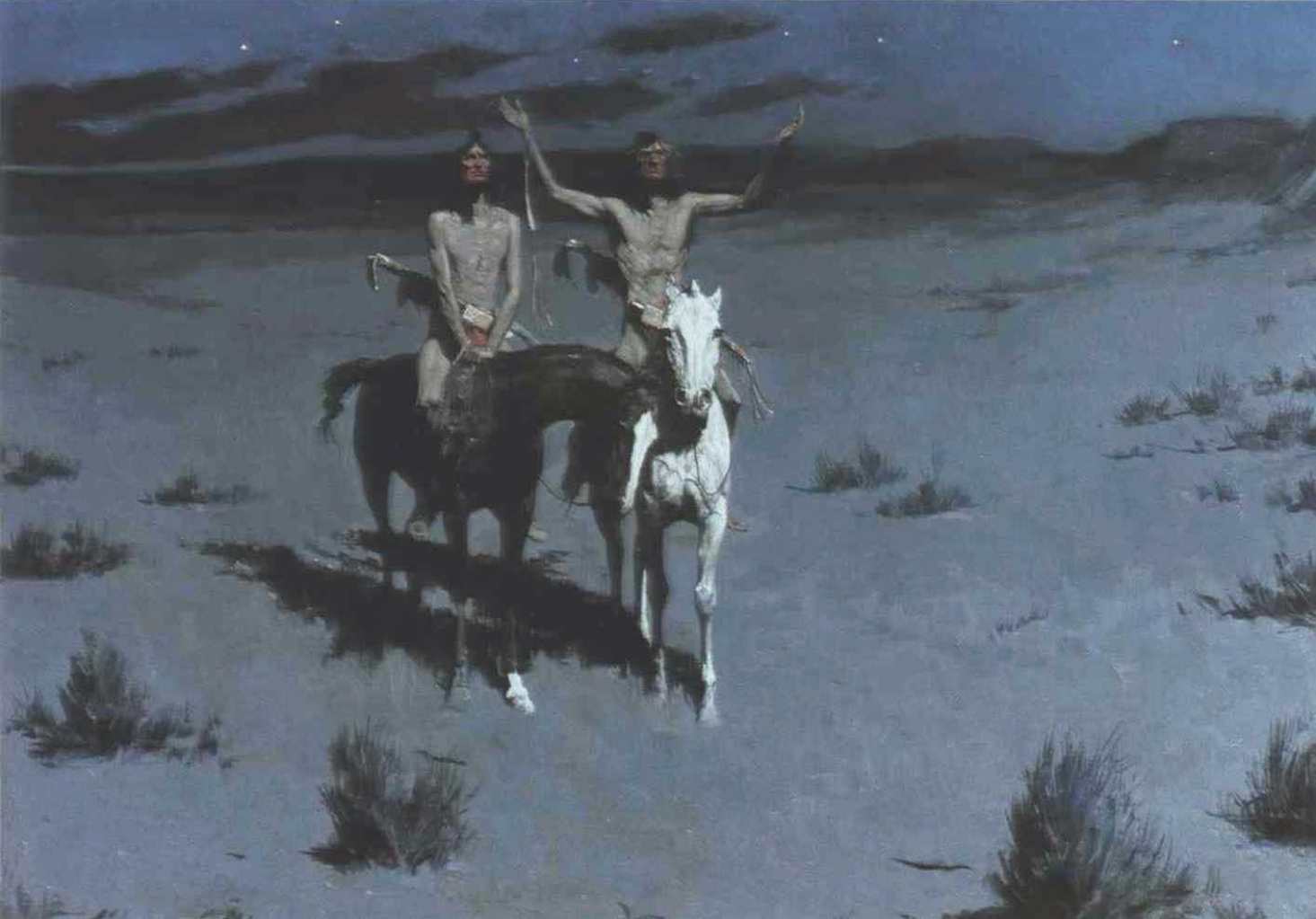
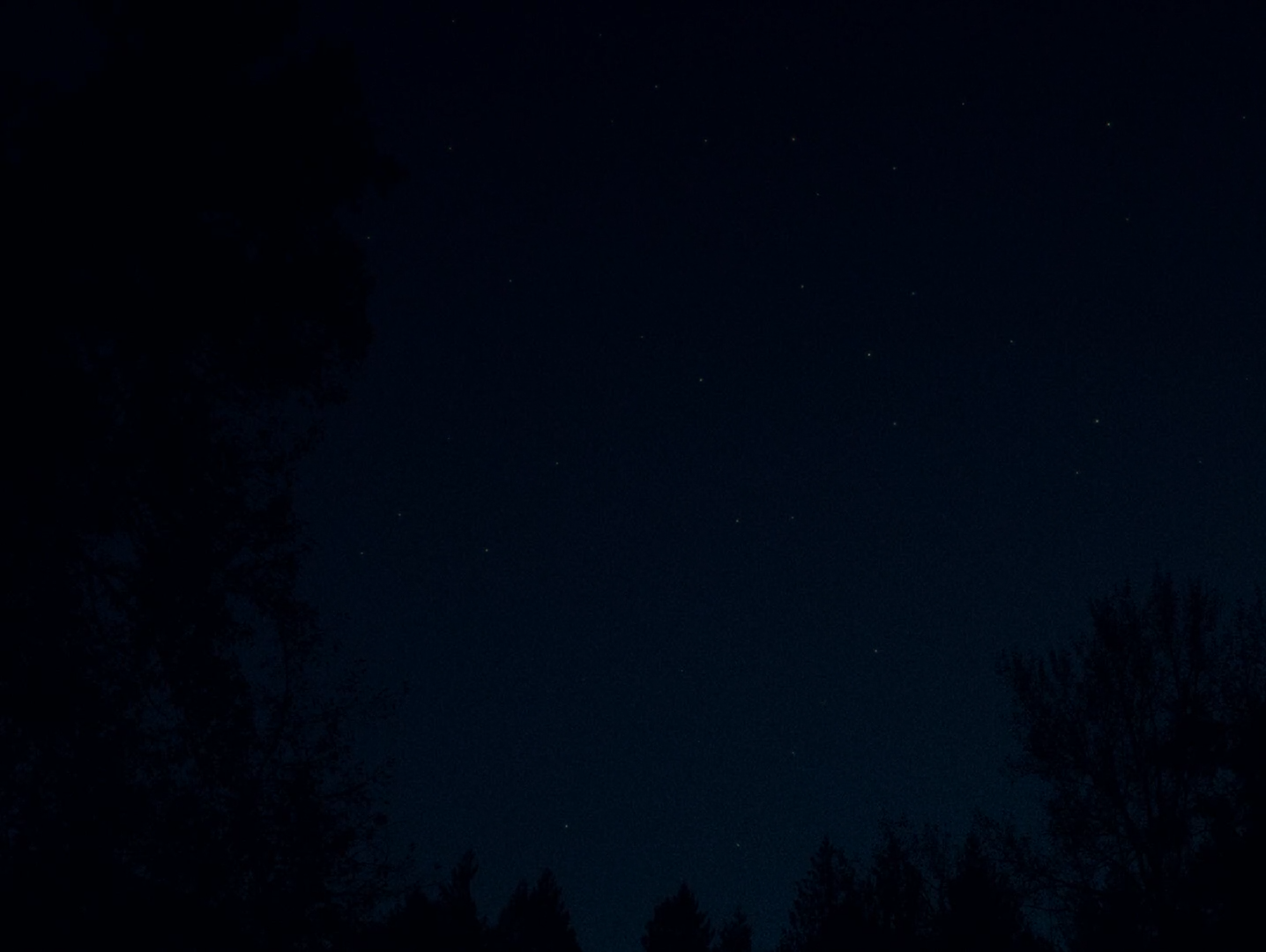
- Remington R7
- Δu′v′ 0.0479direction 252°, ample levels
- Remington R41
- Δu′v′ 0.0085direction 285°, ample levels
- First Cow 307
- Δu′v′ 0.2552direction 263°, quantisation-limited
- Sky detections in the film
- 58 of 46625 with enough levels to measure a hue
Question 2 of 9
Is the daylight sky the same daylight sky?
Opposite sides of neutral
Both bodies of work spend a great deal of time under flat cloud, and both keep that cloud close to grey. The difference is which way each of them leans off grey, and the answer is: opposite ways.
Remington's overcast, sampled above the snow slope, sits Δu′v′ 0.0134 from D65 at a direction of 16 degrees — a warm, faintly pink-grey. First Cow's overcast sits at 0.0127 and 0.0249 in the two frames sampled, at directions of 187 and 213 degrees. The magnitudes are almost identical; the directions are 171 and 162 degrees apart, which is as close to exactly opposite as two directions get.
The separation between them, Δu′v′ 0.026 and 0.038, is two and three times the reproduction floor, so this is a real difference and not an artefact of printing. Corpus-wide the same thing shows up: across Remington's nocturne plates the sky band's mean direction is 6 degrees, warm; across the film it is 167 degrees, cyan. The film's sky is not a desaturated version of Remington's sky. It is the other side of the wheel.
The control run is unusually clean here: not one of the 39 corpora measured falls inside the reproduction floor of Remington's nocturne sky, including his own daylight plates, which sit 0.0240 away. His skies are too varied for a corpus median to be close to anything. First Cow ranks 22nd of 39, at Δu′v′ 0.0473. The claim defended here is the direction, not the rank: whatever else is true of Remington's skies, they do not lean cyan, and the film's do.
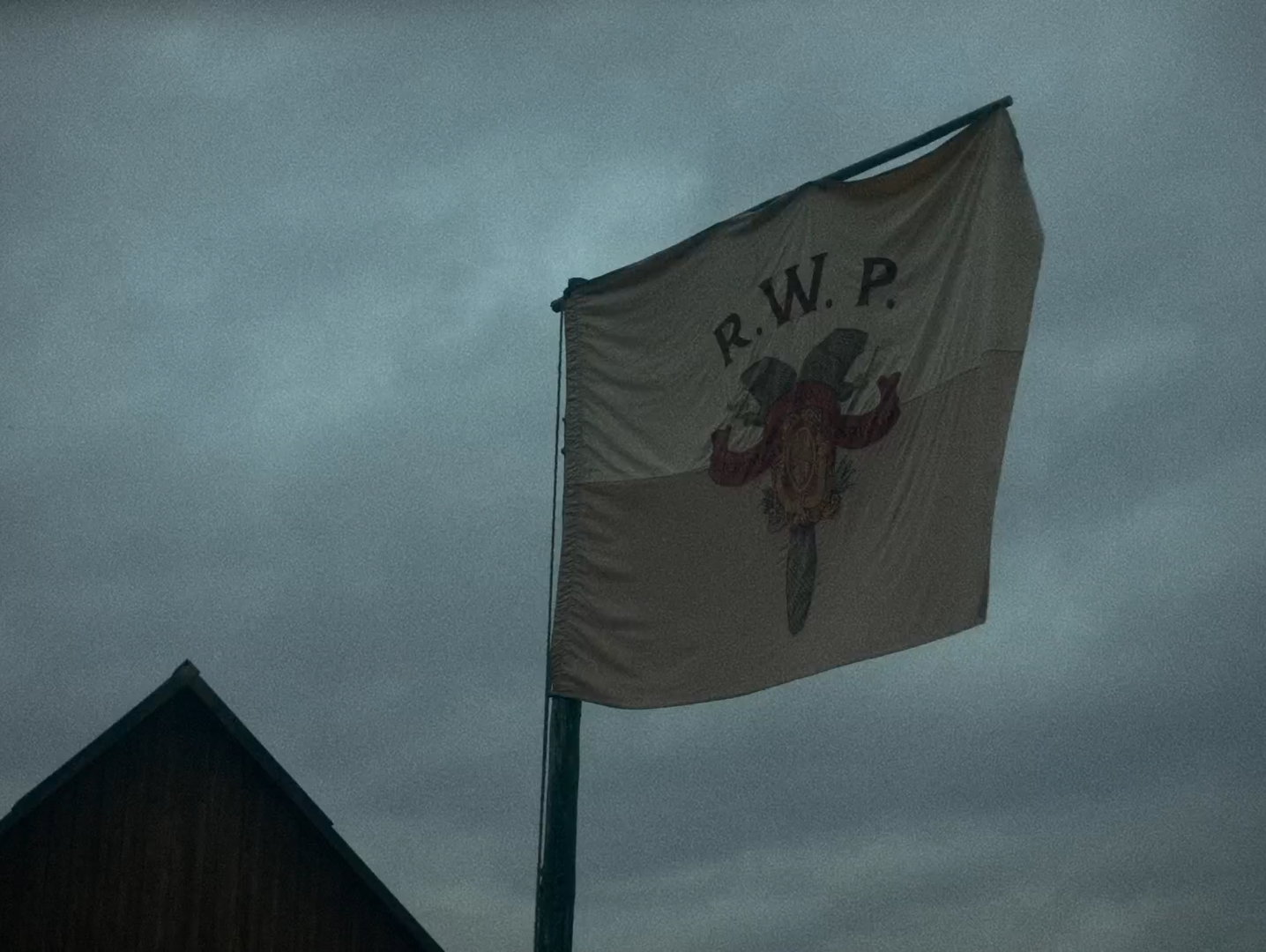
- R25 vs shot 92
- Δu′v′ 0.0260171° apart · resolved difference
- R25 vs shot 251
- Δu′v′ 0.0378162° apart · resolved difference
- Plate sky direction
- 6°mean over 35 nocturne plates
- Film sky direction
- 167°mean over 25 usable detections
| Rank | Corpus | Images with the material | Δu′v′ from the nocturne median | Direction apart |
|---|---|---|---|---|
| 1 | Drive | 11 | 0.0170 | 19.5° |
| 2 | Oppenheimer | 10 | 0.0181 | 56.8° |
| 3 | Zatoichi | 11 | 0.0212 | 16.2° |
| 4 | Remington · daylight | 12 | 0.0240 | 62.5° |
| 5 | 1917 | 18 | 0.0249 | 83.0° |
| 6 | Gangubai Kathiawadi | 11 | 0.0274 | 71.2° |
| 22 | First Cow | 25 | 0.0473 | 161.1° |
Highlighted row is First Cow. Rank 1 is the corpus whose median for this material sits closest to the Remington nocturnes; a corpus inside the reproduction floor is not distinguishable from them at all.
Question 3 of 9
Is the unlit forest green the same forest green?
Same family, further from grey
This is the material the film is made of and the one Remington uses least: the dark green-to-cyan rule finds a qualifying mass in 88% of First Cow's frames and in 12% of the nocturne plates. Remington's nocturnes are open country; First Cow is inside a wood for most of its length. Any comparison here is between a corpus staple and a corpus exception.
Where both have it, the direction is broadly shared and the amount is not. Remington's unlit timber measures Δu′v′ 0.0239 and 0.0163 in the two printings of one painting; the film's fern and moss measure 0.0399 and 0.0667 in the two frames sampled. Across the corpora the same gap holds: the plate median is 0.0181 against the film's 0.0307. First Cow's unlit green is roughly 1.7 times further from grey than Remington's.
The directions differ too, and by more than the floor: 101 degrees across the plates against 136 degrees across the film. Remington's dark green leans toward yellow; the film's leans toward cyan. Of the seven other films checked here that have enough dark green to measure, First Cow's is the most cyan of all, which is a point about this grade rather than about forests.
Against controls the film's green is not especially Remington-like either. Measured the same way, First Cow is 23rd of 38 corpora for closeness to Remington's unlit green, outside the reproduction floor, while 9 corpora sit inside it — Point Blank, Gangubai Kathiawadi, Leviathan, 1917 and Let the Right One In among them. The film's forest is further from Remington's than most films' shadows are, and it is further in a specific direction: toward cyan, and away from grey.
The honest qualifier is large. This exact rectangle is the least stable in the whole reproduction control: the two printings of the same Remington painting disagree by Δu′v′ 0.0118 and 26 degrees of direction, which is about three quarters of the corpus-level hue gap between the plates and the film. The corpus medians are built from many images and are therefore steadier than any single pair, but a reader who wants to see this difference in one painting and one frame will be looking at something a printer could have caused.
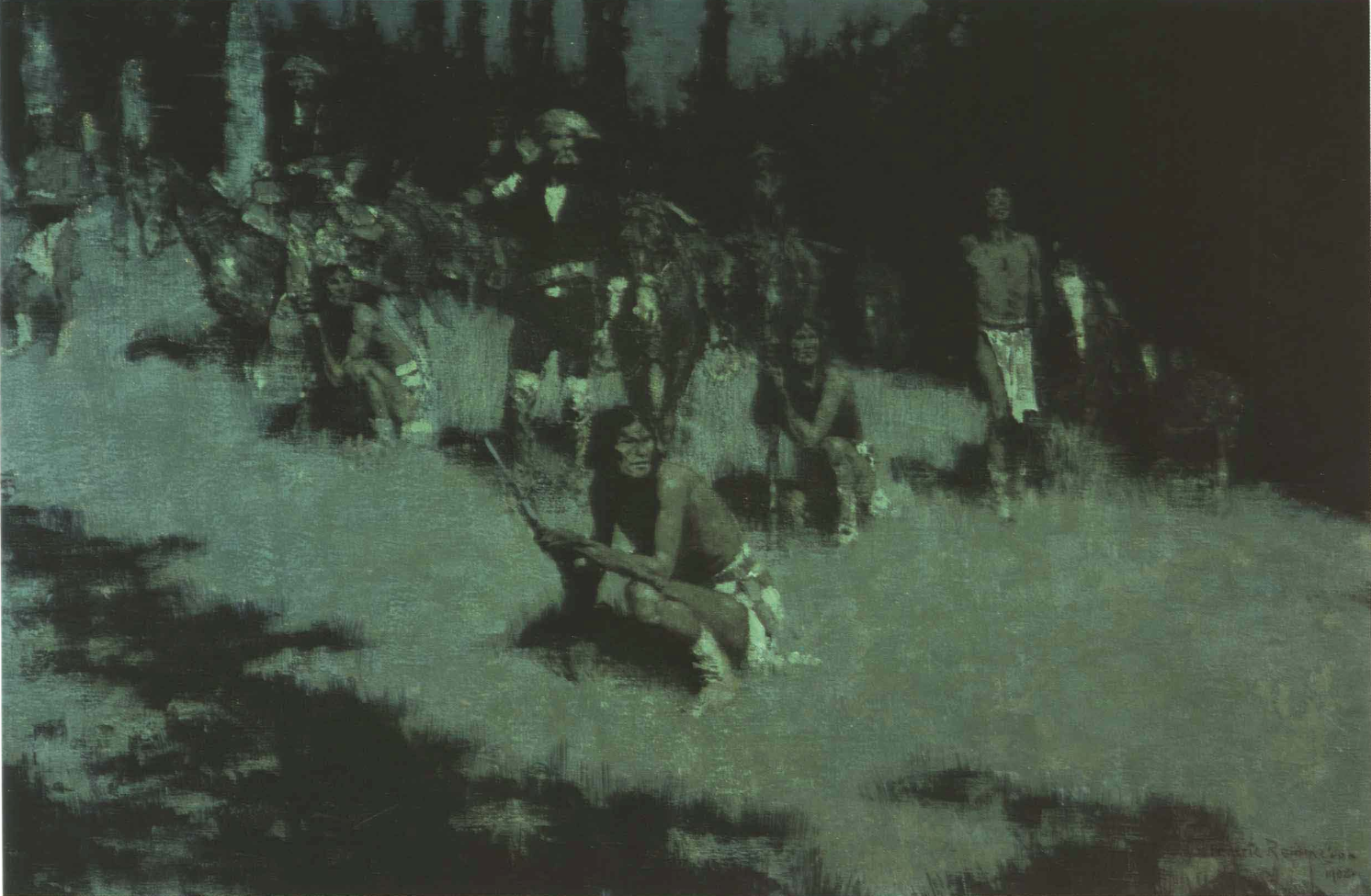
- Shot 18 vs R63
- Δu′v′ 0.019621° apart · resolved
- Shot 18 vs R12
- Δu′v′ 0.031347° apart · resolved
- Plate corpus median
- Δu′v′ 0.01817 plates, direction 101°
- Film corpus median
- Δu′v′ 0.0307297 frames, direction 136°
| Rank | Corpus | Images with the material | Δu′v′ from the nocturne median | Direction apart |
|---|---|---|---|---|
| 1 | Point Blank | 39 | 0.0069 | 2.2° |
| 2 | Gangubai Kathiawadi | 68 | 0.0070 | 5.5° |
| 3 | Leviathan | 37 | 0.0070 | 12.6° |
| 4 | 1917 | 72 | 0.0086 | 1.3° |
| 5 | Let the Right One In | 84 | 0.0097 | 11.1° |
| 6 | Drive My Car | 54 | 0.0108 | 32.7° |
| 23 | First Cow | 297 | 0.0188 | 34.3° |
Highlighted row is First Cow. Rank 1 is the corpus whose median for this material sits closest to the Remington nocturnes; a corpus inside the reproduction floor is not distinguishable from them at all.
Question 4 of 9
Is the snow the same snow?
No counterpart in the film
There is no snow in First Cow. All 466 photographed frames were reviewed at thumbnail size and none contains any. The film is set in the Oregon wet season and its weather is rain, river mist and mud. Snow is Remington's single most distinctive material — it appears in roughly a third of the plate set and it is what most of his best-known nocturnes are made of — and the film simply does not have it. That asymmetry is the largest single fact in this report and no measurement can repair it.
What can be done is a substitution test, stated as such. If the question is what happens to the picture's largest pale, low-chroma field — the material that sets the ceiling and carries the light — then Remington's is snow and First Cow's is overcast sky and the river under it. Both were sampled and compared, not as the same material, but as the same job in the composition.
They land in almost the same place. Remington's sunlit snow measures Δu′v′ 0.0114 from D65 and his moonlit snow 0.0155; First Cow's overcast sky measures 0.0127 and 0.0249. The separation between the film's fort sky and Remington's sunlit snow is Δu′v′ 0.0082, and against his moonlit snow 0.0053 — both below the reproduction floor of 0.01179. On the chromaticity plane, this film's pale field and this painter's snow are indistinguishable at the resolution this method has.
The corpus-wide version agrees. The bright low-chroma field rule finds a qualifying field in 38% of the nocturne plates at a median Δu′v′ of 0.0186, and in 23% of the film's frames at 0.0166. The directions are 112 and 136 degrees, which is inside the floor as well.
That agreement is real and it is not distinctive. On the same measurement across every corpus here, First Cow is 15th of 39 for closeness to Remington's large pale field, and 21 corpora fall inside the reproduction floor. The closest of all is The Assassination of Jesse James by the Coward Robert Ford, at Δu′v′ 0.0011 — which is what one would expect from a film with real snow in it, and is the clearest illustration in this report of how little a single material agreement proves.
The lightness is a different story and cannot be compared honestly. Remington's snow reaches a median L* of 82 after exposure matching; the film's pale field reaches 57. In the delivered encode the gap is far wider still, 62 against 22. A painted snow field is the brightest thing in its picture by a long way, and First Cow's brightest thing is not.
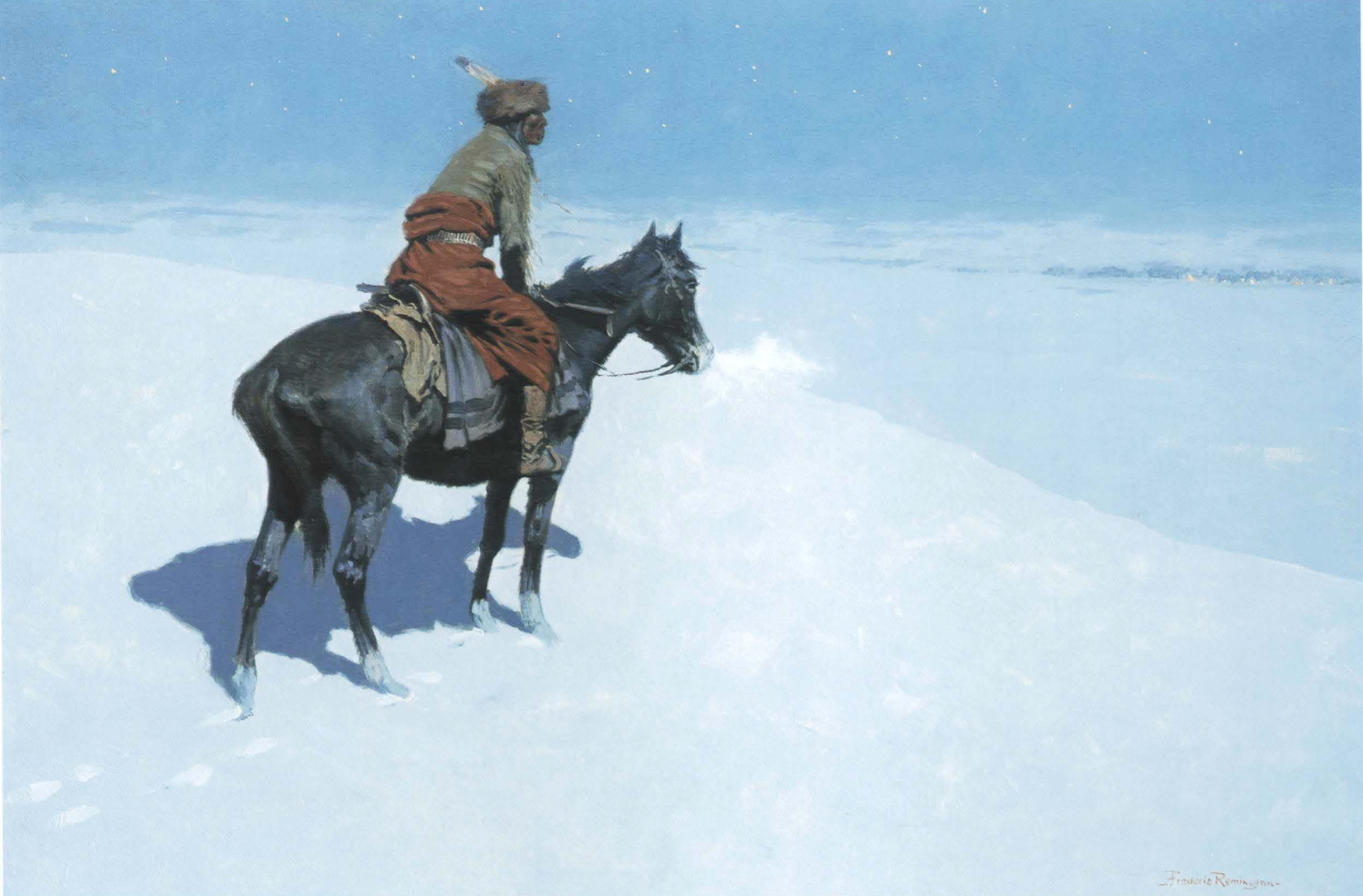
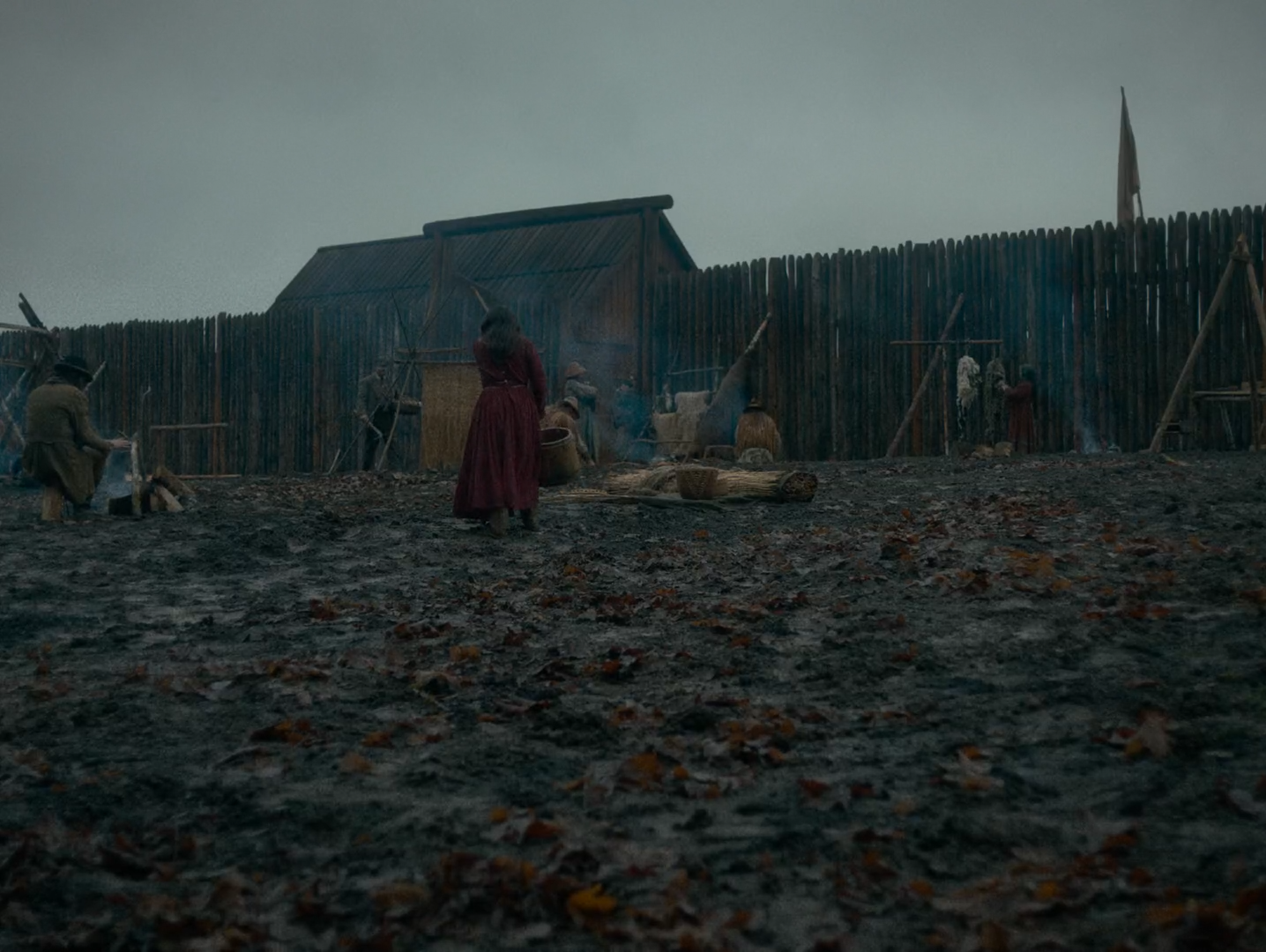
- Shot 92 vs sunlit snow
- Δu′v′ 0.0082indistinguishable at this resolution
- Shot 92 vs moonlit snow
- Δu′v′ 0.0053indistinguishable at this resolution
- Snow in the plate set
- 38%of nocturne plates carry a large pale field
- Snow in the film
- none0 of 466 photographed frames
| Rank | Corpus | Images with the material | Δu′v′ from the nocturne median | Direction apart |
|---|---|---|---|---|
| 1 | The Assassination of Jesse James by the Coward Robert Ford | 39 | 0.0011 | 3.1° |
| 2 | No Country for Old Men | 22 | 0.0017 | 5.2° |
| 3 | Sicario | 24 | 0.0019 | 3.6° |
| 4 | The Toxic Avenger | 9 | 0.0026 | 6.7° |
| 5 | Gangubai Kathiawadi | 47 | 0.0029 | 8.8° |
| 6 | A Short Film About Killing | 9 | 0.0036 | 9.4° |
| 15 | First Cow | 104 | 0.0077 | 24.5° |
Highlighted row is First Cow. Rank 1 is the corpus whose median for this material sits closest to the Remington nocturnes; a corpus inside the reproduction floor is not distinguishable from them at all.
Question 5 of 9
Is the firelight the same firelight?
Indistinguishable
This is the one place where the answer is yes, and it is the strongest agreement anywhere in the report.
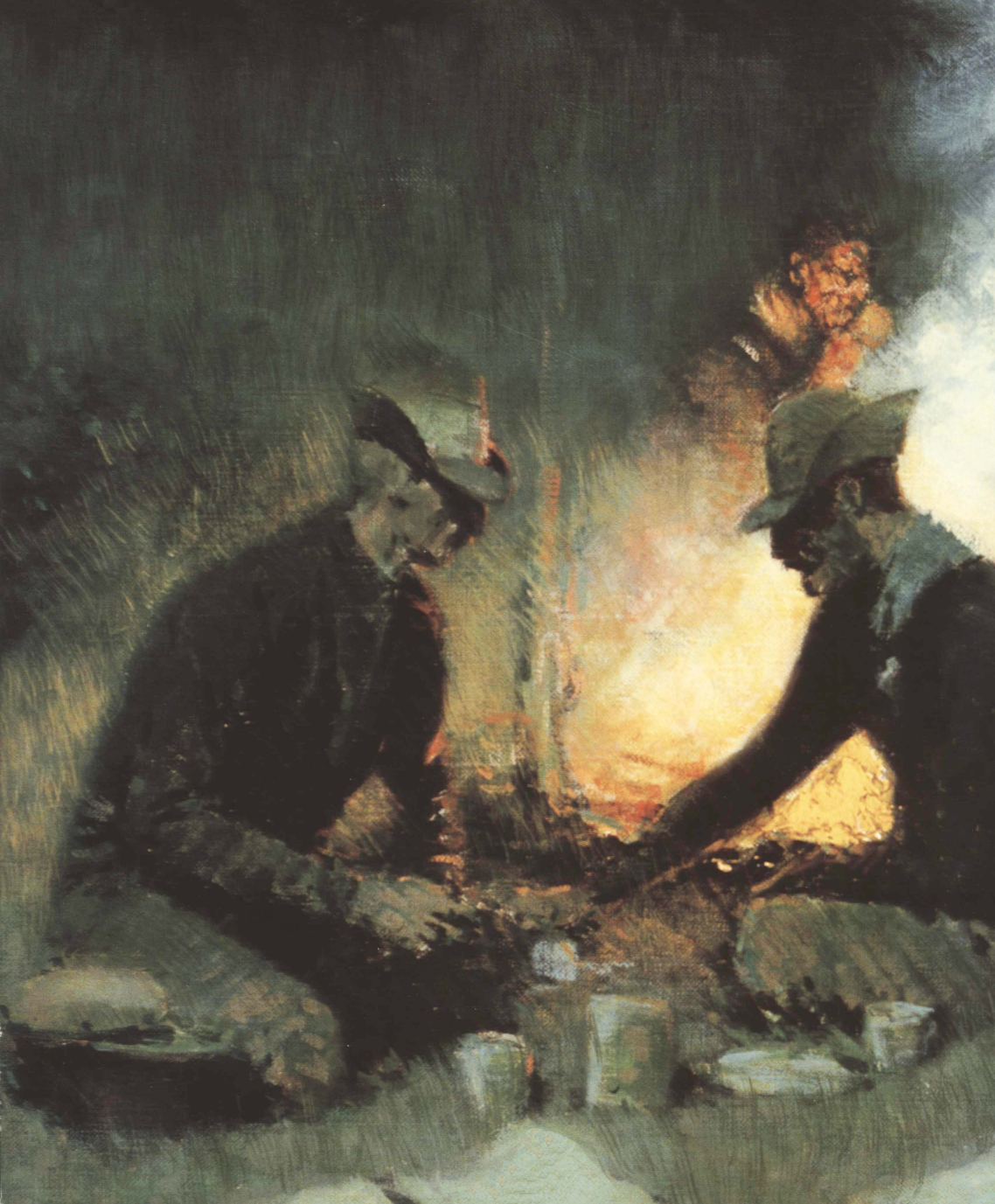
The warm-light-core rule — the picture's own brightest, strongly warm pixels — was applied unchanged to both corpora, so the flame in a painting and the flame in a frame are selected by the same definition rather than by hand. Remington's campfire core measures Δu′v′ 0.0472 from D65 at a direction of 47 degrees; his second campfire 0.0583 at 44 degrees; First Cow's candle 0.0454 at 38 degrees. The separation between the film's flame and the nearer plate is Δu′v′ 0.0074 with 9 degrees of direction between them — inside the 0.01179 floor. Against the second plate it is 0.0140, marginally outside it.
Corpus-wide the same result holds and is better supported: 10 plates and 168 frames carry a qualifying core, at median Δu′v′ 0.0512 against 0.0449, in directions 45° against 38°. Both differences are inside the floor.
The conclusion needs care, because it cuts both ways. It is a real agreement: a painted campfire and a photographed candle put their hottest colour in the same place, which is not guaranteed — a grade that warmed its flames, or a painter who pushed them red, would show here immediately, and neither did. But it is also the least distinctive agreement available. Running the same measurement on every corpus in this repository puts First Cow 6th of 38 for closeness to Remington's flame colour, with 8 corpora inside the reproduction floor. Another Round, O Brother, Where Art Thou? and Portrait of a Lady on Fire are all closer. Fire is a black-body radiator, and everyone who photographs or paints one honestly lands in the same small region of the plane.
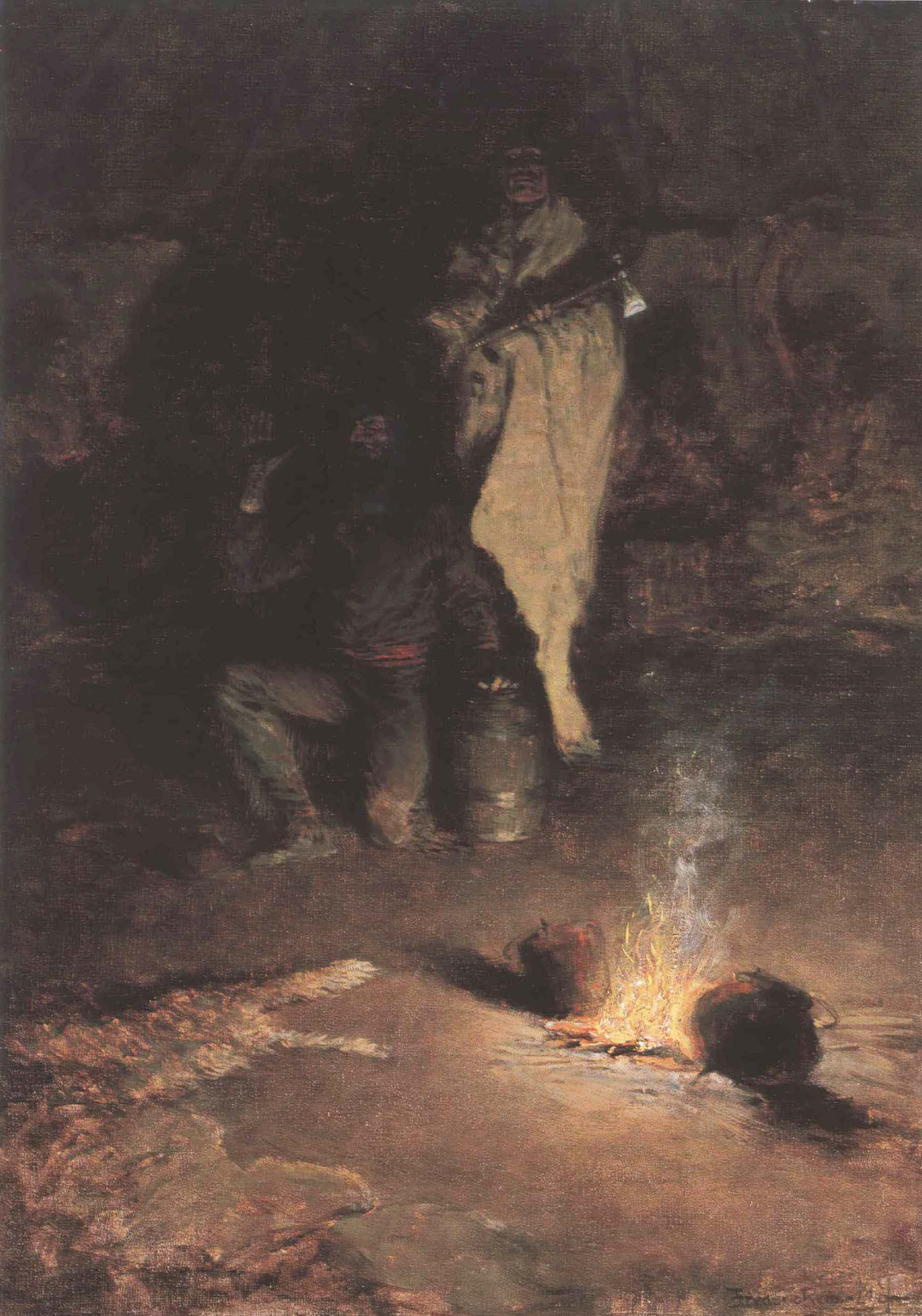
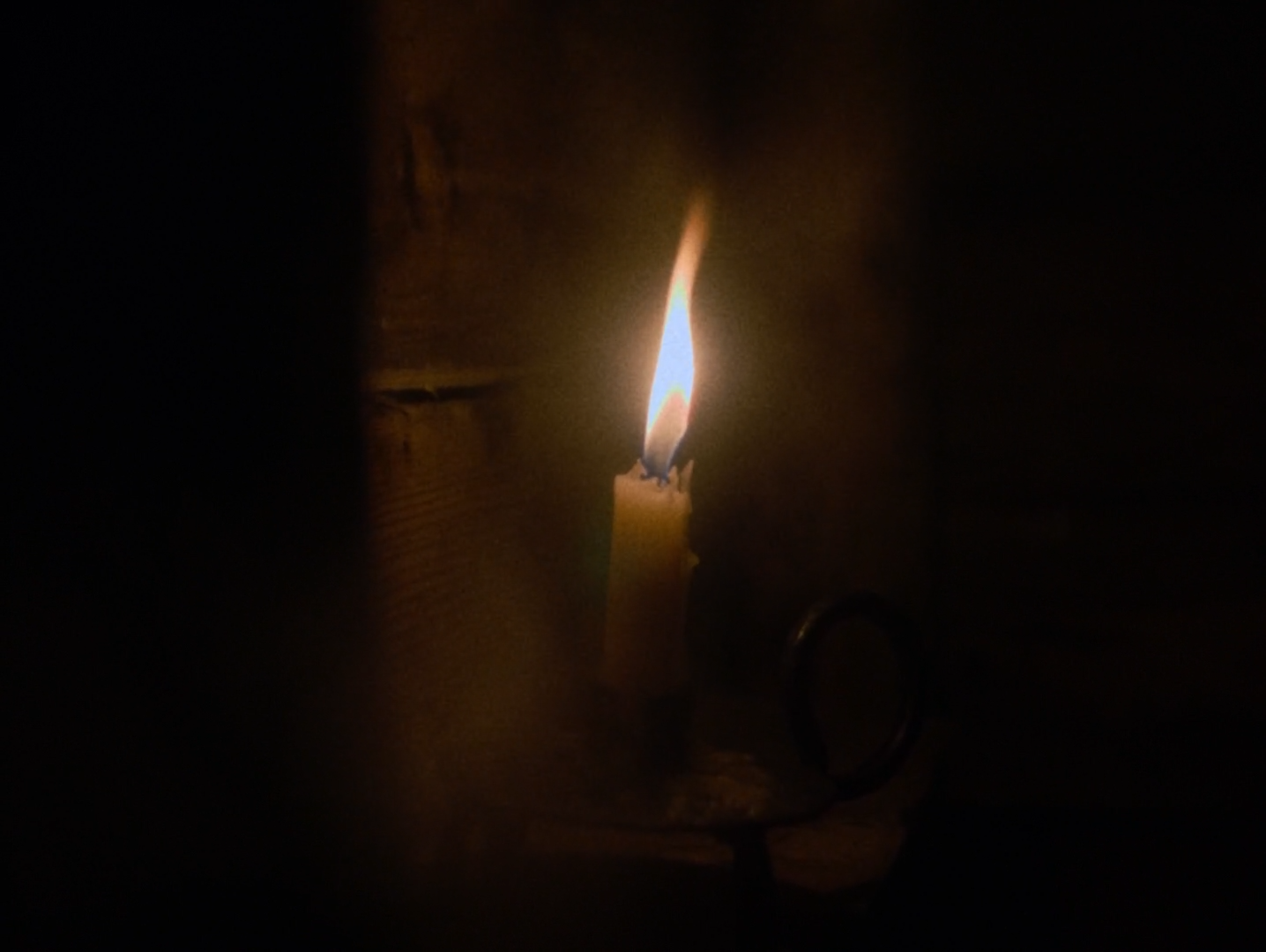
- Candle vs R47
- Δu′v′ 0.00749° apart · indistinguishable at this resolution
- Candle vs R62
- Δu′v′ 0.01406° apart · resolved difference
- Plate corpus median
- Δu′v′ 0.0512direction 45°
- Film corpus median
- Δu′v′ 0.0449direction 38°
| Rank | Corpus | Images with the material | Δu′v′ from the nocturne median | Direction apart |
|---|---|---|---|---|
| 1 | Another Round | 13 | 0.0017 | 1.8° |
| 2 | O Brother, Where Art Thou? | 14 | 0.0033 | 1.7° |
| 3 | Portrait of a Lady on Fire | 41 | 0.0052 | 1.4° |
| 4 | Skyfall | 13 | 0.0071 | 4.8° |
| 5 | Drive | 23 | 0.0073 | 1.4° |
| 6 | First Cow | 168 | 0.0084 | 6.7° |
Highlighted row is First Cow. Rank 1 is the corpus whose median for this material sits closest to the Remington nocturnes; a corpus inside the reproduction floor is not distinguishable from them at all.
Question 6 of 9
Is what the fire lights the same colour?
Same direction, film stronger
The flame is a small object; the light it throws is the picture. Sampling what each fire falls on separates the two questions, and they get different answers.
The direction survives. Remington's firelit ground measures a direction of 35 degrees and First Cow's candlelit boards 28 degrees — 7 degrees apart, comfortably inside the floor. Both put the warmth of a fire's falloff in the same orange.
The amount does not. Remington's firelit ground sits Δu′v′ 0.0535 from D65; the film's lit boards sit at 0.1404, and the separation between them is 0.0875 — seven times the reproduction floor and the second largest gap in this report. In the film, the light thrown by a candle is more strongly coloured than the flame itself: 0.1404 for the boards against 0.0454 for the core. In the painting the relationship runs the other way, 0.0535 for the ground against 0.0472 for the flame.
Both put more colour into the falloff than into the source, and that in itself is a shared instinct. The size of the effect is what separates them. In Remington's campfire the ground is 1.1 times further from grey than the flame — 0.0535 against 0.0472, a difference smaller than the reproduction floor. In First Cow the boards are 3.1 times further from grey than the candle — 0.1404 against 0.0454. Remington lets flame and firelit ground be nearly the same colour; the film keeps the flame core almost white, and its own five-cluster palette puts that core at a pale blue-white, then spends all the warmth on the wood. In a picture where nothing else is warm at all, that is where the warmth has to live.
- Boards vs R47 ground
- Δu′v′ 0.08757° apart · resolved
- Boards vs R84 ground
- Δu′v′ 0.126652° apart · resolved
- Film flame vs its falloff
- 0.0454 → 0.1404the light is more coloured than the source
- Plate flame vs its falloff
- 0.0472 → 0.0535source and light nearly equal
Question 7 of 9
Is firelit skin the same colour?
Same direction, film stronger
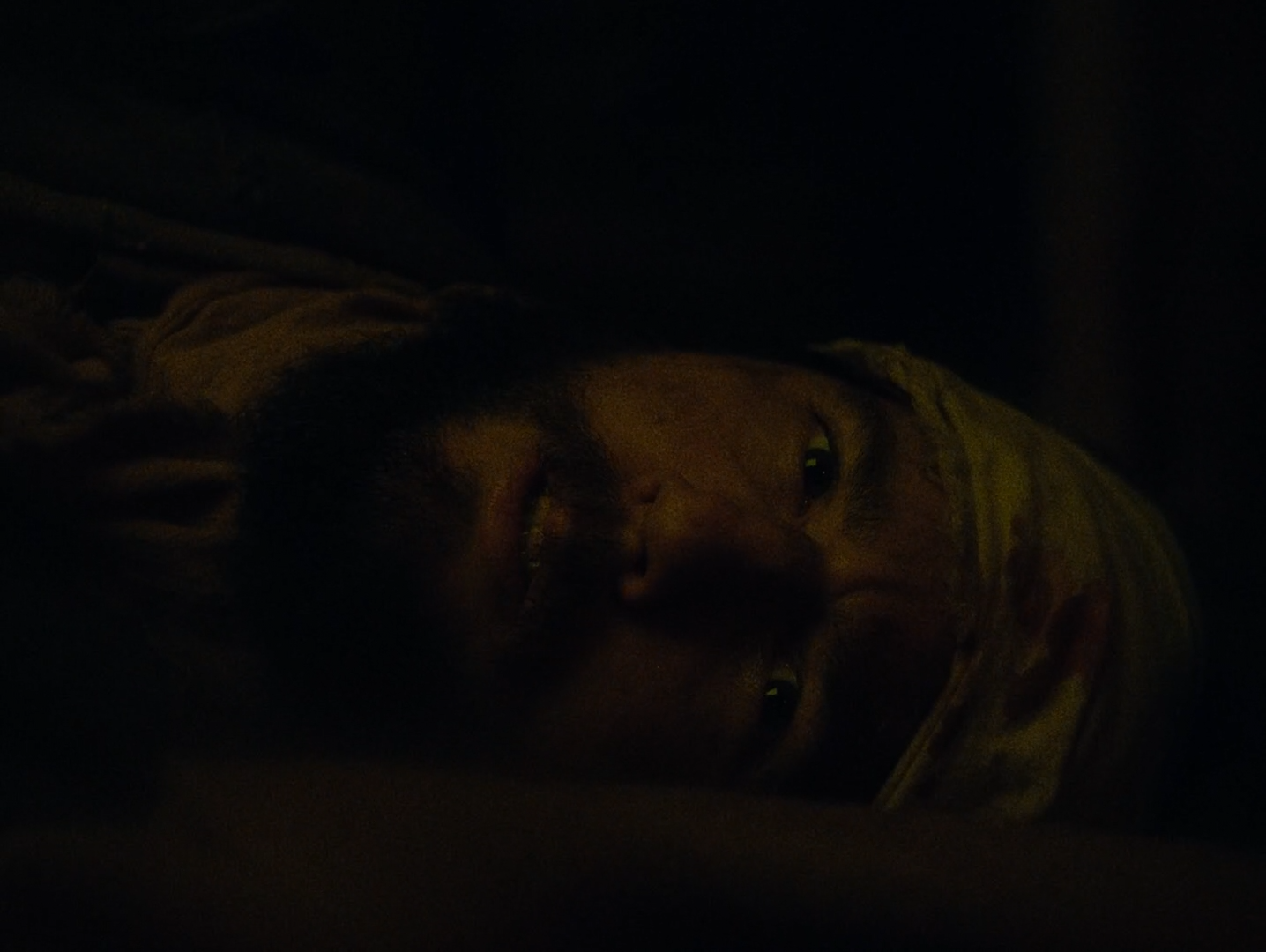
A face across a fire in Remington measures Δu′v′ 0.0676 from D65 at a direction of 38 degrees. A face under lamplight in First Cow measures 0.1013 at 24 degrees. The separation is Δu′v′ 0.0395 with 14 degrees between the directions — a resolved difference in magnitude, and a direction difference of about half the floor, so the hue is shared and the intensity is not. The film's lit skin is half as far again from grey as the painting's, and leans further toward red.
The corpus-level version of this question could not be answered with the tools available. This repository's candidate-skin heuristic is designed for photographed faces; applied to the plates it selects 32% of the average painting, because dry grass, horsehide, deerskin and lamplit canvas all pass the same gate. On the film it selects 3%. The heuristic is not wrong so much as inapplicable, and the numbers it returns for the plates describe warm paint rather than skin. That is why this question is answered from two hand-placed, visually confirmed patches and not from the corpus.
The result is consistent with the falloff finding above and probably the same finding. Both media light a face with fire; the film puts more chroma into what the fire reaches.
- Separation
- Δu′v′ 0.039514° apart · resolved
- Plate
- Δu′v′ 0.0676direction 38°, ample levels
- Film
- Δu′v′ 0.1013direction 24°, marginal levels
- Skin heuristic on plates
- 32%of the average plate — it is finding warm paint, not skin
Question 8 of 9
Is the water the same water?
Different
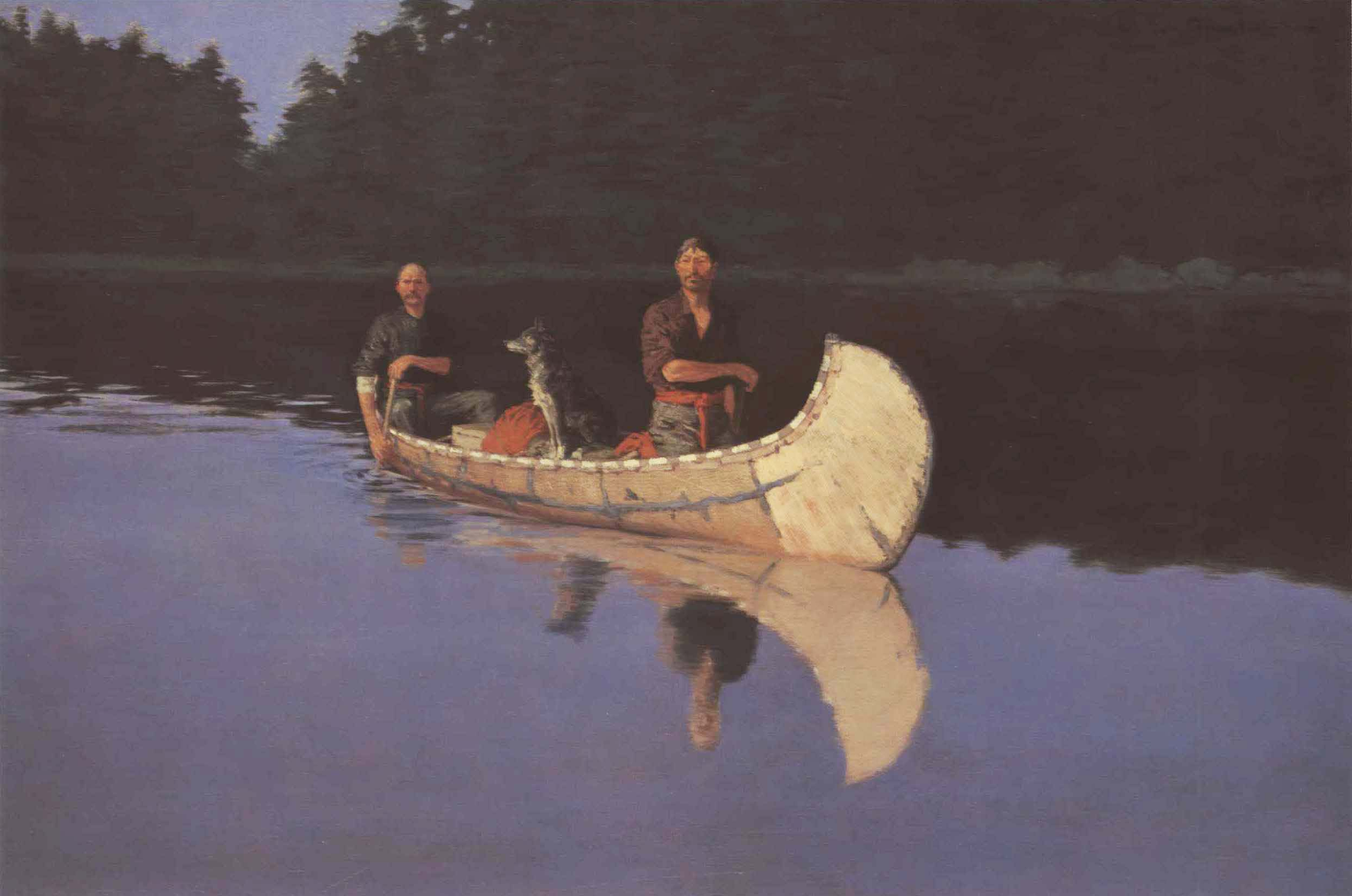
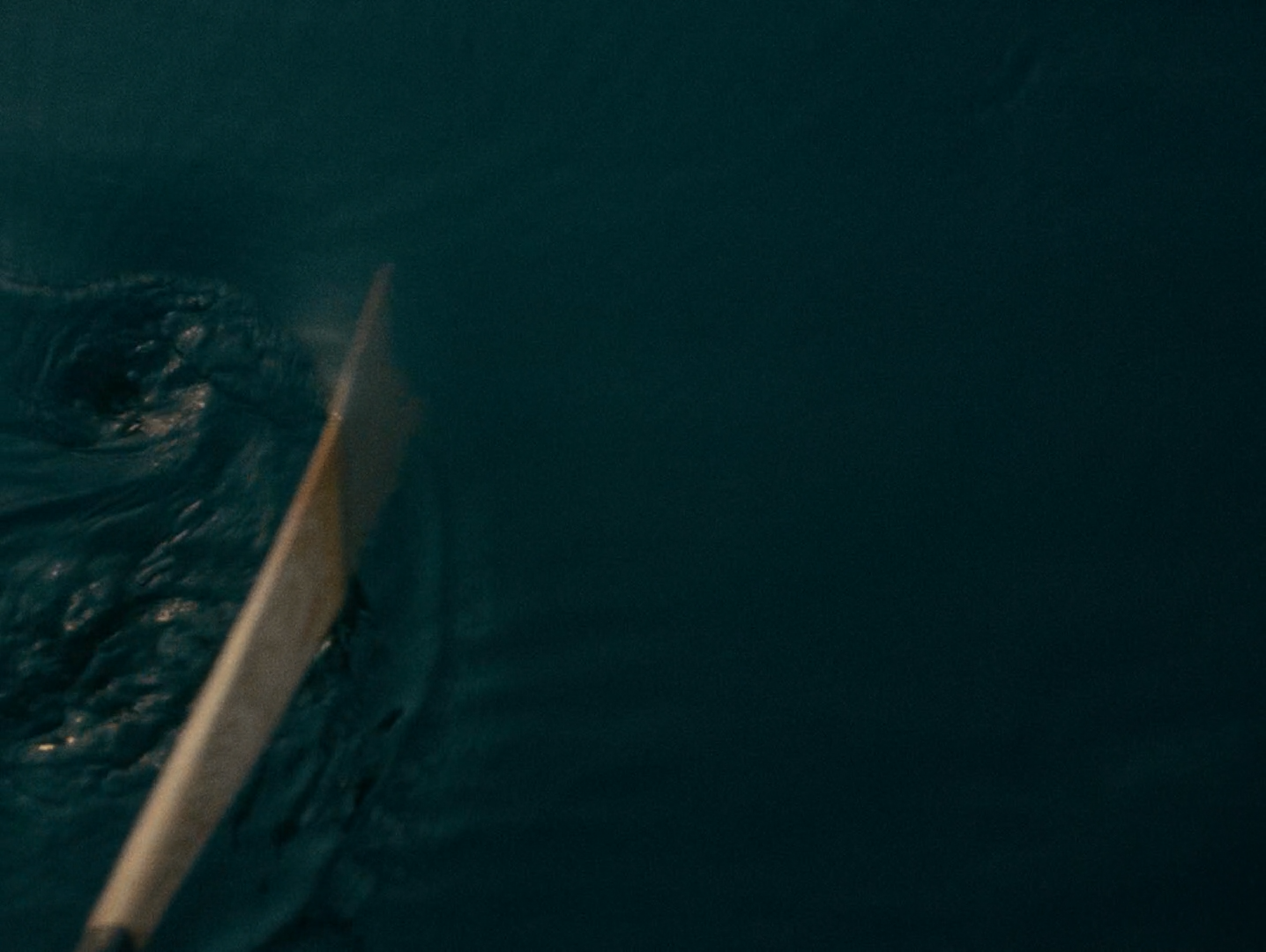
Both bodies of work spend real time on water at low light: Remington's canoe nocturnes on still lakes, First Cow's opening river and the stream the men cross. The samples do not agree, and they do not agree in an interesting way.
Remington's lake below the canoe measures Δu′v′ 0.0333 at a direction of 279 degrees — a definite blue-violet, the same quadrant as his night skies, which is what a still lake reflecting a night sky should be. First Cow's river beside the paddle measures 0.0662 at 211 degrees, a strong cyan-blue; its broken river surface measures 0.0060 at 103 degrees, which is very nearly neutral. The separations from the plate are Δu′v′ 0.0621 and 0.0393, both far outside the floor.
The two film samples are 0.06 apart from each other, which is more than either is from most other things in this report. That is not a contradiction: a smooth deep river reflecting a teal sky and a broken riffle scattering white light are genuinely different materials, and the film treats them as such. Remington's water is more consistent because his water is nearly always the same thing — a flat reflecting surface at night.
The direction difference is the one worth noting. Remington's water goes violet; the film's goes cyan. That is the same split the sky question found, and for the same reason: the two put their ambient light on opposite sides of neutral.
- Shot 414 vs R36
- Δu′v′ 0.062168° apart · resolved
- Shot 62 vs R36
- Δu′v′ 0.0393176° apart · resolved
- Plate direction
- 279°blue-violet, with his night sky
- Film directions
- 211° / 103°cyan-blue, and near-neutral
Question 9 of 9
Is the ground the same ground?
Warm against cool
Remington's dry foreground grass measures Δu′v′ 0.0566 from D65 at a direction of 44 degrees: a definite warm ochre, sitting in the same quadrant as his firelight. First Cow's ground measures 0.0193 at 86 degrees in the leaf litter of the prologue, and 0.0183 at 175 degrees in the fort mud — barely coloured, and in the second case leaning cyan. The separations are Δu′v′ 0.0443 and 0.0701, four and six times the reproduction floor.
This is the clearest single disagreement in the report and it is about ambient light rather than about ground. Remington's plains at night are lit by something he paints as warm, and his ground returns that warmth. First Cow's forest floor and fort mud are lit by overcast Oregon sky, and the grade lets them keep its coolness. The same split appears in the sky, in the water and here; three materials, one cause.
It also explains most of the whole-picture result. The largest areas in a Remington nocturne — ground, grass, snow, sky — carry his warm bias, and the largest areas in First Cow carry the film's cool one. That is what moves the two hue spectra 34 degrees apart while their fires sit on top of each other.
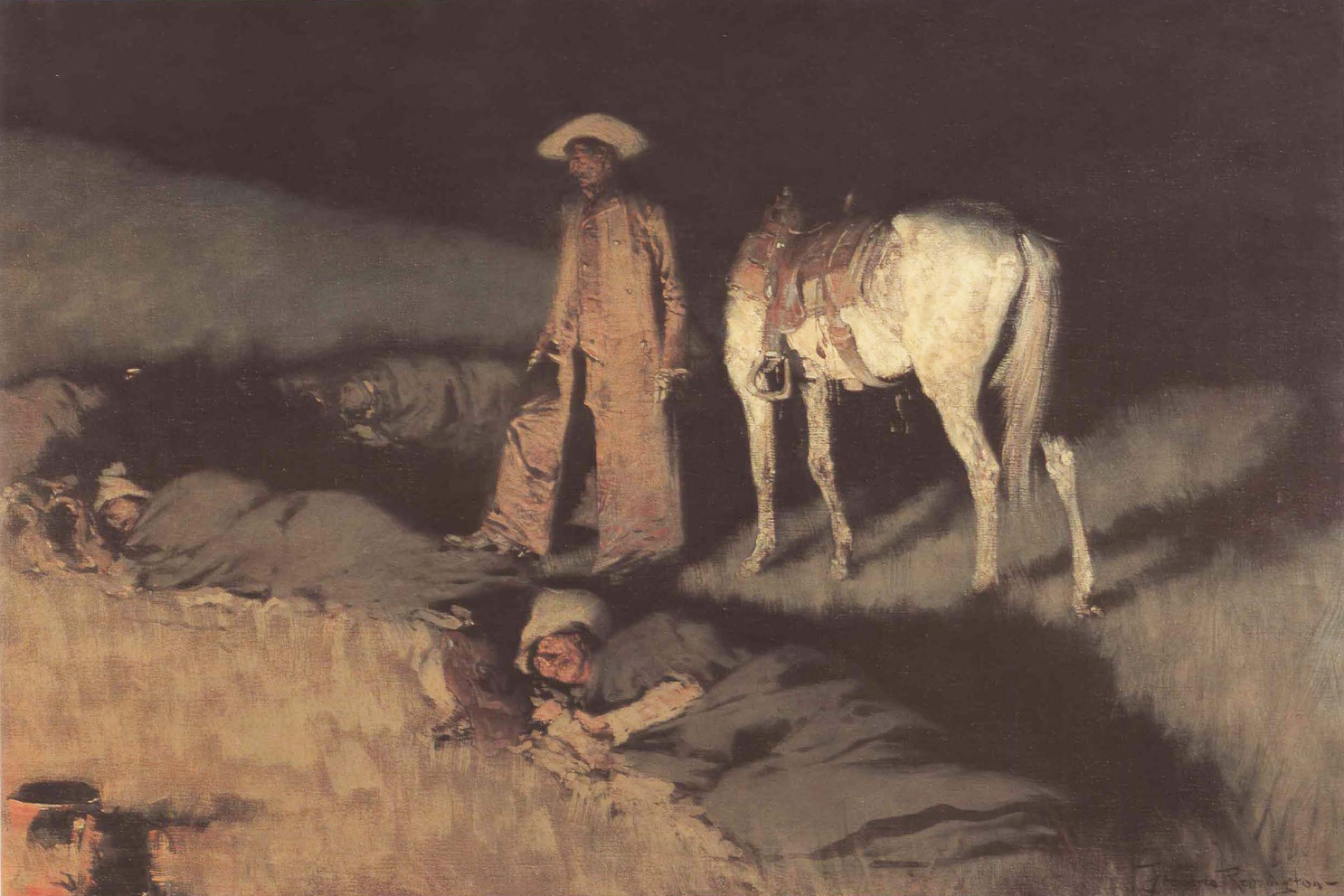
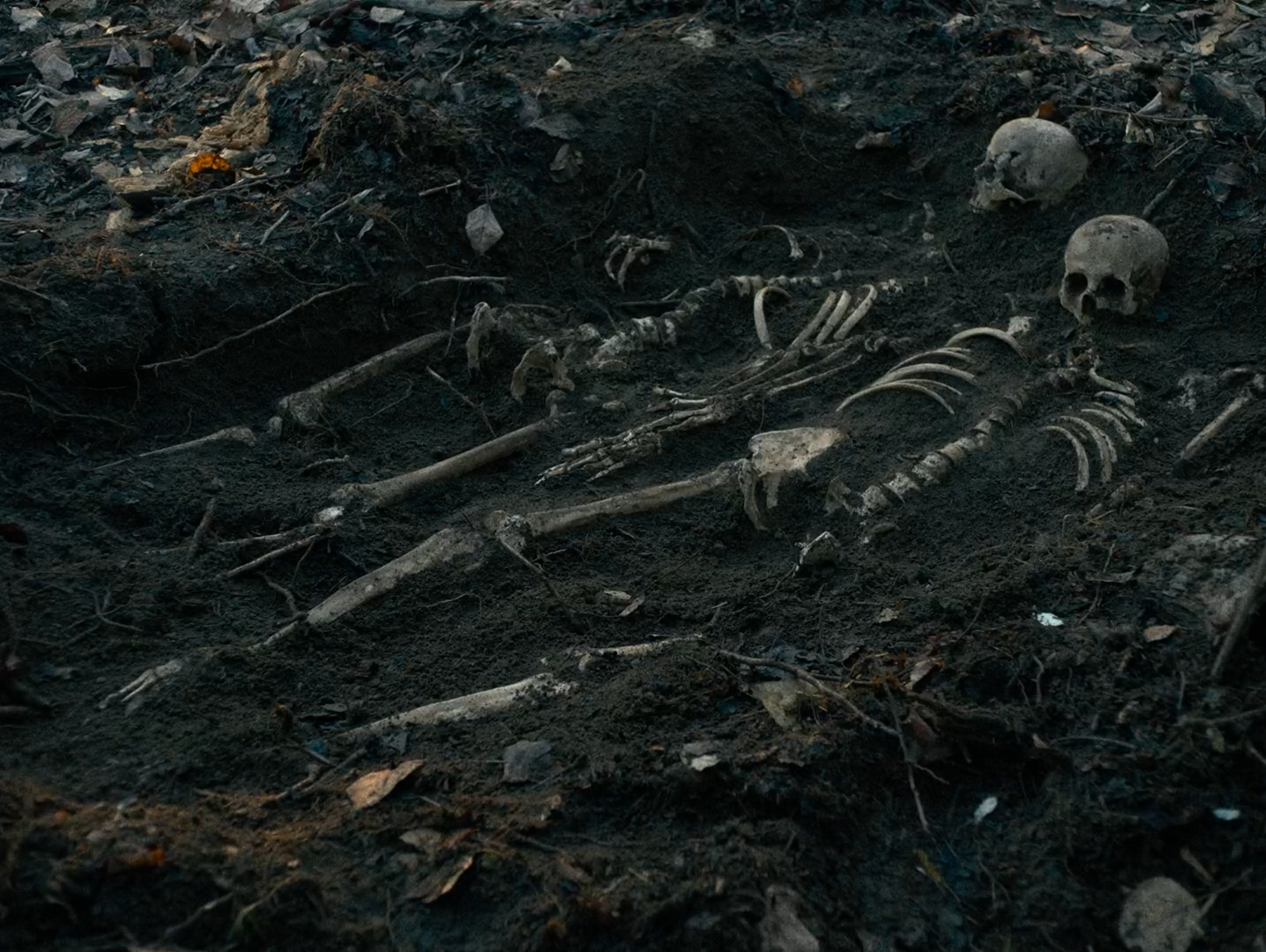
- Shot 15 vs R56
- Δu′v′ 0.044342° apart · resolved
- Shot 92 vs R56
- Δu′v′ 0.0701132° apart · resolved
- Plate ground
- Δu′v′ 0.0566direction 44°, warm ochre
- Film ground
- 0.0193 / 0.0183directions 86° and 175°