Eight frames from the darkest and least chromatic corpus in this repository, where daylight stops at a third of the scale, shadows are almost neutral, small warm sources carry all the chroma, and nothing clips.
First Cow is graded against the grain of almost every habit a colourist has. Across its 466 photographed midpoint frames the mean lightness is L* 7.28 and the mean chroma C* 3.56. Measured over every analysis-eligible frame so that the corpora are directly comparable, that is L* 7.25 at C* 3.55 against L* 8.90 at C* 8.18 for A Short Film About Killing, the next darkest study in this repository: barely darker in level, and less than half as chromatic. 88.6% of the average frame lies below L* 20 and 64.3% below L* 5. Only 43 of those 466 frames put more than one per cent of their pixels above L* 65, and 93 of them contain no connected region above L* 20 at all.
None of that is achieved by crushing. In the whole picture range exactly one frame has more than a tenth of a per cent of its pixels at or above code value 253 in any channel, and that frame is a candle. What the film does instead is set its ceiling very low and then spend the entire range below it: overcast daylight tops out around L* 33 at the 99th percentile, shadows carry a mean chroma of C* 3.0, midtones C* 11.2 and the small highlights C* 20.1. Colour is not spread across the picture; it is concentrated in whatever is lit.
These eight studies take that architecture apart one problem at a time — a river under a sky that never reaches white, a fern bed that separates without brightness, a fort under a flat ceiling, a room split between a daylight doorway and two flames, a face four L* points above black, smoke used as a depth control, the film's single saturated interior, and one candle whose hottest point is its coolest colour. Each separates what the photography and the production had to supply from what a colourist can plausibly rebuild.
Subject
First Cow
Studies
8 frames
Measured against
466 eligible midpoint frames
Interpretation
gamma24
The film-level construction
What holds the look together
The ceiling is set far below white
Across the 466 photographed frames the mean 99th-percentile lightness is L* 33.3, the mean share of pixels above L* 65 is 0.52%, and only 43 frames exceed one per cent. Daylight, snowless overcast and window light are all allowed to be the brightest thing in the picture without being allowed anywhere near display white.
Nothing clips
Mean channel clipping across the picture range is 0.0000, and exactly one frame — a candle — exceeds 0.1%. A low ceiling is being reached by placement, not by compression against the top of the scale, and any reconstruction that arrives here by clipping has arrived somewhere else.
Chroma rises with light
Mean chroma is C* 3.0 in the shadow zone, C* 11.2 in the midtone zone and C* 20.1 in the highlight zone. Shadows are nearly neutral and whatever is lit is coloured, which is why a flat saturation change reads as a grade on this film faster than on almost any other.
Green-cyan is the default and warmth is an event
The corpus mean hue is 146 degrees with a 51-degree spread, and 74.9% of frames are cool-dominant with a mean warm/cool balance of 0.348. A red skirt, a child's dress, a cow's hide or a candle carries the warm register alone, and does so on scarcity rather than on saturation: the mean share of pixels above C* 40 is 0.05%.
Resolve blueprint
A node tree built to be adjusted, not copied blindly
Normalize camera originals into DaVinci Wide Gamut / DaVinci Intermediate through Resolve Colour Management or a documented input CST before anything below. The input transform is not part of this look, and transforming the supplied 8-bit reference into a wide-gamut working space does not restore its bit depth, its highlight latitude or its camera primaries.
The graph splits into parallel branches early and stays split. This film needs the sky, the forest, the faces, the narrative colours and the practical sources to be movable independently, because it has so little chroma overall that any global move is immediately structural. Suggested values are starting ranges for correctly normalized log or raw footage, not recovered settings.
Group Pre-ClipC01
Input transform
Normalize camera originals before any of this film's darkness is read as a creative decision.
Do this
Decode raw from camera metadata, or transform a documented log/gamut into DaVinci Wide Gamut / DaVinci Intermediate.
Give any plate, element or archival insert its own correct input transform before it meets this graph.
If project colour management already performs the IDT, omit this node instead of doubling it.
Starting points
Keep creative tone mapping out of the input stage; display mapping belongs to C12.
For the supplied 8-bit reference only, use Rec.709 primaries and provisional gamma 2.4 as an explicit comparison assumption, not as a grading source.
Watch
At this key a wrong transfer curve is invisible in the picture and fatal in the numbers: a frame whose 99th percentile sits at L* 4 cannot be judged by eye on an uncalibrated display.
Confirm data/video levels before treating a floor this low as intentional.
Clip · serialC02
Exposure and neutral placement
Set level and balance for a picture whose photographed frames average L* 7.3, without lifting it into a conventional key.
Do this
Use Offset for the large move, then HDR Global or Log wheels for small zone placement.
Pick neutrals from wood, cloth and river stone in daylight scenes; do not neutralise on foliage or on firelit skin.
Place faces from modelling and texture, then leave them where the environment puts them.
Starting points
Begin inside about ±0.3 stop on well-exposed log material and expect to end below where instinct puts you.
Keep temperature and tint corrective here; the film's green-cyan cast is built in C05 and C10, not by mis-balancing the whole clip.
Watch
Auto-neutral on an overcast Oregon exterior pushes the whole film warm and destroys its central relationship.
A global lift to make a night interior 'readable' converts the shadow field into visible 8-bit noise.
Clip · serialC03
Toe architecture and black placement
Build the long, slow toe that lets 88.6% of the average frame sit below L* 20 and still separate.
Do this
Shape the toe with Custom Curves or HDR Black/Shadow rather than lifting or crushing with Lift.
Keep a measurable gap between the darkest object and the encode floor; check on a waveform at full scale, not by eye.
Set contrast and pivot low, and let separation come from the curve's slope near black.
Starting points
Try contrast 0.95–1.10 with pivot 0.18–0.30, then shape the toe separately.
Aim for a 5th-percentile that stays off the floor: in this master the average frame's 1st percentile is L* 0.12 and its 10th is L* 0.57, so the working room is genuinely one or two code values wide.
Watch
Crushing here is unrecoverable and will not show on a display with raised black.
Any toe steep enough to be 'punchy' removes the film's entire shadow vocabulary.
Clip · parallelC04
Overcast sky and river field
Hold the film's ceiling. Daylight exteriors are the brightest material in the picture and they still stop far short of display white.
Do this
Combine a broad luminance key with a landscape window following the sky line or the water plane.
Adjust density and temperature with HDR Highlights/Gain and small RGB curves rather than one white-balance move.
Keep river texture and cloud structure with restrained local contrast.
Starting points
The corpus mean 99th percentile is L* 33.3, and only 43 of 466 photographed frames put more than 1% of their pixels above L* 65. Treat L* 55–75 as an exceptional ceiling, not a target.
Try ±0.10–0.25 stop on the sky branch before touching saturation.
Watch
A luminance-only key will take pale cloth, skin and shingle with the sky.
Large smooth sky gradients in an 8-bit deliverable band before they clip; check the sky on a scope, not on a monitor.
Clip · parallelC05
Forest green and foliage density
Give fern, moss, conifer and leaf litter their own density without letting green become the only colour in the film.
Do this
Use shallow, wide Hue vs Hue moves to converge yellow-green and blue-green rather than narrow spikes.
Control foliage luminance with Hue vs Lum before reaching for saturation.
Use Color Warper with pins on the foliage axis, on skin, and on the film's narrative colours so they can move independently.
Starting points
Start with 2–6 degree hue rotations and 10–20% density changes.
The corpus mean hue is 146 degrees with a 51 degree spread: the green is wide, not a single note. Do not compress it to one.
Watch
Foliage carries this film's highest chroma at low lightness; a global desaturation flattens the forest before it touches anything else.
Wet leaves and moss have specular structure that a heavy Hue vs Lum move turns to plastic.
Clip · parallelC06
Skin and firelit faces
Keep faces legible when they are the only lit surface, without pulling them to a generic skin line.
Do this
Build a broad pre-look HSL key, then intersect it with a tracked window; a key alone will take wood, straw and hide.
Correct luminance and local separation before making any hue move.
Treat daylight faces and firelit faces as separate branches; they are different colours in this film and should stay so.
Starting points
Across 295 frames where the coherent-skin heuristic returns a usable area, candidate skin measures L* 23.0, a* 3.7, b* 12.4 — a hue near 73 degrees at chroma 13 — and sits about 14 ΔE from its own immediate surround. Use that separation, not an absolute target.
Key Output Gain 0.25–0.60 and exposure inside ±0.25 stop are safer first tests than full correction.
Watch
Cold skin under overcast is not failed skin.
Beards, fur hats, hide coats and hung cloth all pass a skin key; inspect the matte at full resolution.
In near-black frames a skin key will track noise.
Clip · parallelC07
Narrative colour protection
Protect the handful of objects that carry colour in a picture whose average chroma is C* 3.6.
Do this
Qualify the red skirt, the red child's dress, the cow's hide, the blue interior wall and the gold epaulette on separate branches.
Adjust density and local contrast first; raise chroma last and by small amounts.
Check each protected object against the frames on either side of it before committing.
Starting points
These objects are legible because of scarcity: the corpus mean high-chroma share (C* ≥ 40) is 0.05%. A saturation increase that looks modest here is a large change to the film's hierarchy.
Try ±5–12% saturation and ±0.15 stop inside a protected qualifier.
Watch
A global saturation move destroys this hierarchy faster than any other operation in the graph.
Costume red and firelight share a hue region; check that the fire branch and the costume branch are not fighting.
Clip · parallelC08
Practical warm sources
Render candle, lantern and open fire as small, hot, non-clipping events with a wide warm falloff.
Do this
Separate the source core from its falloff with two nested qualifiers; they behave differently and should be graded differently.
Use HDR Specular or a soft shoulder on the core; keep hard clipping out of the graph.
Shape the falloff on wall, cloth and skin with a feathered window that follows the real light, not the frame centre.
Starting points
In this master a candle core reaches L* 42 at the 99th percentile with 0.1% of pixels at or above code value 253 — the only frame in the corpus above 0.1%. Treat a clipped flame as a failure state, not a look.
Expect the warm colour to live in the falloff: the measured flame core is the coolest part of the light.
Watch
A qualifier keyed on 'warm and bright' will take firelit skin with the flame.
Raising a source's chroma reads instantly as video; raising the falloff's chroma usually does not.
Clip · parallel · optionalC09
Atmosphere and depth
Manage woodsmoke, river mist and rain haze, which do most of this film's depth work.
Do this
Grade haze with a depth-following window rather than a luminance key; smoke and pale cloth occupy the same values.
Reduce local contrast in the far plane before lifting it.
Keep the haze slightly cooler than the material behind it if the plate supports it.
Starting points
Start bypassed. Add only where smoke is visibly present in the plate.
±0.10 stop and 5–15% local contrast are enough to change a whole background plane.
Watch
Adding glow to simulate smoke that was not photographed shows immediately in the fine branch detail behind it.
Haze amplifies 8-bit banding; check the sky-to-treeline transition.
Clip · serialC10
Luminance-dependent chroma
Reproduce the film's most consistent measurement: shadows almost neutral, midtones coloured, small highlights the most chromatic of all.
Do this
Use Lum vs Sat, or a chroma-versus-lightness curve in Color Warper, to hold shadow chroma down without desaturating the picture.
Keep the midtone band free to carry the green and the browns.
Do not apply the same rule to the practical-source branch (C08), whose highlights are meant to be chromatic.
Starting points
The corpus target is a rising curve: mean chroma C* 3.0 in the shadow zone, C* 11.2 in the midtone zone, C* 20.1 in the highlight zone.
Reduce shadow saturation by 15–35% and leave the midtones alone as a first pass.
Watch
Flat saturation across the range makes the shadows look tinted and the film look graded.
Over-suppressing shadow chroma removes the blue-green that separates unlit forest from unlit cloth.
Clip · serial · optionalC11
Texture and noise floor
Keep grain and sensor noise below the level at which this film's shadows stop reading as photography.
Do this
Prefer a very light, coarse film grain over noise reduction that removes fern and moss detail.
If noise reduction is used, use temporal before spatial and check moving footage; a midpoint frame cannot show chatter.
Check the deliverable's bit depth and codec at the same time as the grade; this film's shadow separation is one or two code values wide.
Starting points
Start bypassed. Add only after the toe in C03 is settled.
Judge on the largest display available at correct black level, and confirm on a scope.
Watch
Chroma noise in near-black frames turns to coloured speckle under any downstream lift.
Heavy spatial noise reduction erases the micro-contrast that separates individual fern fronds.
Timeline / Group Post-ClipC12
Output transform and display trim
Deliver a picture whose whole argument is below the middle of the scale, to displays that will not all agree about black.
Do this
Apply one documented output transform for the delivery, and trim separately for each additional deliverable.
Verify the darkest sequences at reference black on a calibrated display, and again on a consumer display in a lit room.
Record the transform in the deliverable's documentation; a picture like this is very easy to render wrong downstream.
Starting points
Do not duplicate an output transform already applied by project colour management.
Make the trim for a brighter environment by lifting the toe knee, not the black point.
Watch
Cinema and home trims diverge more here than on a conventional picture; check both.
A deliverable at 8 bit will band in the sky and block in the shadows before it does anything else.
8 reconstruction studies
Read the image first; use the scopes to test the read
Each study begins with what is visible, then tests that reading against measurements of the active picture. Every metric describes the whole midpoint frame: it cannot identify a face, a costume, a flame or a tree without the visual inspection recorded in the prose, and the palette clusters name colour populations, not objects.
Build the base with every optional node bypassed. Add only the operations named in the shot recipe, inspect mattes at full resolution, and review moving footage before approving any qualifier, tracked window or texture node.
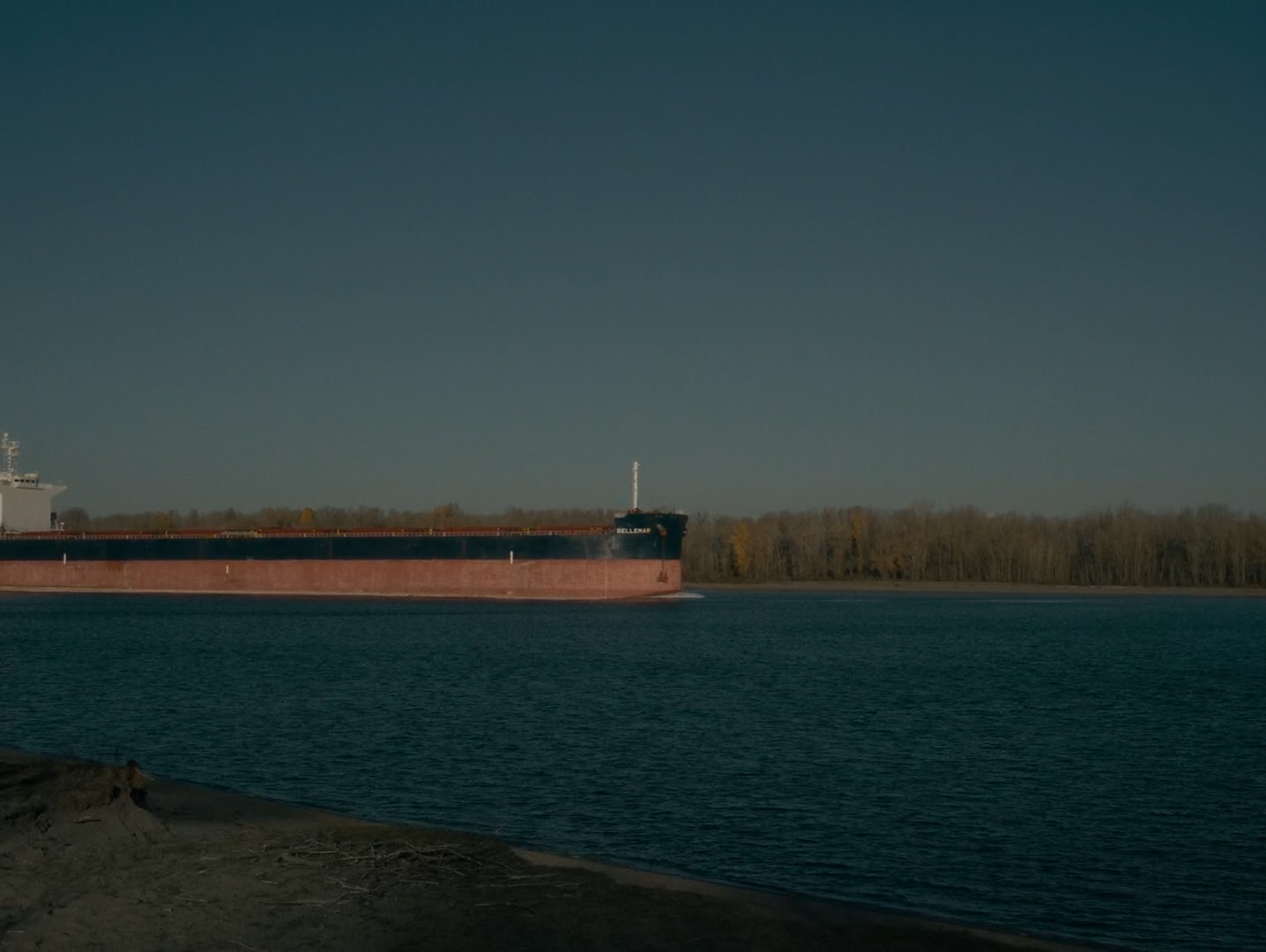
01 · Value architecture · the river before the story · shot 2 · 01:03:02:16
A rust hull under a sky that never reaches white
A loaded cargo hull crosses a wide river below a deep blue-teal sky; a dark treeline closes the far bank and a pale sand spit enters at the lower left.
The brightest material in the frame is the sky, and it stops around L* 35; the hull's rust band is the only warm mass in the picture.
What is remarkable
This is one of the brightest photographed frames in the film and it still contains no highlight. The active picture's 99th percentile sits at L* 35.1 and not a single pixel reaches the L* 65 highlight threshold. The ceiling is set by the sky, which runs as one long vertical gradient from a deeper blue at the top to a pale band at the horizon, and the water below it holds a separate, darker blue-green plane. The film's whole tonal argument is stated here before the story begins: daylight is allowed to be the top of the scale without being allowed to be white.
Colour is organised by scarcity rather than by intensity. Mean chroma is C* 8.9 with a 90th percentile of 12.5, which is high for this corpus and low in absolute terms, and the warm/cool classifier puts only 13.3% of chromatic pixels on the warm side. The rust band along the hull is therefore the single warm event in a frame otherwise built from blue-green water, blue sky, a near-black treeline and grey-brown sand. The five-cluster palette confirms it: four clusters are blue-green or near-black, and the fifth, a brown at #463121, holds 5.8% of the picture.
The sand spit in the lower left corner is the only place where the frame approaches a neutral, and it is textured rather than smooth. The centre of the frame measures 10.7 L* above its edge, which is consistent with the bright water plane occupying the middle and the darker bank and treeline occupying the borders — a description of what is photographed, not evidence of a vignette.
Where the image comes from
The barge, the river, the low winter treeline and the flat late light are photographic and cannot be manufactured downstream. What the grade owns here is the ceiling, the separation between sky and water, and the decision to leave the rust band as the only warm area rather than balancing it away.
Work in this order: place the sky's top value first, because everything else in the film is measured against it; then split water from sky, which are close in hue and far apart in level; then protect the hull band. Resist correcting the overall green-blue cast — it is the film's baseline, not an error in this shot.
Waveform
RGB distribution
Vectorscope
Can regular footage get there?
High
A correctly exposed daylight exterior on log or raw material reaches this comfortably. The difficulty is not capture but restraint: almost every default pipeline will place this sky higher and warmer than the film does.
Minimum capture conditions
Overcast or low late light with no direct sun on the water.
A capture that holds sky gradient without banding, and a deliverable with enough bit depth to keep it.
A hull or equivalent warm mass that is genuinely present in the plate; adding it in grade would show against the near-neutral surround.
Composite and background read
Nothing in the frame invites a composite reading
Water contact, reflection, atmospheric falloff along the far bank and the scale relationship between hull and treeline are all internally consistent. A working river and a real vessel are the simplest explanation.
A still cannot rule out invisible cleanup, and modern river traffic or bank detail may well have been removed; only production documentation could settle that.
Shot-specific Resolve pass
Use the global tree, then make these decisions
C02
Place the exterior key
Set Offset so the sky's upper band lands near the film's ceiling and the sand spit falls just above the toe.
Why: Everything later in the film is read against how bright this daylight is allowed to be.
Watch: Do not neutralise on the water; it is genuinely blue-green.
C04
Split sky from water
Use a landscape window on the horizon combined with a soft luminance key; give sky and water separate density and a small hue offset.
Why: They share a hue family and must not merge into one blue field.
Watch: Feather the window across the treeline, not along it.
C03
Hold the treeline off the floor
Shape the toe so the far bank keeps its branch structure above the encode floor.
Why: The treeline is the frame's only fine detail at low level.
Watch: Check on a waveform at full scale; this separation is invisible on most displays.
C07
Protect the hull band
Qualify the rust band and adjust its density before its chroma.
Why: It is the only warm mass in the frame and carries the composition.
Watch: A saturation increase here reads immediately as a graded object.
C10
Keep the shadow field neutral
Reduce saturation in the bottom of the range so the bank and treeline stay near-neutral while the water keeps its colour.
Why: The corpus separates shadow chroma from midtone chroma by roughly 8 C*.
Watch: Do not take the water's colour with the shadows.
Failure modes to check before approval
The sky gradient is the most likely place in the whole film for 8-bit banding; inspect it on a scope and on moving footage before approving the deliverable.
Watch the horizon line across the shot: any window placed on it will be revealed if the camera or the vessel moves.
Confirm on moving footage that the water's specular structure does not crawl once shadow chroma is suppressed.
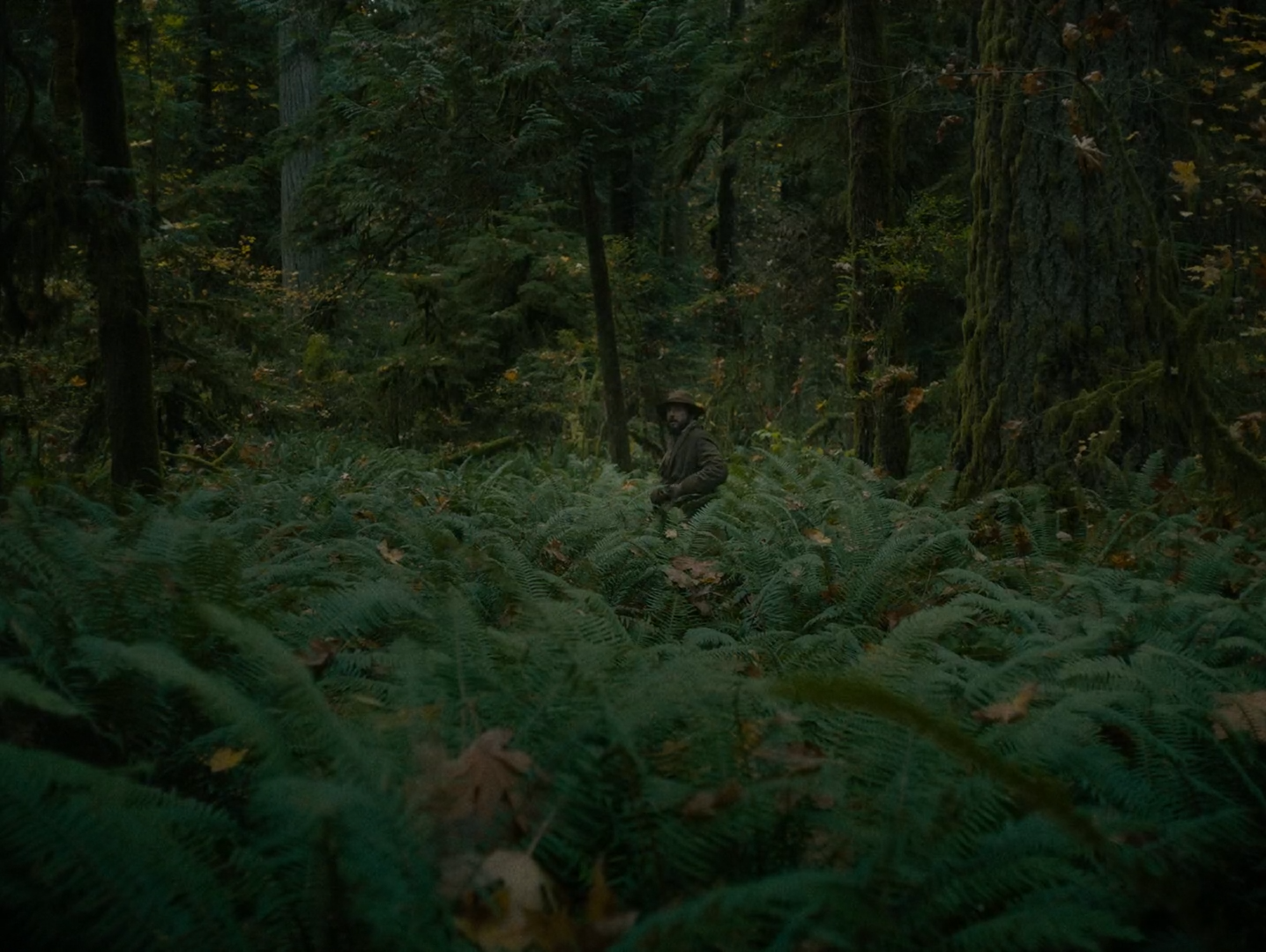
02 · The green mass · separation without level · shot 20 · 01:09:47:15
A man made small by sword ferns
Sword ferns fill the lower half of the frame beneath mossed trunks; a small hatted figure stands far back among them, scaled down until the undergrowth reads as the subject.
96% of the frame lies below L* 20 and half of it below L* 5, yet individual fern fronds stay separate through hue and micro-contrast rather than brightness.
What is remarkable
Almost the whole picture is in the shadow zone — 96.0% below L* 20, 49.7% below L* 5 — and none of it reads as a black frame. The separation is doing something unusual: the ferns hold the highest chroma in the frame at the lowest lightness, with a 90th-percentile chroma of C* 17.4 against a mean lightness of L* 6.9. Fronds are legible from each other because they differ in hue and in fine local contrast, not because any of them is bright.
The colour is green-yellow rather than green-blue: a* -6.0 with b* +6.2 puts the frame's average around 134 degrees in CIELAB, distinctly warmer than the corpus average. Moss on the trunks, wet frond surfaces and the scatter of fallen yellow leaves all sit inside that band. The trunks themselves fall away to near-black and act as vertical dividers rather than as objects.
The figure is deliberately not privileged. The connected-region measure finds seven regions above L* 20 and the largest of them covers 0.3% of the frame, so nothing here is 'lit' in the ordinary sense; the man is found by silhouette and by the hat's edge against a slightly paler gap in the trees. A grade that lifted him would break the shot's premise.
Where the image comes from
The forest, the moss, the standing water on the fronds and the flat overcast that reaches the floor of the wood are all production and location. Grading cannot invent the fern texture and cannot recover it if the capture put it below the noise floor.
Grade the foliage as a volume, not as a colour. Set the toe first so frond edges survive, then give the green its density, then check that the figure has not been lifted out of the mass. The instinct to 'find the actor' is exactly what this frame is built to resist.
Waveform
RGB distribution
Vectorscope
Can regular footage get there?
Conditional
Log or raw capture with real exposure on the fern bed will reach this. A compressed or underexposed source will not: at this key, frond separation and shadow chroma are the first things a codec discards, and no grade restores them.
Minimum capture conditions
Genuine ambient light reaching the forest floor, so the ferns are exposed above the noise floor even though they are rendered dark.
Enough bit depth to keep chroma at low lightness; this frame's colour lives entirely below L* 20.
A location with real depth layering — near ferns, mid figure, far trunks — since the grade cannot build that separation from a flat plate.
Composite and background read
A photographed forest interior with a real performer
Occlusion between fronds and figure, consistent falloff into the tree line and shared overcast direction are all coherent. Nothing suggests an element.
A midpoint frame cannot exclude wire removal, cleanup or a replaced background patch; only source or production material could.
Shot-specific Resolve pass
Use the global tree, then make these decisions
C03
Set the toe under the fern bed
Shape the toe so the darkest fronds sit a measurable distance above the encode floor, then set contrast low with a pivot near 0.20.
Why: Half the frame is below L* 5; the toe is the only thing keeping it from becoming one black shape.
Watch: Judge on a waveform, not on a display; this is invisible in a lit room.
C05
Give the ferns their own density
Use Hue vs Lum on the green band to place the fern bed relative to the trunks, then a shallow Hue vs Hue move to converge yellow-green and blue-green.
Why: Foliage density, not brightness, is what makes the undergrowth read as the subject.
Watch: Keep the move wide; a narrow qualifier on this hue produces visible edges on frond tips.
C10
Protect chroma at low lightness
Hold saturation in the lower midtones rather than the shadows, so the ferns keep colour while the trunks stay near-neutral.
Why: This frame's chroma is unusually high for its lightness and that is the point of it.
Watch: A flat desaturation removes the fern colour before it touches anything else.
C11
Leave the texture alone
Keep noise reduction bypassed; if the source demands it, use temporal only and review moving footage.
Why: Spatial noise reduction erases the micro-contrast that separates individual fronds.
Watch: Inspect at full resolution; the loss is invisible at review size.
Failure modes to check before approval
Any local window on the figure will be exposed the moment he moves; if he must be helped, help the gap in the trees behind him instead.
Check the frame after the output transform: shadow chroma at this level survives grading and then dies in delivery.
Review moving footage before saying the ferns are static; a midpoint frame cannot show wind.
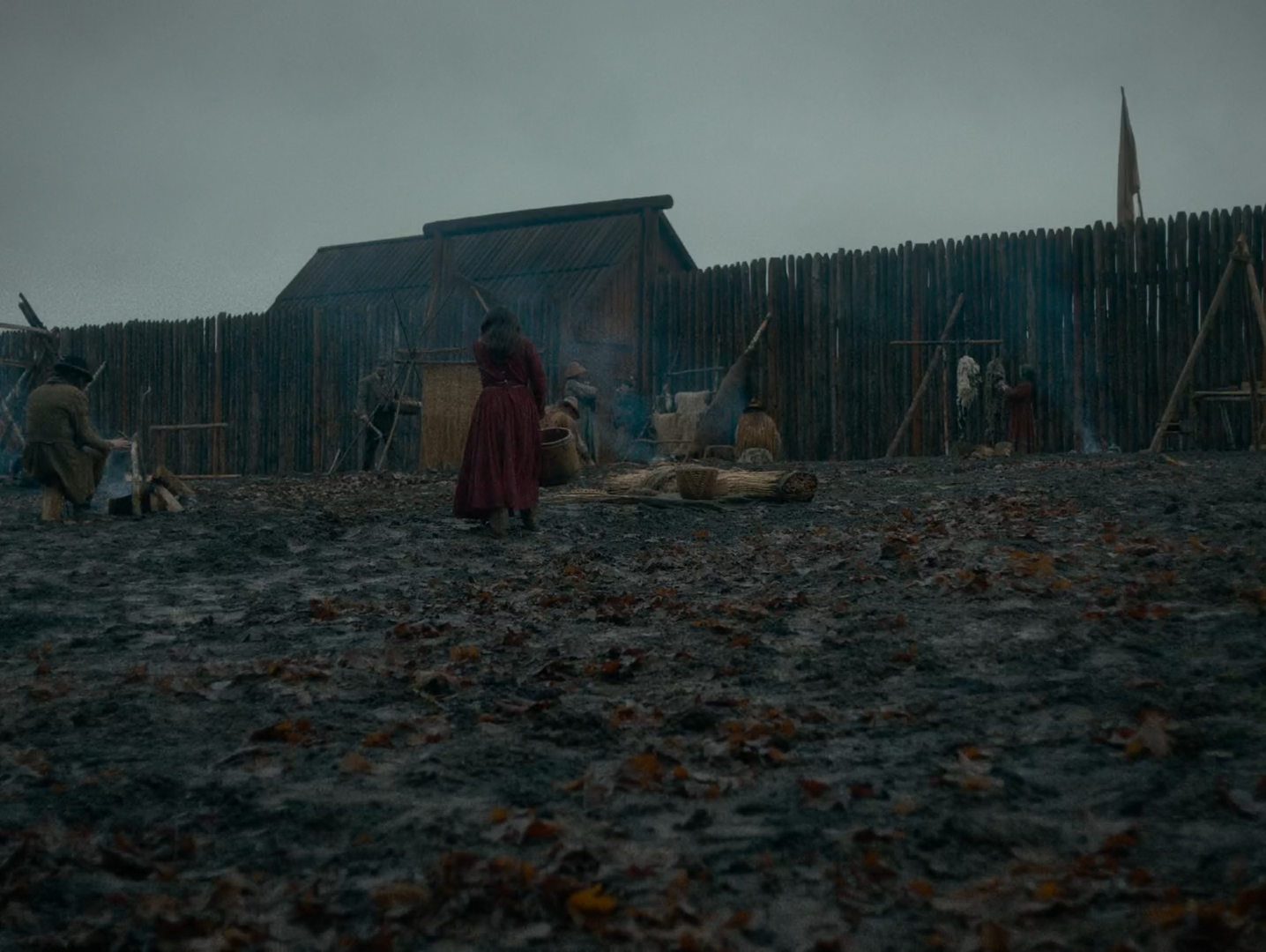
03 · Overcast ceiling · one colour in a neutral field · shot 92 · 01:28:54:03
A red skirt on churned fort mud
A slope of leaf-strewn mud runs up to a timber palisade and a shingled shed under flat pale sky, with a woman in a deep red skirt standing at the centre of the compound.
The frame runs from L* 2 at the tenth percentile to L* 55 at the ninetieth, and carries a mean chroma of only C* 4.4; the skirt is legible because nothing else is coloured.
What is remarkable
This is the film's flattest daylight: a pale, almost colourless sky sets a hard ceiling and the churned mud sets a floor, with a 53-point spread between the tenth and ninetieth percentiles and a mean chroma of just C* 4.4 — the lowest of the eight studies here. The palisade, the shed roof, the smoke and the standing figures all sit inside a narrow grey-green band, and the 90th-percentile chroma of C* 7.1 confirms that even the most coloured parts of the frame are barely coloured.
The red skirt is not saturated. It is simply the only chromatic mass in a picture whose warm/cool classifier assigns 11.3% of chromatic pixels to the warm side. The scattered orange-brown leaves across the foreground mud belong to the same warm family and act as a lower register of the same note, which is why the skirt reads as a continuation of the ground rather than as an inserted object.
The edge of the frame measures 13.5 L* brighter than the centre, because the sky occupies the top band and the pale mud the bottom while the dark palisade runs across the middle. That inversion is the composition, not a vignette, and any centre-weighted shaping applied here would fight it.
Where the image comes from
The fort, the mud, the costume red, the woodsmoke and the flat weather are production and location. The grade's work is to keep the sky from becoming white, keep the mud from becoming brown, and keep the skirt from becoming a colour correction.
Set the sky ceiling and the mud floor first, then reduce the competing hues in the palisade and roof so the picture converges toward grey-green, then treat the skirt on a protected branch with density before chroma.
Waveform
RGB distribution
Vectorscope
Can regular footage get there?
High
A well-exposed overcast exterior gives everything needed. The failure mode is enthusiasm: adding contrast or warmth to 'help' the mud immediately separates the skirt from the leaf litter it belongs with.
Minimum capture conditions
Genuine overcast, with no sun breaking through onto the compound.
A costume red that is dark and slightly desaturated in the plate; a brighter red would need to be pulled down rather than protected.
Enough capture latitude to hold sky texture while the mud stays below L* 10.
Composite and background read
A built set is the straightforward reading; extension is possible but unproven
The palisade, shed and compound are internally consistent in scale, perspective and light, and the smoke integrates with the background. A period fort of this size is routinely built practically.
The one ambiguity is what lies beyond the palisade: it is uniformly flat and low in contrast, which is equally consistent with real overcast distance and with an extension.
Neither reading can be settled from a midpoint still. Set extension leaves no decisive cue at this contrast, and its absence is not evidence.
Shot-specific Resolve pass
Use the global tree, then make these decisions
C04
Set the overcast ceiling
Place the sky with HDR Highlights and a soft shoulder so it holds structure without approaching white.
Why: The sky is the brightest material in the frame and defines the scene's ceiling.
Watch: A hard shoulder merges sky with the shed roof.
C02
Balance on wood, not on mud
Take the neutral from the palisade timber, then check the mud rather than the other way round.
Why: Wet mud is genuinely coloured and will drag a balance warm if it is used as the reference.
Watch: Confirm the result on the standing figures' faces.
C05
Converge the near-neutrals
Use a shallow Hue vs Sat reduction on the yellow and orange families outside the protected skirt, so the compound settles toward grey-green.
Why: The picture depends on almost everything being uncoloured.
Watch: Do not take the foreground leaf litter all the way to neutral; it is the skirt's rhyme.
C07
Protect the skirt
Qualify the skirt with a tracked window, adjust luminance and local contrast, and only then consider ±5% chroma.
Why: It carries the composition on scarcity, not on saturation.
Watch: Check that the qualifier is not also holding the orange leaves.
C09
Let the smoke sit back
If the smoke near the shed needs help, reduce its local contrast rather than lifting it.
Why: Smoke and pale sky share a value band and separate on contrast, not level.
Watch: Start this node bypassed.
Failure modes to check before approval
The distant figures at the frame edges are only a few code values from the palisade behind them; check they survive the output transform.
Any window on the skirt must be tracked, and its edge checked against the moving figure at full resolution.
The sky is large, smooth and pale — the second most likely banding site in this film after shot 2.
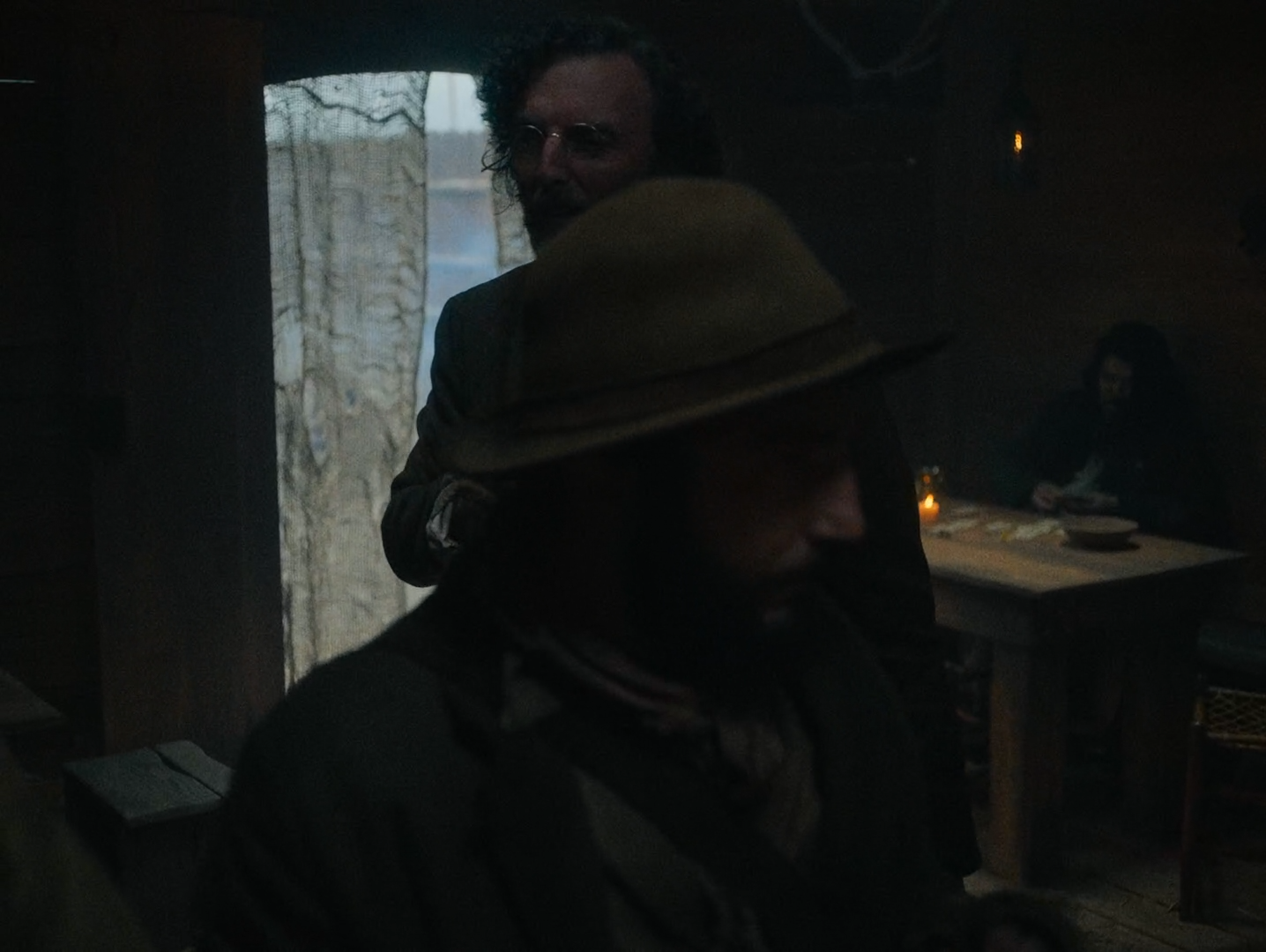
04 · Range split · a daylight aperture against two small flames · shot 116 · 01:33:12:06
A hat brim between a bright doorway and a table candle
A hat brim and a shoulder block the foreground of a dim room; a net-curtained opening at the left admits cool daylight, a candle burns on a table at the centre right, and a small lantern hangs high on the right wall.
The median pixel is at L* 0.9 and the 99th percentile at L* 57.6: the frame holds the film's floor and one of its few genuine highlights at the same time.
What is remarkable
The split here is the widest tonal event in the eight studies apart from the blue room. Half the picture sits below L* 0.93 and 87.0% below L* 5, while 0.5% of it crosses L* 65 and averages L* 72.7 inside that highlight zone. The bright material is the net-curtained opening at the left, and it is very nearly colourless: the frame's mean chroma is C* 1.4, the lowest of the eight, and shadow chroma is C* 0.78. This is a picture built almost entirely from level.
The two warm sources are small and are not the brightest things in the frame. The table candle and the wall lantern read as warm points against the neutral doorway, and the warm/cool classifier returns 0.283 — a minority warm share in a frame most viewers would describe as candlelit. Hierarchy is being carried by area and placement rather than by intensity: the doorway is bright but peripheral and partly screened, the candle is dim but central.
The foreground hat and shoulder are almost pure black and do structural work. The connected-region measure finds only two regions above L* 20, the larger covering 8.3% of the frame, which puts a number on how little of this room is lit at all. What separates the seated figures from the walls behind them is a difference of two or three code values, and it survives only because the toe is long.
Where the image comes from
The room, the net curtain, the candle, the lantern and the placement of the actors relative to the opening are production and lighting. The grade cannot invent the doorway's exposure relationship and cannot recover the room if the practicals were not exposed above the floor.
Set the doorway ceiling and the room floor first as one decision, since they are the two ends of the same curve. Then treat the two flames on a separate branch so their falloff can be shaped without lifting the room. Do not attempt to balance the doorway and the candles to a common white; the film keeps them different.
Waveform
RGB distribution
Vectorscope
Can regular footage get there?
Conditional
Achievable on log or raw with real practicals and a genuinely bright exterior beyond the opening. It is not achievable from an underexposed compressed source: the entire interior lives in a two-to-three code value band that a delivery codec will block before a colourist sees it.
Minimum capture conditions
Practical candle and lantern exposed so their falloff, not only their flames, is above the noise floor.
A real exterior brightness beyond the curtain; a lit card will not produce the same falloff across the room.
Capture latitude wide enough to hold both ends without an in-camera compromise that flattens one of them.
Composite and background read
An in-camera lighting relationship
Falloff from the doorway across the floor and table, the candle's local pool and the lantern's small halo are consistent with each other and with the geometry of the room.
A still cannot establish whether the exterior beyond the curtain is real, a lit backing or a replacement; it is too diffused and too screened to show a seam either way.
Shot-specific Resolve pass
Use the global tree, then make these decisions
C03
Build the long toe first
Shape the toe so the seated figures separate from the wall behind them, and check the separation on a waveform before looking at the highlight end.
Why: Half the frame is below L* 1; almost all the picture's information is in the toe.
Watch: Any crush here removes the woman at the right entirely.
C04
Place the doorway
Use a soft shoulder on the curtained opening so it holds weave texture around L* 70 rather than clipping.
Why: It is the frame's only large bright surface and it must stay neutral.
Watch: Keep it colourless; warming it turns the interior blue by comparison.
C08
Separate flame from falloff
Qualify the candle and lantern cores, then build a second, wider qualifier for the warm pools they throw on the table and wall, and grade the two differently.
Why: The sources are small and the falloff is what the audience reads as candlelight.
Watch: A single 'warm and bright' key will take the doorway's edge as well.
C06
Find the faces without lifting the room
Use tracked windows on the man at the doorway and the woman at the table, intersected with a broad skin key, and move them by a fraction of a stop.
Why: Faces here are only a few code values above their surroundings.
Watch: At this level a skin key alone will track noise; the window must do most of the work.
C10
Hold shadow chroma near zero
Suppress saturation in the bottom of the range so the black foreground stays neutral while the candle pools keep their warmth.
Why: The measured shadow chroma here is C* 0.78; any tint reads as a fault.
Watch: Exclude the practical-source branch from this reduction.
Failure modes to check before approval
Inspect the interior on a calibrated display at reference black; on a consumer display in a lit room this frame is a black rectangle with a bright doorway and the whole study disappears.
Check the candle flame for clipping on moving footage — a flame that survives a midpoint frame can still clip on a flare.
Verify the doorway's weave texture after the output transform; it is the first thing a trim for a brighter environment will lose.
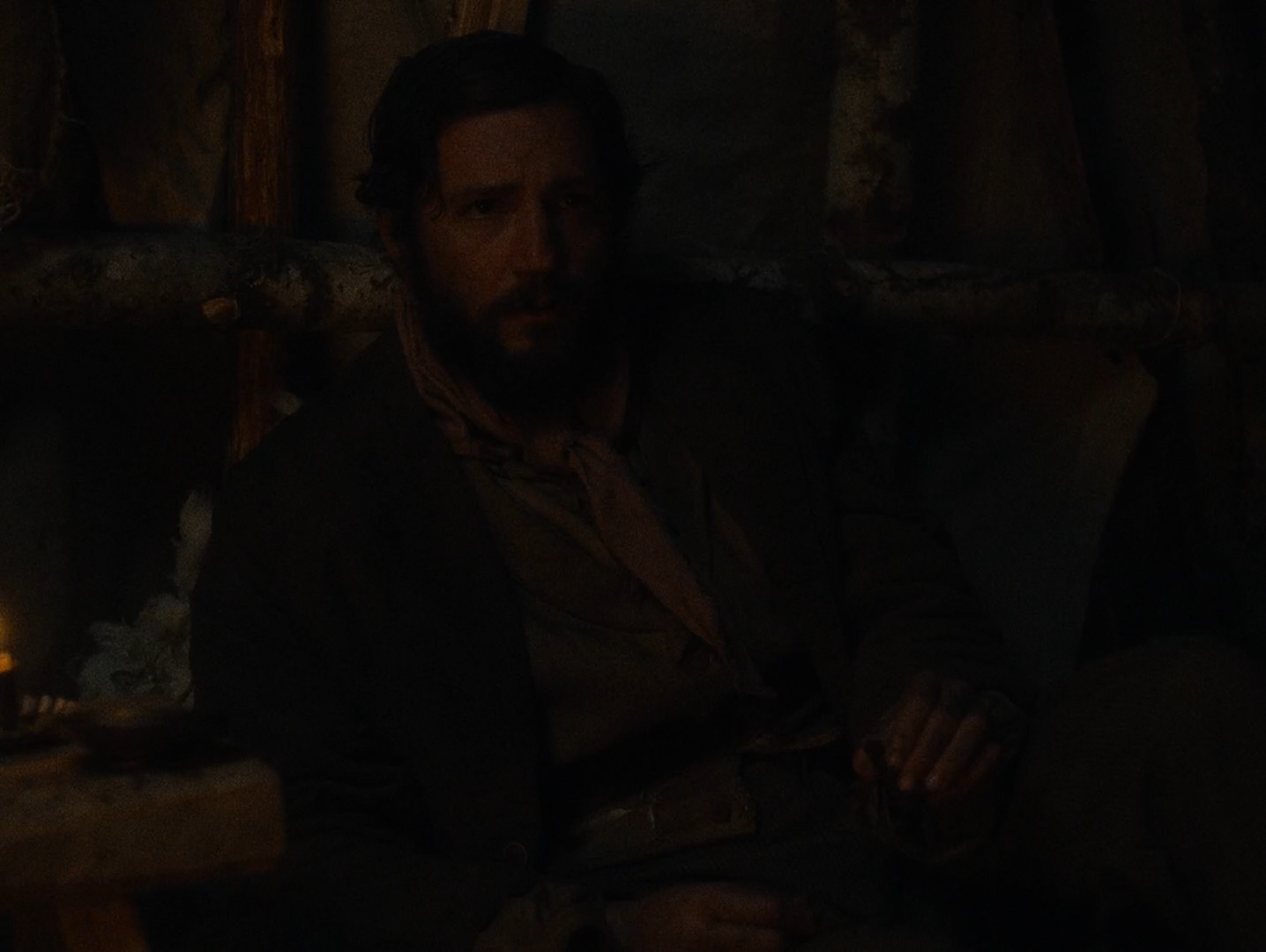
05 · The floor · a face at the noise limit · shot 188 · 01:52:31:13
Firelight that never reaches L* 5
A bearded man in a coat and pale neckerchief rests back against lodge poles and hung cloth; a fire burning out of frame at the left lifts his face, throat cloth and loose hands just clear of black.
The entire active picture lies below L* 4.3 at the 99th percentile, with 99.5% of it below L* 5 and no connected region anywhere above L* 20.
What is remarkable
This is the extreme of the corpus and it should be read as a limit case rather than a target. Mean lightness is L* 0.52, the standard deviation is 0.93, and the 99th percentile is L* 4.25, so ninety-nine per cent of the picture occupies about four points of the lightness scale. The connected-region measure returns zero: there is no region anywhere in this frame that reaches L* 20. Of the 466 photographed frames in the film, 93 share that property, so the condition is characteristic rather than exceptional.
What is left is direction and warmth. The warm/cool classifier returns 0.929, the highest of these eight studies, so nearly every chromatic pixel that survives is warm, and mean chroma is C* 0.71. The five-cluster palette runs #010101 at 74.8%, then #050201, #0E0502, #160802 and #230E03 at 0.7% — five near-blacks separated by a handful of code values, all warming as they rise. That progression is the shot: a fire is described entirely by the order of five almost identical dark values.
Inspected under a strong lift for content only, the coat and cloth show coloured speckle rather than texture. That is the 8-bit distribution floor, not the photography, and it marks the boundary of what any downstream operation can do with this frame.
Where the image comes from
A real fire at a real distance, an exposure that places a face this low deliberately, and a costume and lodge that hold their form in almost no light are all production. The grade did not make this dark; it kept it dark and kept it ordered.
There is essentially no grading headroom. The only defensible operations are placing the toe and protecting the order of those five near-blacks. Any attempt to 'recover' the face converts the frame into noise, and any attempt to add warmth converts it into a tinted black.
Waveform
RGB distribution
Vectorscope
Can regular footage get there?
Low
This frame is offered as a reference for how far the film goes, not as a generally reproducible candidate. Reaching it needs a camera with genuine shadow latitude, a monitored set, and a delivery chain that will not block the result — and even then the outcome depends far more on the capture and the display than on anything in the grade.
The supplied reference is an 8-bit distribution encode. At this key, that encode is itself part of what is being measured: some of the separation a colourist would work with in the master no longer exists in the file this study can inspect.
Minimum capture conditions
A camera and exposure that record usable, low-noise information several stops under key, on a monitored set with reference black available.
A finishing and delivery chain at 10 bit or better; an 8-bit deliverable blocks this frame before anyone sees the grade.
A presentation environment with controlled ambient light. On an uncalibrated display in a lit room this image does not exist.
Composite and background read
There is nothing visible to composite
The frame contains too little information to support any integration reading in either direction. Warmth direction and falloff across the face and hands are internally consistent, and that is all a still at this level can say.
Absence of evidence here is genuinely absent evidence, not evidence of absence; a frame this dark could conceal almost any invisible work.
Shot-specific Resolve pass
Use the global tree, then make these decisions
C03
Place the floor deliberately
Set the black point so the darkest cloth sits above the encode floor and the face keeps its four-point separation; use the curve's toe, never Lift.
Why: The whole frame is inside four L* points and the toe is the only control that matters.
Watch: Measure it; at this level a display cannot be trusted.
C06
Shape the face with a window, not a key
Use a soft tracked window on the face and hands with a very small gain change; keep any skin qualifier out of the chain.
Why: A skin key at this level tracks noise rather than skin.
Watch: Keep the change under a tenth of a stop and check the edge against the cloth behind.
C10
Let the warmth stay in the order of values
Leave chroma alone. If anything, reduce saturation slightly so the darkest cluster stays neutral while the higher near-blacks keep their warm drift.
Why: The palette's warmth is carried by five values a few code points apart, and adding chroma destroys the sequence.
Watch: Verify on a vectorscope; this is not judgeable by eye.
C11
Decide about noise before anything else
Test temporal noise reduction on moving footage, and accept visible grain rather than a plastic face.
Why: This is the frame where the noise floor and the picture are the same signal.
Watch: Spatial noise reduction here removes the face's only modelling.
C12
Check every deliverable
View this shot at reference black on the calibrated display and again on a consumer display in a lit room, and trim by lifting the toe knee rather than the black point.
Why: This frame will be rendered wrong by more displays than any other in the film.
Watch: An 8-bit deliverable blocks it; confirm the bit depth of every delivery.
Failure modes to check before approval
Do not approve this shot from a review copy; use the master on a calibrated display in a dark room.
Any downstream lift — a trim, a broadcast pass, a viewer's brightness control — will reveal chroma speckle in the coat before it reveals detail.
Review the fire on moving footage before making any claim about flicker or falloff; a midpoint frame is one instant of a moving source.
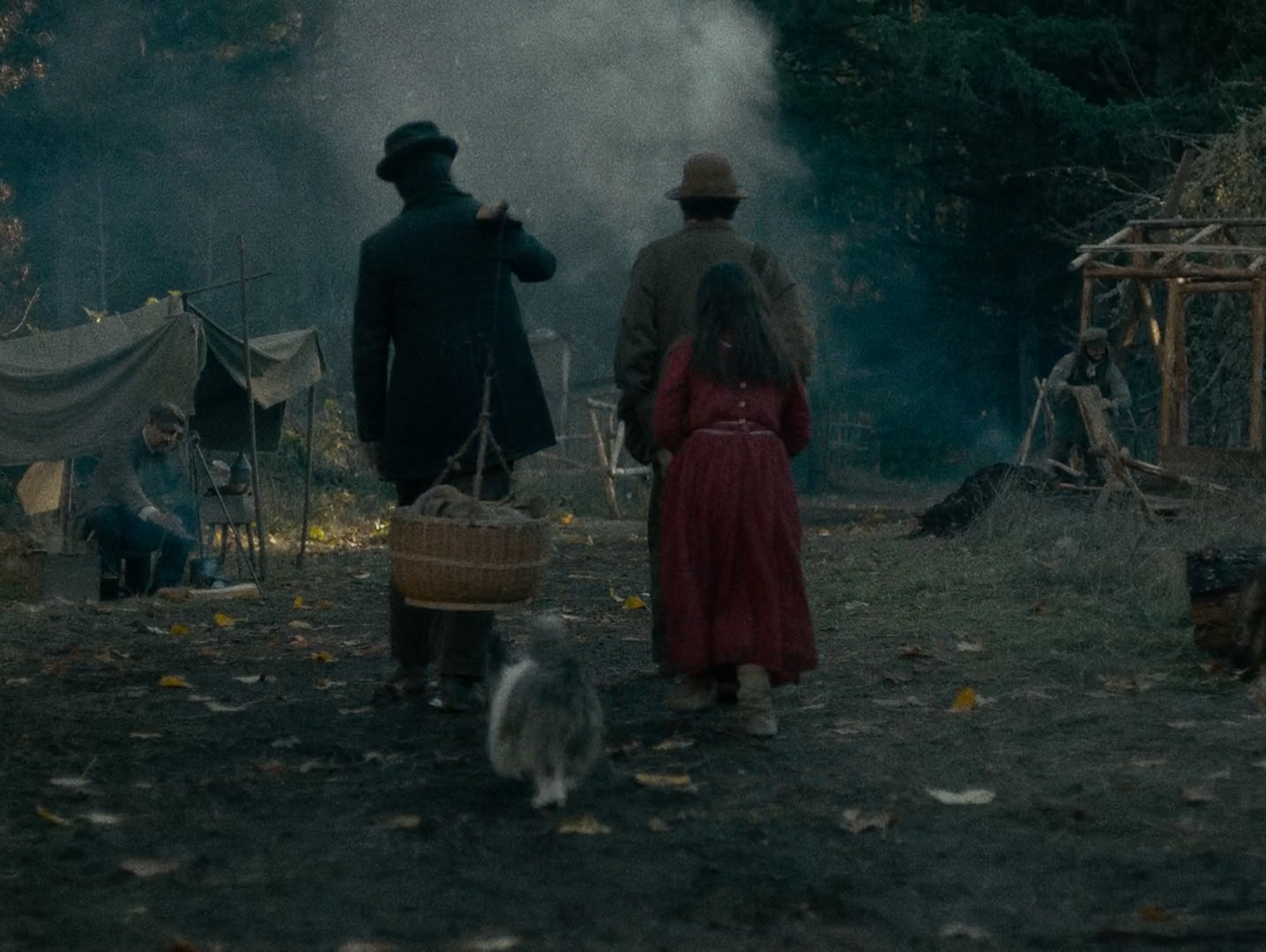
06 · Atmosphere · smoke as the depth control · shot 206 · 01:59:42:00
Red walking away into woodsmoke
Two men and a child in a red dress walk away from camera through a camp of hung cloth and lashed poles; a white dog crosses in front of them and woodsmoke flattens the trees behind into a grey-green haze.
Nineteen separate regions cross L* 20 and the largest covers 8.1% of the frame; the smoke does the depth work while the red dress carries the only warmth.
What is remarkable
This is the most spatially broken-up frame in the eight studies: the connected-region measure finds nineteen regions above L* 20, none of them larger than 8.1% of the picture. Canvas, smoke, the dog, scattered leaves and pale poles all sit in that band. In place of one lit subject there is a field of small bright fragments, which is why the eye reads the camp as a space rather than as a composition.
The smoke does the work a background light would normally do. It raises the far trees, drops their local contrast and pulls them toward the frame's overall grey-green — the mean here is a* -4.29 and b* -0.18, the most neutral-cool balance of the eight. The warm/cool classifier returns 0.096, the coolest reading in this set, so the child's red dress is doing what the skirt does in the fort shot: carrying the entire warm register alone.
Mean chroma is C* 5.6 with a 90th percentile of C* 9.8. The picture is barely coloured, and the smoke is a large part of the reason: haze mixes everything behind it toward a single desaturated value, and the film accepts that flattening instead of correcting it.
Where the image comes from
The camp, the canvas, the fire and the smoke are production. Real atmosphere is the one thing in this frame that grading genuinely cannot fake at this scale, because it changes contrast, not only level, and it does so differently at every depth.
Grade the depth planes in the order the smoke created them: near camp, mid figures, far trees. Use windows that follow the depth transitions rather than a centre-weighted shape, and protect the red dress last.
Waveform
RGB distribution
Vectorscope
Can regular footage get there?
High
A location with real atmosphere makes this straightforward. Without it the frame is much harder than it looks: adding haze in grade raises level without lowering local contrast, and the far branch detail immediately gives it away.
Minimum capture conditions
Genuine smoke or atmosphere in the plate, at a density that separates the tree line from the camp.
A costume red dark enough to belong to the scene rather than to sit on top of it.
Overcast or shaded light so the camp has no direct sun to break the haze.
Composite and background read
A practical camp with practical atmosphere
The smoke passes correctly in front of the middle-ground figures and behind the near canvas, and the trees lose contrast with distance in a way consistent with a real medium.
Animal work and the arrangement of a period camp are the kinds of thing that often need cleanup, so incidental removal is plausible even though nothing here indicates it.
A midpoint still cannot show whether the smoke moved correctly with the figures, which is where a composited haze usually fails; only moving footage could.
Shot-specific Resolve pass
Use the global tree, then make these decisions
C09
Grade the haze by plane
Use a soft depth-following window on the far tree line and reduce its local contrast slightly before adjusting level.
Why: Smoke separates from cloth by contrast, not by value.
Watch: This node starts bypassed; enable it only where atmosphere is visibly in the plate.
C05
Settle the tree line into grey-green
Apply a shallow Hue vs Sat reduction to the far foliage so the hazed trees converge toward the frame's neutral-cool average.
Why: The picture's depth depends on the background giving up its colour.
Watch: Keep the near foliage out of the qualifier.
C04
Place the canvas
Give the hung cloth and the lean-to their own small density adjustment so they read as the camp's brightest material without becoming highlights.
Why: Canvas is the largest pale surface here and sets the frame's ceiling.
Watch: Do not let a luminance key take the dog with the canvas.
C07
Protect the dress
Qualify the red dress with a tracked window and adjust luminance before chroma.
Why: It is the only warm mass in a frame where 9.6% of chromatic pixels are warm.
Watch: Check it does not drift as the child walks into the smoke.
C03
Keep the near ground off the floor
Hold the foreground mud and leaf litter above the toe so the camp has a base.
Why: 30.4% of the frame is below L* 5 and it still needs to read as ground.
Watch: Verify after the output transform, not before.
Failure modes to check before approval
Confirm on moving footage that the smoke and the figures separate correctly; a window graded on a midpoint can break the moment the smoke drifts.
The white dog is close to the canvas in value; check that a highlight adjustment does not merge them.
Watch the red dress across the shot — as the child moves into denser haze her costume should lose chroma, and a static qualifier will fight that.
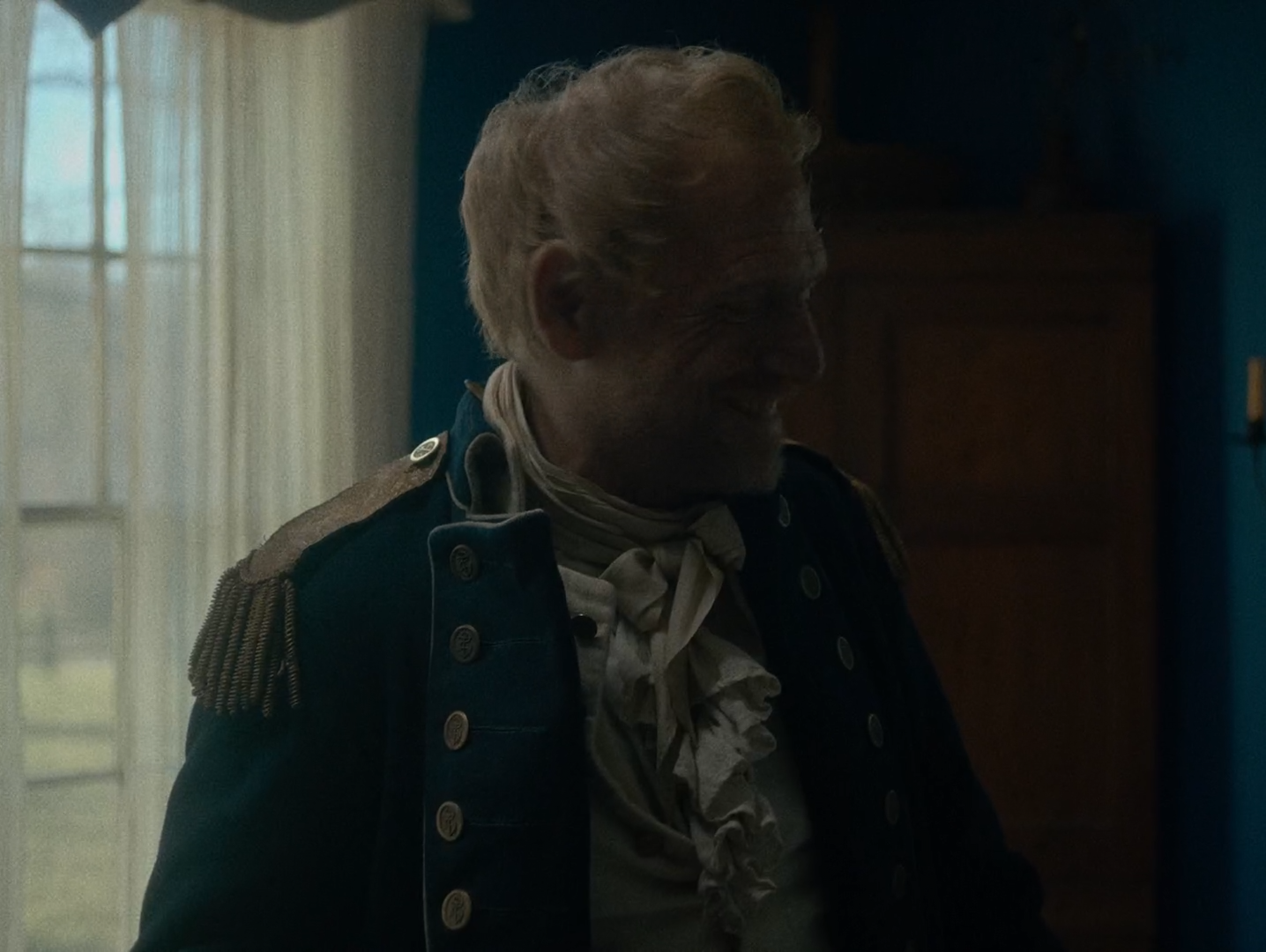
07 · Production colour · the one saturated room · shot 332 · 02:22:32:21
A gold epaulette against a blue-teal wall
A white-haired man in a navy coat with a bullion epaulette and a loose white stock turns towards a tall curtained window; the wall behind him is the deep blue-teal of the Chief Factor's house.
The frame runs from L* 0.2 at the tenth percentile to L* 77.7 at the ninety-ninth — the widest range of these eight studies — and it is the only one whose warm and cool chromatic pixels are nearly balanced.
What is remarkable
This is the film's one large saturated surface and it comes from the walls, not from the grade. The blue-teal wall reads as a genuine colour field rather than as a cast, and the palette records it as a dark blue-green cluster at #04151B holding 7.0% of the picture, sitting beside a near-black at 61.7% and a pale warm grey at 19.1%. In a film whose mean chroma is C* 3.6, a room painted this colour is a structural event.
The tonal architecture is the widest here: L* 0.21 at the tenth percentile, L* 57.5 at the ninetieth and L* 77.7 at the ninety-ninth, with 2.5% of the frame above L* 65 at a mean of L* 74.8. The net curtain carries that highlight, and it is doing so without clipping — the corpus records no meaningful channel clipping anywhere, and this frame is no exception. The window is allowed to be bright, and it is allowed to stop.
Warm and cool are nearly balanced for the only time in this set: the classifier returns 0.514, against a corpus mean of 0.348 and a low of 0.096 in the smoke shot. The gold bullion, the cream stock, the pale skin and the warm floor hold one side; the wall, the curtain's shaded folds and the coat hold the other. Edge measures brighter than centre by 14.2 L*, which is the window at the left doing the work, not a shape.
Where the image comes from
The wall colour, the uniform, the bullion and the net curtain are production design and costume. So is the decision to light the room from one tall window. Grading cannot invent a saturated interior in a film that has none, and should not try to talk this one down toward the rest.
Handle the wall, the coat and the skin as three separate branches. The navy coat and the blue-teal wall are close enough in hue to merge under a single qualifier, and the epaulette is small enough to disappear under a broad highlight adjustment.
Waveform
RGB distribution
Vectorscope
Can regular footage get there?
High
The frame is achievable with a painted set, a real window and ordinary log or raw capture. Its difficulty is one of judgement: the wall will read as excessive against the rest of this film if the surrounding scenes have been graded even slightly warmer than they should be.
Minimum capture conditions
A physically painted interior in this blue-green family; a graded wall of this size will show hue error at the edges of the coat and hair.
Window light strong enough to give the curtain a genuine highlight without blowing it.
Costume with real bullion and a real cream stock, since both carry the frame's only warm chroma at any size.
Composite and background read
A practical interior
The curtain's falloff across the wall, the coat's shading and the highlight roll on the epaulette are consistent with one window source and one room.
A still cannot say whether anything beyond the window was replaced; the curtain diffuses it past the point where a seam could be seen.
Shot-specific Resolve pass
Use the global tree, then make these decisions
C02
Balance on the stock, not on the wall
Take the neutral from the cream stock and the white curtain, then confirm the wall rather than correcting to it.
Why: A wall this saturated will drag any automatic balance and pull the whole room warm.
Watch: Check the skin after balancing, not before.
C04
Place the curtain highlight
Use a soft shoulder so the curtain holds around L* 75 with visible weave and no clipped channel.
Why: It is the film's most exposed surface and the corpus never clips.
Watch: Verify on a parade, not by eye; a single clipped channel here is invisible and wrong.
C07
Separate wall from coat
Qualify the blue-teal wall with a hue-and-luminance key intersected with a window that excludes the sitter; treat the navy coat on its own branch.
Why: Wall and coat share a hue family and different jobs.
Watch: Inspect the matte along the white hair, which will fringe.
C06
Let the skin stay cool
Use a broad skin key with a small Output Gain and no hue rotation.
Why: Window light in a blue-green room legitimately cools a face; correcting it separates the sitter from his room.
Watch: White hair and the cream stock will both enter a loose skin key.
C10
Hold the shadow side neutral
Reduce saturation in the lower range so the dark right of the frame does not take on the wall's hue.
Why: 61.5% of the frame is below L* 5 and should stay uncoloured.
Watch: Do not let the reduction reach the wall's mid values.
Failure modes to check before approval
Grade this room in the context of the scenes on either side of it; in isolation the wall invites over-correction in both directions.
Check the epaulette's bullion for clipping and for qualifier chatter as the sitter turns.
Confirm the curtain's weave survives the output transform and any brighter-environment trim.
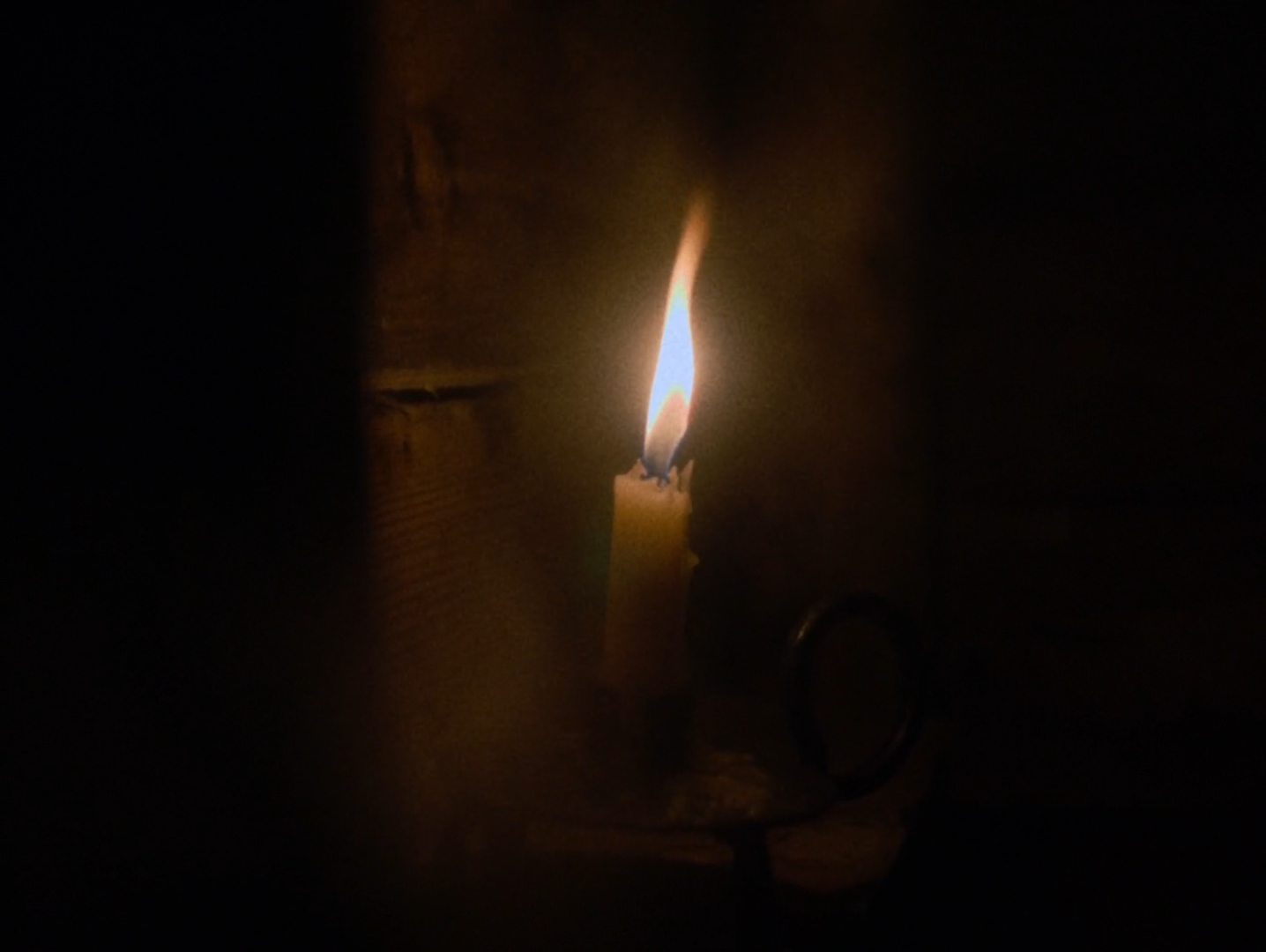
08 · One source · what a flame is actually made of · shot 422 · 02:44:04:10
A candle whose hottest point is its coolest colour
A single candle burns in an iron holder against vertical boards; the flame has a pale core and an orange tip, and a small warm pool of light falls on the wax and the wall.
The flame core clusters at a pale blue-white while the light it throws on the boards clusters at a warm brown: the source is cool and the falloff is warm.
What is remarkable
The most useful measurement in this study is the palette. Five clusters describe the frame: #030000 at 80.3%, #1F0A01 at 14.6%, #41280E at 3.7%, #A1704D at 1.0% and #C2D1E5 at 0.3%. The last two are the point. The 1.0% cluster is the warm light on the boards and the wax; the 0.3% cluster is the flame's own core, and it is a pale blue-white. The hottest part of the light in this frame is its least warm colour, and everything an audience reads as 'candlelight' is happening in the falloff.
The frame is otherwise the corpus at its most extreme in two directions at once. 89.4% of it is below L* 5 and 5.8% of the pixels are within two code values of black — the highest black-clip share of these eight studies. At the other end it is the only one of the eight with any pixels above C* 40, and the only frame in the entire 466-frame picture range with more than 0.1% of pixels at or above code value 253 in a channel. Even here that share is 0.11%: the flame is the one place in the film where the encode is pushed to its limit, and it is pushed by a fraction of a percent.
The overall hue reading swings accordingly. The frame's mean HSV hue is 12 degrees against a corpus mean of 146, and the warm/cool balance is 0.849. Both are the consequence of a very small warm area in a frame with almost no other chromatic pixels, not of a warm grade.
Where the image comes from
The candle, the holder, the boards and the distance from flame to wall are production. The relationship this frame depends on — a cool core inside a warm pool — is physics recorded by the camera, and no grade produces it convincingly from a source that clipped the flame to white.
Grade the core and the falloff separately, and do the falloff first. Almost everything the shot communicates is in the 1.0% warm cluster on the boards; the 0.3% core needs only to be kept from clipping and kept from being warmed.
Waveform
RGB distribution
Vectorscope
Can regular footage get there?
Conditional
A camera with enough highlight latitude to keep the flame core off the clip, exposed for the falloff rather than for the flame, will reach this. A source that clipped the flame cannot: once the core is white, the cool-core-in-warm-pool relationship is gone and adding blue to a clipped flame reads immediately as a correction.
Minimum capture conditions
Highlight latitude in the capture, with the flame core recorded below clipping.
A real practical at a real distance from the wall, so the falloff has the correct gradient and colour shift.
A finishing and delivery chain that will not block the 89% of the frame lying below L* 5.
Composite and background read
A photographed practical
The flame's shape, the gradient of the pool on the boards, the wax translucency and the holder's specular edge are consistent with one small source in one position.
A still cannot exclude a clean-up pass on the flame or the surround; it can only say that nothing here requires one.
Shot-specific Resolve pass
Use the global tree, then make these decisions
C08
Grade the falloff before the flame
Build a wide feathered qualifier on the warm pool across the boards and the wax; set its density and gradient first, and only then look at the core.
Why: The falloff is what reads as candlelight; the core is 0.3% of the frame.
Watch: Keep the qualifier off the flame itself or the two will move together.
C08
Protect the cool core
Use HDR Specular or a soft shoulder to hold the flame core below clipping, and make no hue move on it at all.
Why: Its pale blue-white against the warm pool is the frame's whole colour idea.
Watch: Check every channel on a parade; a single clipped channel destroys the relationship.
C03
Decide where the boards end
Set the toe so the boards fade into black at a chosen distance from the candle rather than being clipped there.
Why: 5.8% of this frame is already within two code values of black and the edge of the light should be a decision, not an accident.
Watch: Measure it; the difference between a placed and a crushed edge is invisible on most displays.
C10
Exempt the source from shadow-chroma control
Keep the practical branch out of the luminance-dependent saturation node.
Why: The film's rule is neutral shadows and chromatic highlights, and this is the frame that states it.
Watch: Confirm the exemption applies to the pool as well as the core.
C11
Check the noise at the edge of the light
Inspect the boards where the pool falls off; add grain rather than reducing noise if the transition is breaking up.
Why: The gradient from warm pool to black is where an 8-bit chain shows contouring first.
Watch: Start bypassed and judge on moving footage.
Failure modes to check before approval
Review the flame on moving footage before approving the highlight; a midpoint frame cannot show a flare or a guttering peak that clips.
Check the warm pool's gradient for contouring after the output transform, especially in an 8-bit deliverable.
Compare this frame against shot 116 in the same session; two practical-light scenes graded on different days will drift apart in a film with this little colour to anchor them.
May I count your visit? Google Analytics would tell me which pages get read.
Nothing loads from Google unless you say yes, and you can change your mind
from the footer.